AEO vs SEO vs GEO: How They Differ and How to Combine Them in One Strategy
Every month a new three-letter acronym shows up, and it feels like SEO has died again. In reality AEO and GEO don't cancel SEO — they extend it into three floors. Here's how they differ, how AI decides whom to cite, and how to combine all three on a single page.


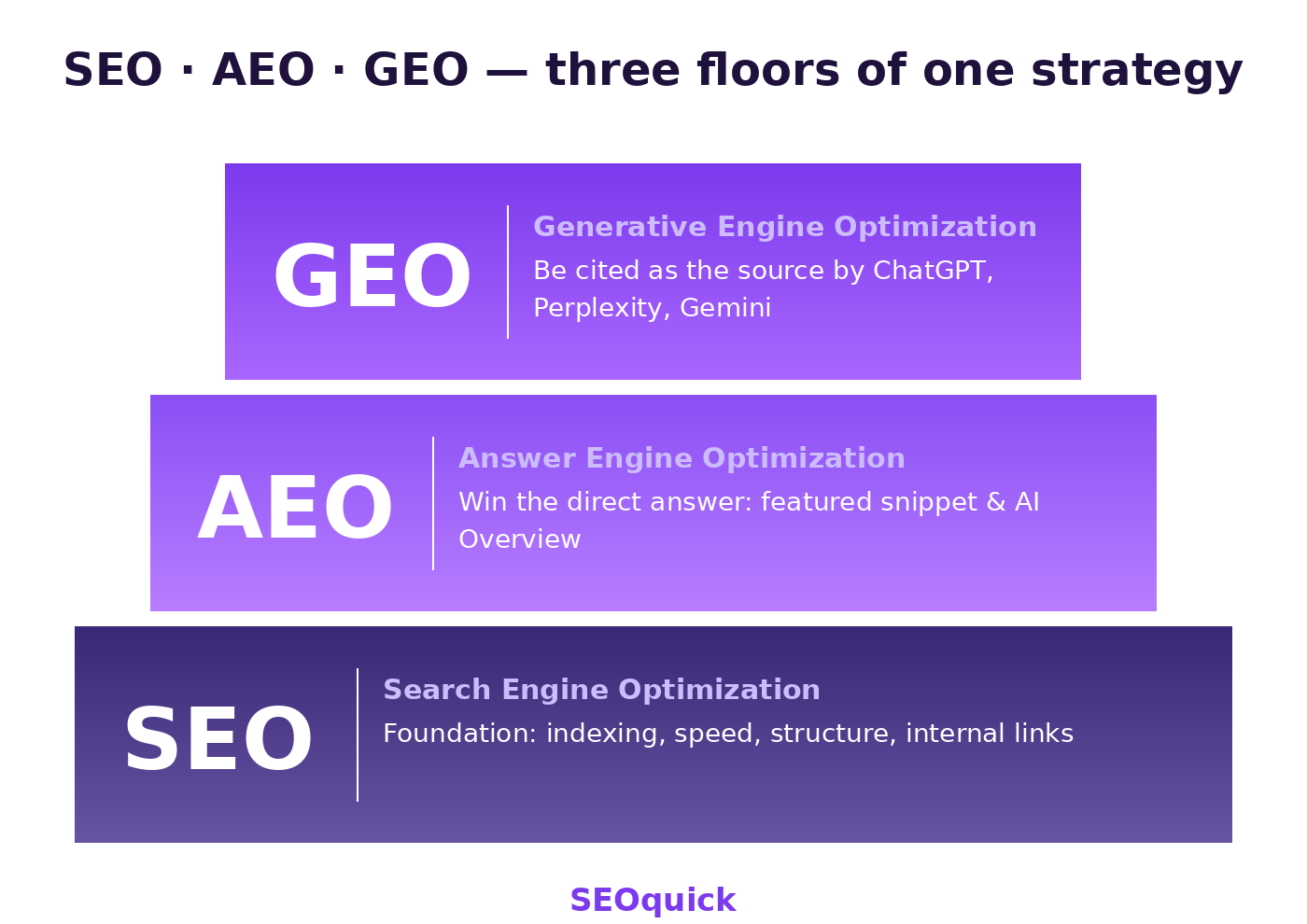
SEO is about ranking in the list of organic results. AEO (Answer Engine Optimization) is about winning the direct answer — the featured snippet, the AI Overview block, the voice assistant. GEO (Generative Engine Optimization) is about being cited inside the generated answer of ChatGPT, Perplexity or Gemini as a trusted source. These aren't three competing strategies but three floors of one: SEO is the foundation, AEO is the short answer, GEO is the authority that makes AI pick you.
Every couple of months the industry coins a new acronym, and someone solemnly declares that "SEO is dead." On the SEOquick channel we've debunked this panic more than once. The short version: SEO didn't die — the old way of doing it did. The 2,000-word wall of text, keyword stuffing and bought links are gone. What replaced them is a logic where the machine checks not your keyword density but your reputation as a source.

What SEO, AEO and GEO mean in plain terms
The easiest way to see the difference is to ask where you're trying to land.
SEO (Search Engine Optimization) — optimizing for the classic list of ten blue links. The goal is to rank as high as possible. This game always has one winner: position #1.
AEO (Answer Engine Optimization) — optimizing for "answer engines": featured snippets, knowledge panels, AI Overviews, voice assistants. There aren't ten spots here. There's one direct-answer slot — you either own it or you don't. AEO rewards short, sharp, factual phrasing: question, answer, no fluff.
GEO (Generative Engine Optimization) — optimizing for generative engines: ChatGPT, Perplexity, Gemini, Claude. The model reads dozens of sources and synthesizes them into a single answer. Your job is to be among the ones it cites. GEO isn't about a slot — it's about being the source the machine references.
The key difference between them
The difference isn't in the tools — it's in the kind of "spot" you're fighting for:
— SEO fights for a position in the list. Metric: rank.
— AEO fights for one answer slot. Metric: did you win the featured snippet / AI Overview or not.
— GEO fights for a mention inside the synthesis. Metric: how often large language models cite you.
Here's the crucial part: generative engines lean on the same authority and relevance signals as classic search. So GEO and AEO don't replace SEO — they amplify it. Gartner projects that classic search volume will drop about 25% by 2026 — which doesn't mean "SEO is dead" but rather "traffic is shifting into new formats, and you need to optimize for those too."
Why it's three floors, not three strategies
In our video I explained this through a "branches of government" metaphor, but a building is simpler. SEO is the foundation and the basement. Boring, technical, invisible — but nothing stands without it. Indexing, speed, structure, internal linking. If the foundation is crooked, no upper floor will save you.
AEO is the ground floor, the storefront. Short, punchy answers to specific questions. When someone asks "did you buy the hotel?", you don't tell a 2,000-word story — you say "yes" and give the fact. Those are exactly the blocks Google and assistants pull into the direct answer.
GEO is the top floor, where reputation lives. Here the machine checks not your keywords but your "biography": who you are, what you specialize in, who links to you. Here's how I put it in the breakdown:
"AI doesn't count your keywords — it checks your biography. It asks: is this source a trusted expert, or just a faceless website? If you have no name and no trust, you don't exist for the model. You have to become an entity, not a page."
We covered how to build that "entity" for GPT in detail in a separate piece on GEO optimization for GPT.
How AI decides whom to cite
This is the part worth reading for. Generative engines run on RAG (retrieval-augmented generation): the query is split into sub-queries, each is searched, and the model assembles an answer from what it finds. And they pick sources differently.
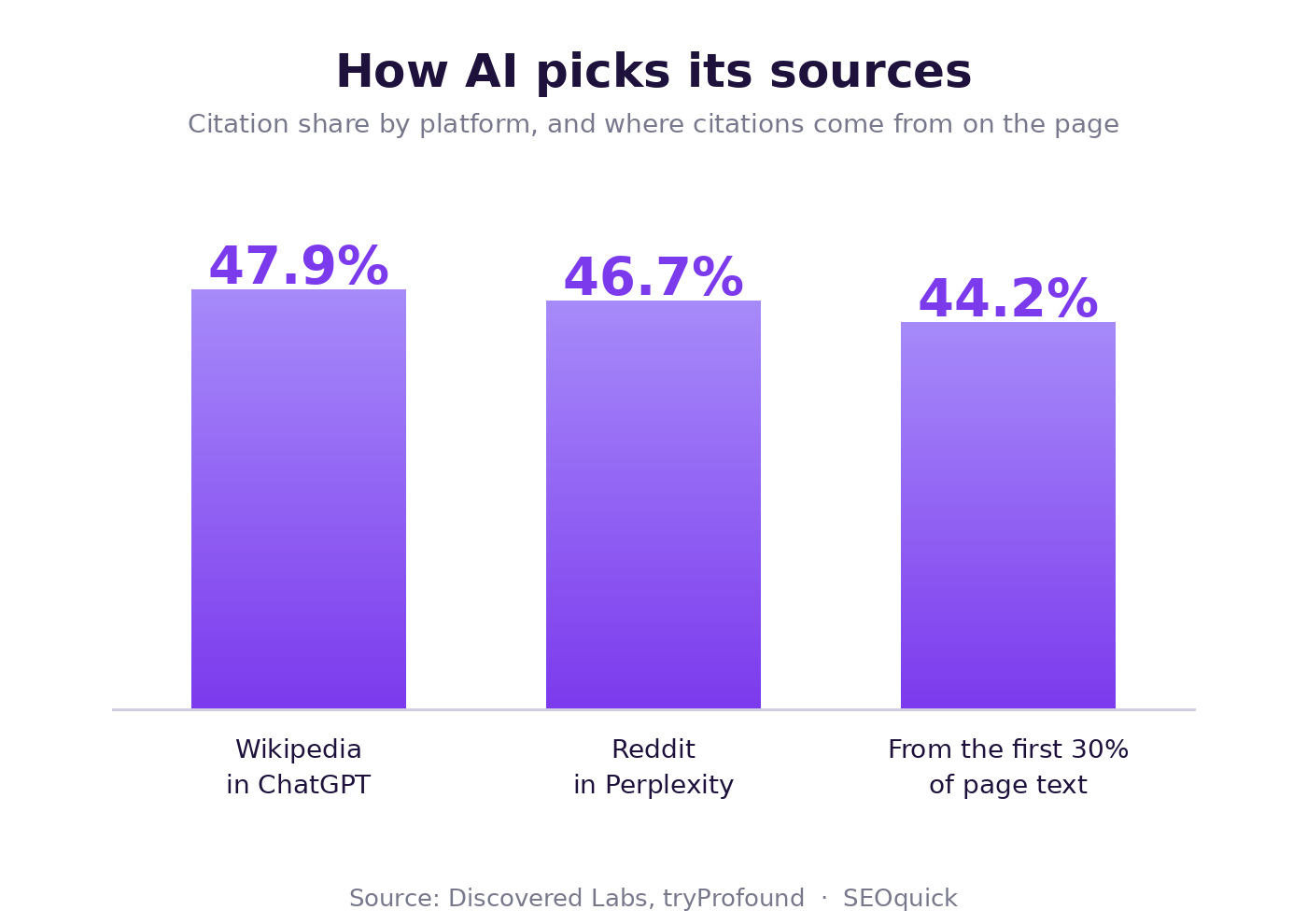
According to tryProfound and Discovered Labs, ChatGPT most often cites Wikipedia (~47.9% of citations), while Perplexity leans on Reddit (up to 46.7% in some categories). On average Reddit accounts for about 40% of all citations across ChatGPT, Claude, Perplexity and Google AI Overviews. The takeaway: presence on authoritative platforms and in discussions sometimes matters more than your tenth title-tag tweak.
One more number to pin on the wall: 44.2% of all LLM citations come from the first 30% of a page's content (Discovered Labs). If your direct answer is buried under five intro paragraphs, the machine never reaches it.
And here's what actually moves visibility, measured in a peer-reviewed study. The researchers who coined the term GEO — from Princeton, Georgia Tech and IIT Delhi (arXiv, KDD 2024) — tested nine methods and found that adding statistics, quotes and citations to authoritative sources boosts your chance of being cited by up to 40%. Stylistic edits — better readability and simpler language — add another 15–30%. In short, the machine loves the same things a human does: facts, numbers and clear language.
How to combine SEO, AEO and GEO on one page
Good news: you don't need three separate pieces of content. The same page can be built to work on all three levels.
Foundation (SEO): clean technicals, fast loading, logical H1–H2–H3 structure, internal linking, correct indexing. Without this, AI simply won't find your page.
Ground floor (AEO): in the first 30% of the text, a direct answer to the page's main question, 25–40 words, no fluff. Phrase subheadings as questions (like in this article). Add a visible FAQ block with short answers.
Top floor (GEO): add the specifics that get you cited — statistics with sources, expert quotes, links to authoritative data. Credit a real, expert author. Build brand presence where the models live: Reddit, industry platforms, YouTube.
The same "answer first, prove with facts" principle underpins every trend we collected in our 2026 SEO trends overview.
Where to start right now
Don't try to "buy Greenland" — to seize the top by force, the old way. Start small and systematically. First, an audit: check for technical errors that make you look like an unreliable source. Second, a rewrite: move the direct answer to the top, break the walls of text into short paragraphs, add facts and numbers with sources. Third, authority: sign your articles with real experts and grow brand mentions. You don't have to do it all by hand — that's exactly the routine worth delegating.
Frequently asked questions
Are AEO and GEO the same thing?
No, though they're often confused. AEO is about the direct answer in featured snippets and AI Overviews (the Google ecosystem). GEO is about being cited in the generative answers of ChatGPT, Perplexity, Gemini. The methods overlap, but the engines and metrics differ.
Do I need to drop SEO for GEO?
No. GEO sits on the SEO foundation: generative models rely on the same authority signals. Remove the foundation and the upper floors collapse.
What gives the fastest result?
AEO. Moving the direct answer into the first 30% of the text and adding an FAQ is the quickest win — it lifts both featured snippets and AI citations.
How do I know AI is citing me?
Track referral traffic tagged chatgpt.com, perplexity.ai and similar in GA4, and manually check whether your brand is mentioned in assistant answers for your key queries.
The bottom line is simple: stop choosing between SEO, AEO and GEO. Build all three floors on one page — a foundation for indexing, a short answer for the slot, facts and authority for the citation. Those are the pages that win in both Google and ChatGPT. And if you need a hand building them, we at SEOquick do it every day.
AI Content and Google in 2026: What Actually Gets Penalized (Spoiler — Not AI)
Google does not penalize text for being written by AI — that is the official position. Here's what scaled content abuse really is, what changed after the 2026 updates, and how to publish AI content that still ranks.
Read →
How to create content for AI answers: AEO and GEO guide for 2026
How to create pages that can be used in AI Overviews, ChatGPT, Gemini, and other answer systems: structure, sources, entities, and UX.
Read →
Content Strategy for Crypto and Trading Projects
Learn how to create unique content for crypto, fintech and trading sites in 2026 so you grow in Google and get cited in the AI answers of ChatGPT, AI Overviews and AI Mode.
Read →Want to apply this to your site?
We will review the current situation, find the first growth levers, and suggest a practical working format.