Agentic Commerce: How to Prepare Your Online Store for AI Agents That Shop
AI agents are already sending you buyers — and those buyers convert better than any other channel. Here is what agentic commerce actually is, why buying inside the chat never took off, and the five things a store owner should fix right now.


I will look at your site and answer your questions on the topic of this article. 30 minutes, no slide decks, no pressure.
Book a consultationAgentic commerce is shopping where the AI agent, not the human, picks the product. It crawls your catalog, checks prices and stock, and pushes the order to your site. If you want an agent to even notice your product, you need a machine-readable feed, honest real-time inventory, and a connection to ACP or UCP protocols.
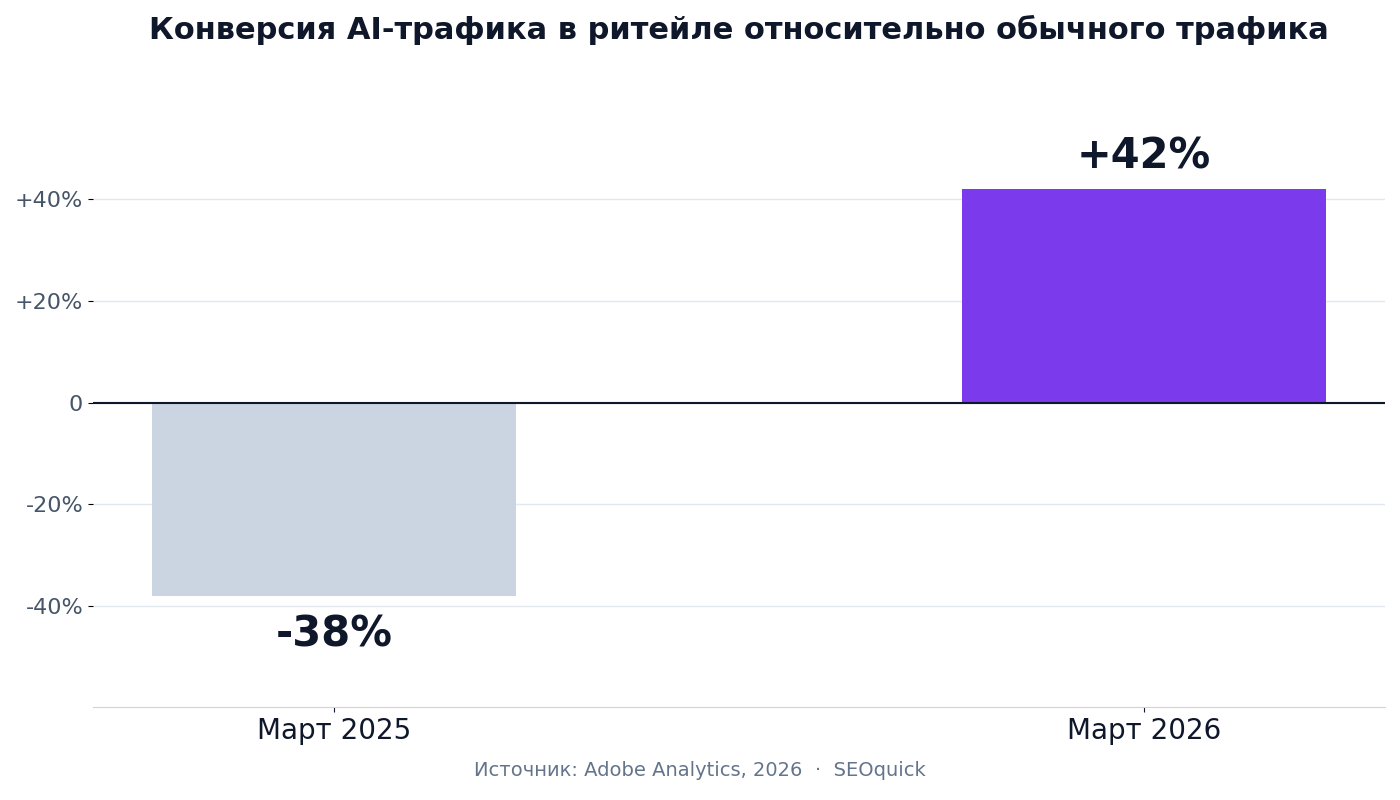
A year ago, people called this sci-fi. Then the numbers hit. According to Adobe Analytics data, in March 2026, traffic from AI assistants converted 42% better than everything else. A year before that? It was 38% worse. That's not a few percentage points. The whole channel flipped—from junk to the most profitable one you run. During the 2025 holiday season, AI-driven retail traffic in the US exploded nearly sevenfold—up 693% year-over-year. So yes, the AI shopper is coming. The real unknown: will the agent even see your product when it shows up?
How it works in the real world
The old path was familiar: user searches Google, hits the site, compares, adds to cart, pays. Now, they just describe the task to an assistant—"laptop under $1200, good battery life, arrives this week"—and the agent does the legwork. It scans catalogs, compares prices, availability, and shipping, then returns a shortlist or just handles the checkout.
There's now a middleman between your product and the buyer, and it doesn't do "guessing." It doesn't scroll through your pretty landing page. It doesn't see your flashy discount banner. It reads structure: price, stock, GTIN, shipping time, return policy. No data? No product in the results. Period.
“ChatGPT is moving aggressively into shopping territory. For us marketers, it's the signal to optimize SEO for AI. If your brand makes it into these results, you're getting a high-intent customer who has already compared you to competitors right in the chat and is ready to buy right now.”
— Nikolay Shmichkov, “How to get into ChatGPT results and capture high-intent customers”

Why "buying in the chat" hit a snag
In 2025, the industry was screaming that payments would move inside the chat. OpenAI even launched Instant Checkout to buy without leaving ChatGPT. Then, in Spring 2026, they quietly killed it. Officially, they cited a "lack of flexibility." The real reason is more blunt: CNBC reports that Walmart found in-chat checkout converted about three times worse than a standard click-through to walmart.com.
The industry summed it up in four words: “discover in AI, buy on site.” Let me translate that into plain English: let the assistant do what it does better than a human—sifting through hundreds of product pages. But keep the money where you have control, analytics, upsells, and loyalty. Honestly, for store owners, this is a gift. You don't have to hand over your payments to a third-party platform. You just need to be visible to the agent during the discovery phase.
ACP and UCP: Two protocols you need to know
For an agent to talk to a store, they need a common language. Right now, there are two.
ACP (Agentic Commerce Protocol) — an open standard from OpenAI and Stripe. Your catalog connects directly to the assistant: it sees live prices, stock, and variants, then hands the order to the seller. The spec is open, and Shopify and Etsy have already implemented it.
UCP (Universal Commerce Protocol) — Google's answer, unveiled in January 2026 at NRF alongside Shopify, Etsy, Wayfair, Target, and Walmart. By May, at Google Marketing Live, they added Universal Cart—a cross-store shopping cart—and BNPL through Affirm and Klarna. It runs through Merchant Center; here's the documentation.
On top of this sits the payment layer: Visa opened up payments for its agents at any merchant in Summer 2026, and Mastercard has Agent Pay. Guessing which protocol wins is a waste of time. In practice, it's simpler: if you're on Shopify, WooCommerce, or Magento, check which one they support and toggle it on. Both need the same data anyway, and the data is your job.
What store owners actually need to do
It starts with the feed. Not paperwork. This is the foundation everything else sits on. For every product, the agent needs GTIN or MPN, brand, exact price with currency, stock status, shipping time/cost, and return terms. If it can't verify stock, it won't recommend you—being wrong is riskier for the agent than staying silent. Next, the product page itself has to be machine-readable: Product schema with offers, price, priceCurrency, availability, aggregateRating, and review. Adobe literally wrote in 2026 that retailers are failing to keep up with AI traffic specifically because of poorly marked-up pages. I broke down the mechanics of this in my AI Overviews guide and the 2026 Ecommerce SEO checklist.
Keep your inventory live. Syncing once a day doesn't cut it anymore. If an agent sends a customer to an out-of-stock item, it remembers that failure and skips you next time. Give it facts that aren't in a standard description—compatibility, dimensions, materials, warranty, who it's for, and who it's NOT for. In agentic search, the prettiest photos lose to the most verifiable attributes—every time. Reviews matter too: the agent cross-checks your promises against what people actually say. A store without reviews is a store without proof.
And here's a stupidly expensive trap: one of our clients saw zero growth in AI traffic for months until we checked their robots.txt. They had Disallow set for GPTBot "just in case." One forgotten flag quietly choked off their highest-converting traffic source. Check that first.
How to tell if agents have found you yet
GA4 added a specific "AI Assistant" channel in May 2026, but it doesn't catch everything by default. In your Traffic Acquisition reports, look for referrers like chatgpt.com, perplexity.ai, gemini.google.com, and copilot.microsoft.com. Check your server logs for hits from GPTBot, OAI-SearchBot, PerplexityBot, and Google-Extended. Don't see them? Then your catalog is invisible to agents.
FAQ
Is this only for big stores?
Actually, it's the opposite. An agent doesn't care that you're small—it compares price, stock, and data. A small shop with a clean feed will easily beat a giant with broken data.
Do I need to move payments into the chat?
No. The 2026 model is "discover in AI, buy on site." AI helps them choose; they pay on your turf. Instant Checkout in ChatGPT was scrapped precisely because in-chat conversion sucked, and you'd lose your analytics, upsells, and customer data in the process.
Should I start with ACP or UCP?
Neither. Start with the data: feed, prices, stock, schema. Connecting to a specific protocol after that is just a couple of settings on your platform's backend.
So where does this leave you
Agentic commerce doesn't ask you to reinvent your store. It demands one thing: data discipline. Accurate feeds, honest stock levels, full Product schema, reviews, and an open door for AI crawlers. The protocols will handle the rest. Those who clean up their data in 2026 will get the high-intent customers. Those who don't will simply vanish from the agent's shortlist—and they won't even know why.
Need a feed and product page audit for AI search? Let's talk about your project—we'll see if agents can actually see you and what's standing in their way.
Best B2B SEO Agencies in 2026: who competes for this search and what they charge
A breakdown of the US B2B SEO market: a published range of $3,000–50,000+ a month, an entry point around $5,000, and why the comparison pages that close your deal are written by your competitors. Our own prices and cases are on the same chart, honestly — including the row that fails its own test.
Read →
Search Everywhere Optimization: Ranking on TikTok, YouTube, Reddit and AI Search
Your customer does not only search on Google: 49% of consumers search on TikTok, Reddit pulls 842M organic clicks a month, and YouTube is the source of roughly one in four AI Overview citations. Here is how a business owner picks 2–3 platforms without burning the budget.
Read →
Making Money Online in 2026: Which Methods Actually Work
An honest breakdown of making money online in 2026: why 'easy money with no investment' is a myth, 5 models that actually work, and how to monetize your own site with affiliate and CPA — by SEOquick.
Read →Want to apply this to your site?
We will review the current situation, find the first growth levers, and suggest a practical working format.