AI Content and Google in 2026: What Actually Gets Penalized (Spoiler — Not AI)
"Will I get banned for AI text?" is a question I get every single week. Short answer: for the mere fact of AI — no. But in 2026 Google tightened the rules three times, and thousands of sites got caught. Here's what really gets penalized and how to stay in the results.


Google doesn't penalize content just because AI wrote it—that's the company's official stance. Sanctions hit for scaled content abuse: mass-generating pages to manipulate search results without providing value to humans. The method of creation doesn't matter—utility, experience, and originality do. 100% "naked" AI generation tanks, while text infused with real-world experience ranks just fine.
"But how do I check text for AI-ness? Do I need to run it through detectors?"—I hear this constantly, and it's almost always masking a fear of "getting banned for AI." Let's break down what Google actually punishes in 2026 and what's just an urban legend. Spoiler's in the headline: it's not about the robot that typed the text, it's about what you did with that text afterward.

Does Google Penalize AI Content?
No. The official wording is: "Our focus is on the quality of content, rather than how content is produced" (Google Search Central). The search engine crawls, indexes, and ranks AI text the same way it does human-written text: it looks at utility and intent, not the tool. And this isn't even a new stance—Google has been repeating it since February 2023. Updates and rhetoric have shifted, but the principle remains the same: crappy content tanks whether an intern typed it by hand or a neural network spat it out in two seconds. So "Google bans for AI" is a myth. Here's what isn't a myth.
What actually gets penalized: Scaled Content Abuse
The real target is scaled content abuse. Google formally introduced this concept in its spam policy in March 2024: "creating many pages with the primary purpose of manipulating search rankings and not helping users." The keyword here is scale. One AI article that's been proofread and supplemented? Fine. A thousand templated "service plus city" pages generated in an evening? Abuse. And the creator doesn't matter: Google explicitly notes that the same trouble occurs whether content is stamped out by a neural network or a human on an assembly line.
The March 2026 core update named scaled content abuse as its primary target. According to DigitalApplied, sites publishing hundreds or thousands of unedited AI pages lost 50–80% of their traffic: informational sites with 500+ AI pages dropped 60–80%, while affiliate review sites dropped 40–70%.

What Changed in 2026: Tightening the Screws
2026 was the year Google stopped warning and started swinging. It began in March with the core update: the rollout took twelve days, and according to Ahrefs and Semrush, more than half of tracked domains saw noticeable position shifts, with scaled content abuse named as the priority target. In May, a spam policy update arrived—Google explicitly wrote into the rules for the first time that "attempting to manipulate the AI response in Google Search" is considered spam; previously, manipulating AI-specific answers wasn't named in the rules. Then, on June 24–26, a spam update powered by SpamBrain rolled through—it hit scaled content abuse, site reputation abuse, and manipulative links, but it didn't hit AI content as such, only the abuse. Meanwhile, on June 3, Google moved AI Overviews and AI Mode into separate Search Console reports—now you can see which pages are cited in AI answers. I wrote about AI Mode in detail in a separate guide.
How Google Tells Live Text from Generated Slop
This is where it gets interesting. AI produces perfect, overly smooth text—and that smoothness is exactly what gives it away. As I say in the video:
"In '26, imperfection ranks. Personal experience, mistakes, live speech, and slang—that's what Google is looking for. Show it you're a living human. AI can't do that."
Raw generation gets caught by technical and stylistic footprints left in the code and the text.
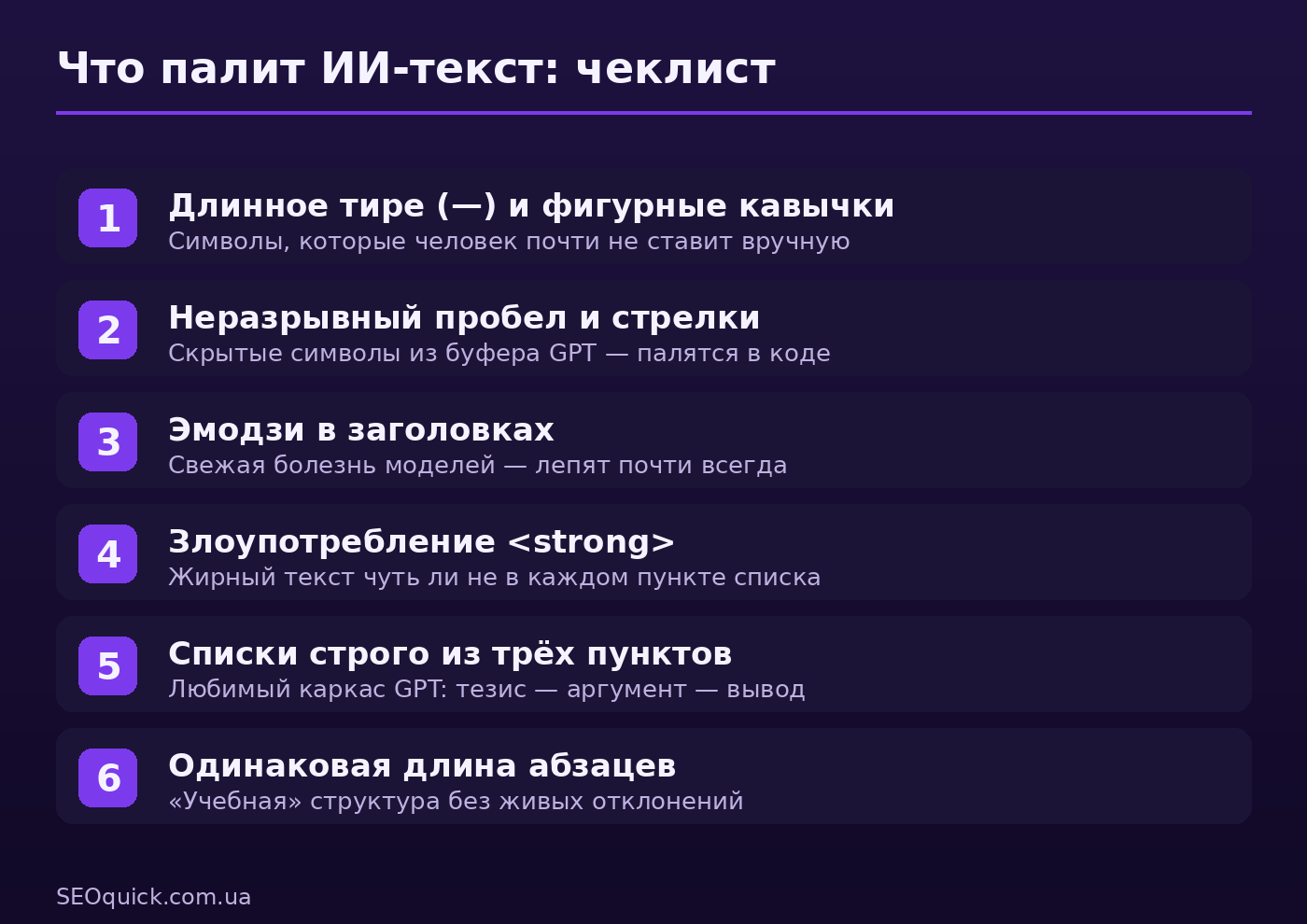
Templated intros like "in today's world" and "it is worth noting," fluff phrases for volume ("there are many ways," "it's important to consider"), a pathological love for lists of exactly three items, identical paragraph lengths, emojis in headlines, and <strong> tags in almost every line—this whole "logical textbook skeleton" screams machine. Humans don't write like that. I showed how to catch these traces technically in my AI content detection guide.
Case Study: Why 50% AI Text Ranks, but 100% Doesn't
The most valuable observation from practice:
"Google really can demote your site if it's just 100% AI-generated content. But if it's generated at about 50% or you've added something to it—that content can rank quite well."
We analyzed category descriptions on Rozetka. Yes, about fifty percent of them "feel" like an AI skeleton—but there are no technical traces of generation: no weird em-dashes, no strange quotes, the text sounds natural, no bolding every other word, and paragraphs vary in length. This was clearly assembled in stages and polished by hand, not spat out in one click. That's where the line between "ranking" and "tanking" is drawn.
How to Publish AI Content Without Risk
A draft from a neural network is fine—I work that way myself. What makes material "alive" is what's missing from AI by definition. First and foremost—your experience: numbers, cases, conclusions that only you possess; an honest "I tried this and it failed" carries more weight than a paragraph of perfect text. Next—opinion and evaluation, because AI avoids being categorical ("good/bad/stupid"), but you can afford to. Real phone photos instead of stock images help too, and if the site can display a video snippet—even better. As I say straight up: "Add photos taken on a phone, not stock." And before publishing, clean out the technical trash—em-dashes, non-breaking spaces, curly quotes, emojis in headlines, excessive <strong> tags—and break the rigid skeleton: vary paragraph lengths, don't make every list three items long, use natural transitions instead of "consequently." Most importantly—don't scale trash: one good page beats a thousand templates, because the scale of useless content is exactly what scaled content abuse is.
The 2026 trend is E-E-A-T and the author's real experience. How search moved to evaluating the source is in the breakdown on AEO, SEO, and GEO, and I've gathered the tools for all this in my AI tools for SEO collection.
FAQ
Does Google ban for using ChatGPT?
No. The method of creating content doesn't break the rules—mass-generating useless pages to manipulate rankings does.
Can I publish AI text without edits?
Technically you can, but it's risky: 100% raw generation tends to drop. Add experience, opinion, and facts, clean up the technical footprints—and that same text will rank.
Will "humanizing" text with a detector help bypass Google?
No. That treats the symptom (characters) but not the cause. If there's no real experience or utility behind the text, an AI rewriter won't save you—Google looks for value, not character patterns.

What ecommerce SEO costs in 2026 and what you pay for
Why the same question gets answered with $300 and $3,000, what actually drives the price, what agencies publish on their own sites, the five costs that are never in the quote, and how to work out whether it pays back on your catalogue.
Read →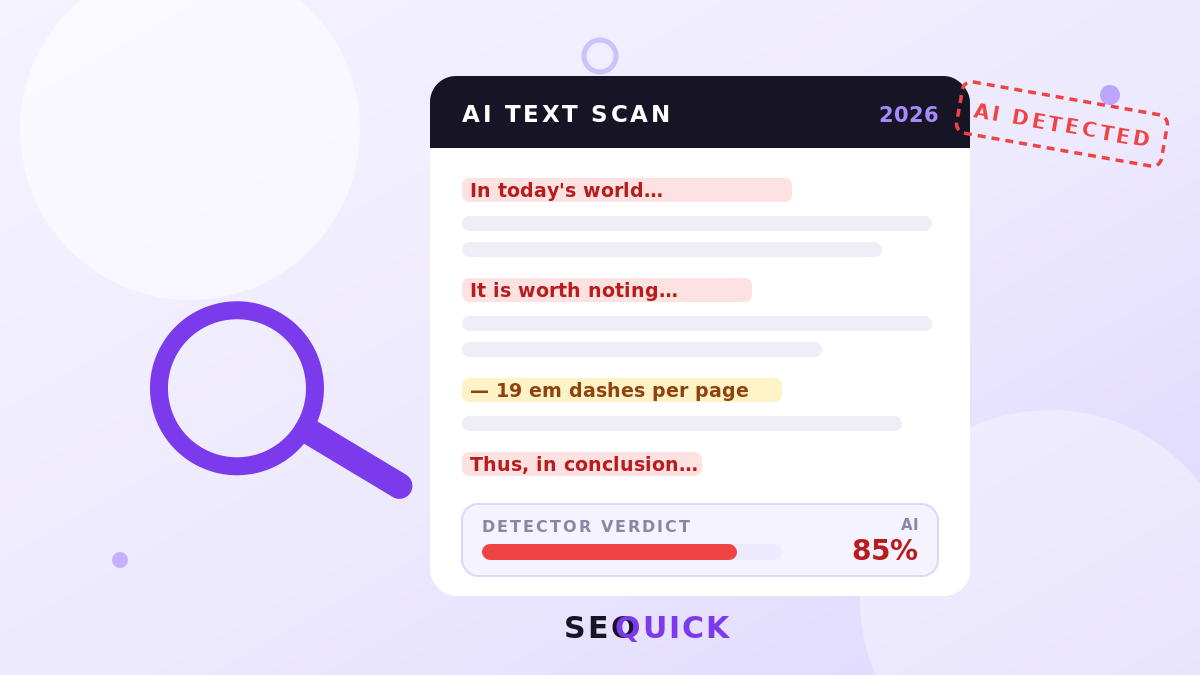
How to Detect AI-Written Text: Language Markers, Code-Level Evidence, and Detection Tools
An AI-text detection system from the creators of the Unmiss AI detector: GPT phrase markers, machine logic, special-character evidence in code, tools, and a 7-step checklist. Plus what Google thinks about it.
Read →
Broken Links and Redirect Chains: Clearing 3XX, 4XX and 5XX Without Bleeding Link Equity
Broken links and extra redirects quietly steal traffic, crawl budget and link equity — and they push your pages out of AI answers. Here's what actually goes wrong and how to get your hops down to zero.
Read →Want to apply this to your site?
We will review the current situation, find the first growth levers, and suggest a practical working format.