How to Get Into Google AI Overviews: 7 Citation Factors
You can land in the AI Overviews block today without a top-10 ranking and without a pile of links. I break down fresh studies and explain what really drives citations — from an extractable answer to brand strength — and why building a keyword map for AI answers is a waste of time.


I will look at your site and answer your questions on the topic of this article. 30 minutes, no slide decks, no pressure.
Book a consultationTo get into the AI Overviews block, you don't need top-10 rankings or keyword density; you need a short extractable answer, clear structure for questions, a recognizable brand with strong E-E-A-T, and freshness. According to 2026 studies, up to 62–83% of AI citations come from pages that aren't even in the top ten.
Google AI Overview is a block with a ready-made answer above the organic results. And the rules for getting into it differ from classic SEO so much that old habits actually get in the way. I've broken down recent research and overlaid it with what we see with SEOquick clients. Below is what really affects citations and an honest answer on whether schema actually helps.

What a study of 405,000 AI Overviews revealed
The starting point was an analysis on Search Engine Journal, which combined data from Ahrefs (300,000 keywords) and Surfer SEO (405,576 queries with AI Overview). The conclusions break conventional logic. Exact keyword matches appear in the response in only 5.4% of cases—that's basically a statistical error. About 80% of queries that trigger an AI Overview fall in the 0–40% difficulty range, meaning these are low-competition topics. And almost half of the cited sources aren't in the top 10 at all.
In the podcast, I put it like this:
"Keywords are practically dead. If you used to optimize content semantics for keywords—today that makes no sense. Exact matches occurred in only 5% of cases; it's an error margin. And I absolutely agree with this—I noticed it a long time ago."
The takeaway for a practitioner: AI Overview opens up a massive field of long-tail queries that people are often asking for the first time. Understand the logic—and you create content for them with almost zero competition.
Why top-10 no longer guarantees a citation
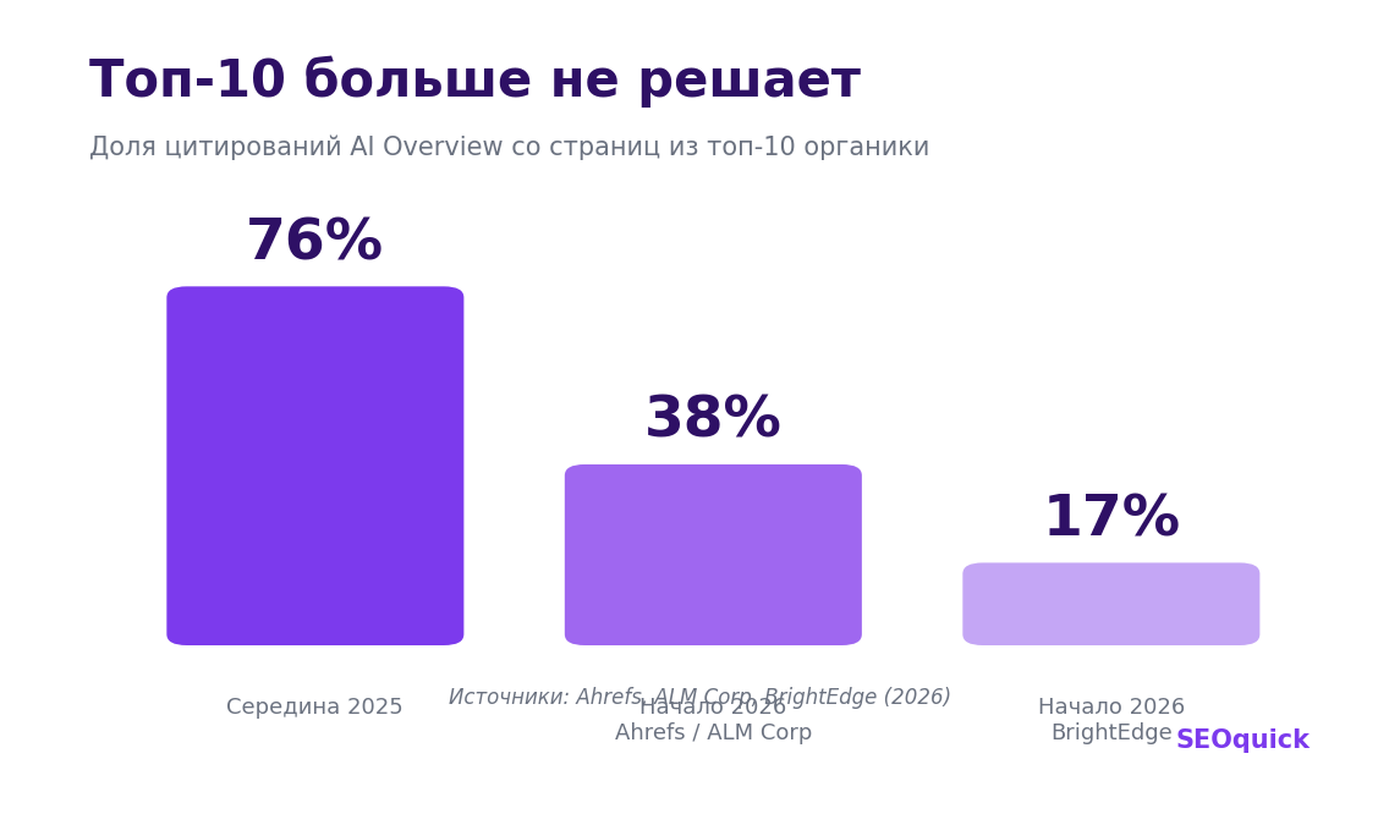
Back in mid-2025, three-quarters of pages cited in AI Overviews were simultaneously in the top 10 for the same query. By early 2026, everything shifted. According to updated Ahrefs data, the share of citations from the top 10 dropped to 38%; ALM Corp saw a drop from 76% to 38%, and according to BrightEdge, the overlap is as low as 17%.
The #1 position in organic search today is a weak predictor of getting into the AI response. We saw this live: in Ukrainian search results, sites that never even stood in the top rankings were popping up in AI Overviews. AI doesn't pick the biggest site; it picks the clearest and most relevant source for a specific sub-query.
Extractable answer and readability
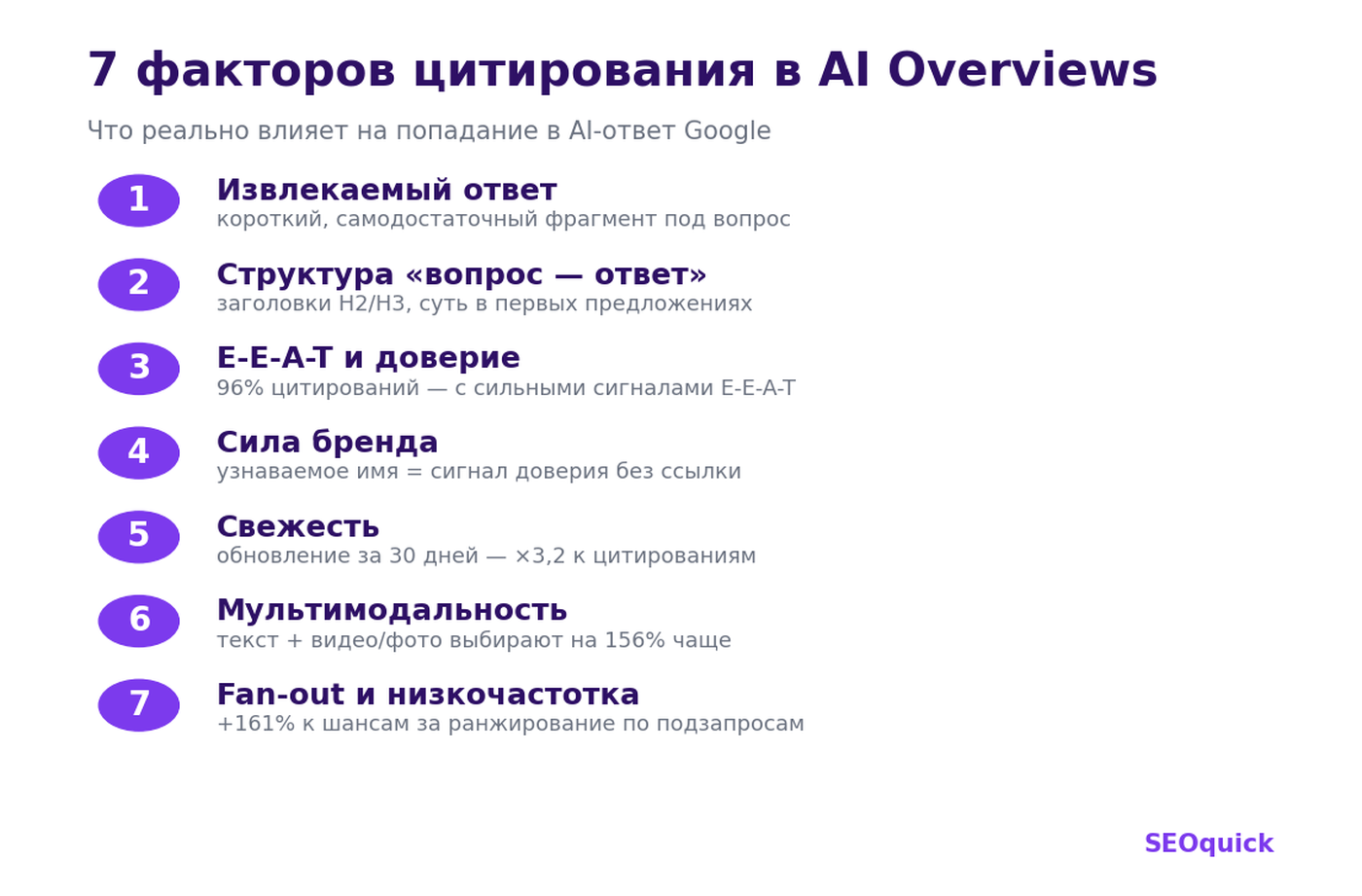
The main thing separating a cited page from the rest is how easily a ready-made answer can be ripped from it. AI doesn't rewrite bulky paragraphs; it looks for a short, self-sufficient snippet for a specific question. That's why formatting is more important than keyword density here. Here's an observation from the podcast that surprises many:
"I analyzed sites where articles were written by really great specialists, almost like a medical study. It was a heavy read, huge paragraphs. But the competitor at the top had an answer written as simply and clearly as possible—GPT-style. And it was exactly this simple answer that Google showed first in the AI Overview."
What to do: break text into short "question — brief answer" blocks, put the core essence in the first one or two sentences of a paragraph, and check readability. More on the extractable answer technique in the material on the difference between AEO, SEO, and GEO.
Does schema markup help?
The honest and slightly uncomfortable answer: schema helps the machine read your page, but it doesn't buy you a citation by itself. For a long time, it was believed that FAQ, Article, and BreadcrumbList were a direct ticket to AI Overview. Recent data cut that down. Ahrefs tracked 1,885 pages that added schema and saw no statistically significant growth in AI citations; Search Engine Roundtable confirms the same. That said, markup still helps Google understand entities, breadcrumbs, and "question-answer" blocks.
My position: do basic markup (Article, BreadcrumbList, and FAQ if you have a real block) as hygiene and to help the bot. But don't expect a single JSON-LD to drag you into the AI response. Content and trust decide it; schema is an amplifier, not the lever.
E-E-A-T and brand power
AI systems are cautious with sources. According to 2026 industry breakdowns, about 96% of citations in AI Overviews come from pages with distinct E-E-A-T signals: author profiles, verifiable expertise, third-party mentions, and overall domain trust. And I'd highlight the brand separately—AI reads a recognizable name as a trust signal even without a link. About links in the podcast, I said it straight:
"Notice, I'm not saying a word about links. Links are important, but they aren't needed in the quantities you think. You need to do two or three high-quality PR publications a month in good media and occasionally remind people about yourself, rather than chasing a domain rating that won't change the weather."
How to boost E-E-A-T for AI was covered in our guide on E-E-A-T in 2026: author experience, primary data, and thematic integrity of the domain.
Freshness and multimodality
AI gravitates toward the relevant and multi-format. According to 2026 analyses, content updated within the last 30 days gets 3.2 times more AI citations, and pages where text is combined with images and video are chosen 156% more often than text-only ones. It's no coincidence that YouTube became the most cited domain in AI Overviews.
At SEOquick, this plays into our hands: we have strong video and podcast formats, and embedding them into articles is logical. A topically inserted video with a transcript provides both multimodality and an expertise signal. On how to use video for AI panels—see the collection of AI tools for SEO 2026.
Fan-out and long-tail sub-queries
The most underrated mechanism. When a user asks a complex question, Google doesn't look for one answer—it breaks the query into a series of hidden sub-queries (fan-out) and pulls a source for each. And these are exactly those long-tail formulations the person didn't say out loud. Here's how I explained it in the podcast:
"Google creates sub-queries inside the query—the person didn't even ask them. These are low-frequency queries with low competition. If you have content created for them, the paragraph is structured, and a short answer is given that's easy to link to—your answer will be accepted into the system."
Recent data confirms this: according to Search Engine Land, ranking for fan-out sub-queries increases citation odds by 161%. Hence the conclusion many don't like:
"For AI Overview, gathering semantics in the old way is the most useless activity you can imagine. Semantics are only needed to track positions and understand which queries actually bring in clients. Analyzing topics and structuring answers is much more useful than a keyword table you'll never use."
What to do with old content
Don't rewrite everything from scratch; restructure it. Most sites already have high-quality content—it's just not sharpened for extraction. My practical advice from the podcast: take your own good article and ask GPT to restructure it—identify the questions and give short answers to them using your own text. Plus basic hygiene, without which the rest doesn't work: fast mobile loading, easy crawling, and a clear header hierarchy. How to build updates systematically—in the guide on content refreshing as a strategy, and how to prepare a site for conversational search—in the Google AI Mode breakdown.
FAQ
Do I need to be in the top 10 to get into AI Overview?
No. According to 2026 data, 62% to 83% of AI citations come from pages not in the top 10. Position helps, but it's not mandatory—the extractability of the answer and source trust are what matter.
Does schema markup guarantee a citation?
No. An Ahrefs study of 1,885 pages showed no significant growth in citations after adding schema. Markup helps the machine understand content, but it doesn't drag you into the AI response by itself—do it for hygiene, but bet on content and brand.
Is it worth building a semantic core for AI Overview?
In the classic sense—no. AI breaks queries into hidden sub-queries, so it's more useful to structure answers for specific questions and work with long-tail. Semantics remain necessary, but for tracking positions and understanding client queries, not as a list of keywords for texts.
The bottom line is simple: stop fighting only for position and keyword density. Give AI a short, honest, structured answer from a recognizable brand—and they'll start citing you even from low positions. Want to check your page's readiness for AI answers—start with GEO site optimization for GPT.
What ecommerce SEO costs in 2026 and what you pay for
Why the same question gets answered with $300 and $3,000, what actually drives the price, what agencies publish on their own sites, the five costs that are never in the quote, and how to work out whether it pays back on your catalogue.
Read →
Google AI Max in 2026: Should You Switch From Performance Max
What Google AI Max is, how it differs from Performance Max, and whether you should switch in 2026. Google's real numbers vs independent data, brand and geo controls, DSA migration. A breakdown by SEOquick.
Read →
E-E-A-T in 2026: How the March Core Update Boosted Author Experience
The March 2026 core update amplified the first E in E-E-A-T — Experience. What changed, why YMYL sites dropped 20–35%, and how to show real author experience — a breakdown from SEOquick.
Read →Want to apply this to your site?
We will review the current situation, find the first growth levers, and suggest a practical working format.