Best AI SEO Tools in 2026: A Roundup by Task and Price
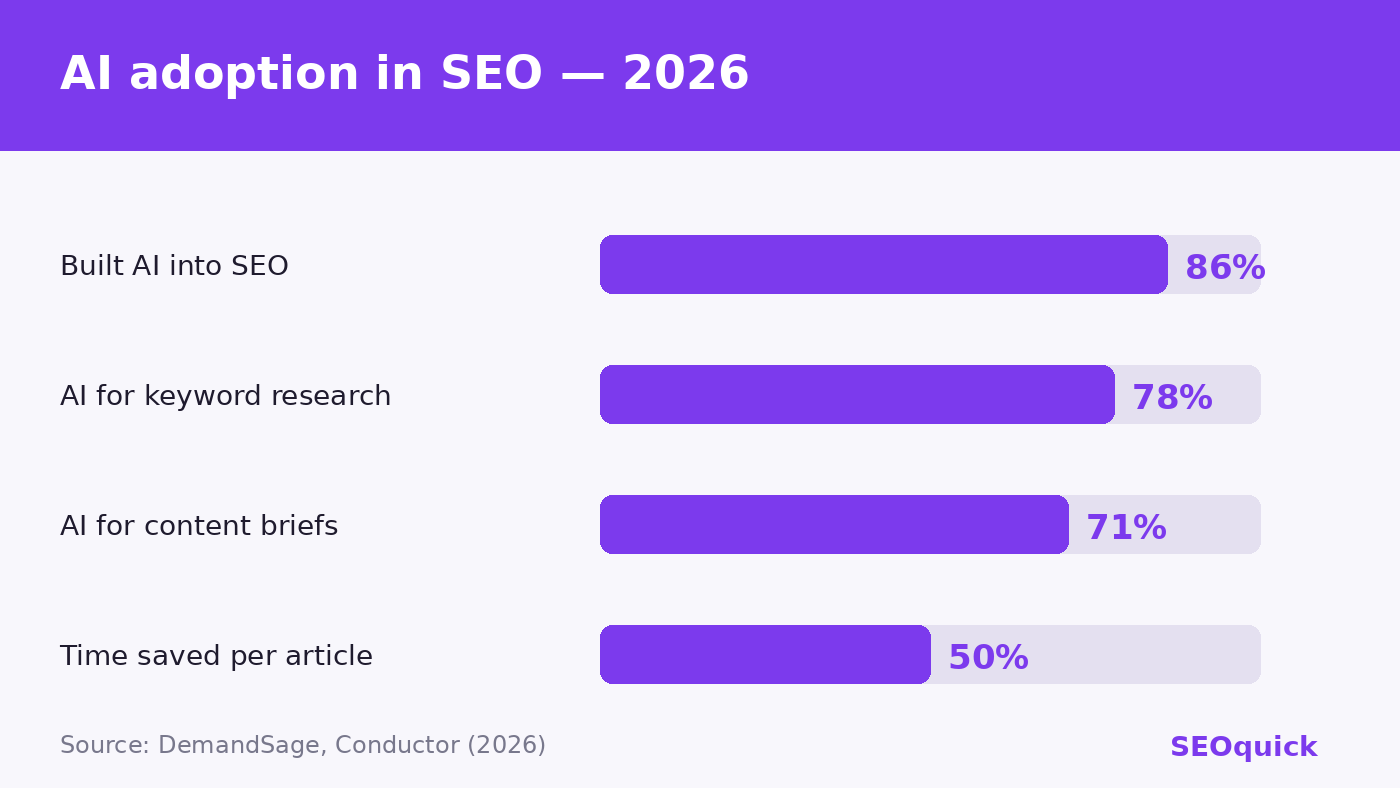
86% of SEO professionals already work with AI, and the average team runs 4.2 tools at once. But it is not about the number of subscriptions — it is about a well-built process. We review the best AI SEO tools of 2026 by task and price and show which stack to assemble for your budget.


The best AI SEO stack in 2026 is a combination of four tool types: a data platform (Ahrefs or Semrush), a content optimizer (Surfer SEO), a generative assistant (ChatGPT, Claude or Gemini), and a brand-new 2026 class — an AI-visibility tracker (Profound or Otterly). A minimal working kit costs $30–100 per month; a full agency stack runs $400–700.
86% of SEO professionals have already built AI into their workflow, and the average enterprise team uses 4.2 tools at once (DemandSage, 2026). But «buying a subscription» and «getting results» are two different things. Below is a 2026 roundup of tools by task and price, plus the workflow we use at SEOquick to turn hours of analysis into minutes.

Why you need AI SEO tools in 2026 at all
Because manual analysis stopped paying off. Tasks that used to eat 20 hours a week of a specialist's time now run in minutes. AI assistants cut article prep time by 40–50%, 78% of teams use AI for keyword research, and 71% use it for content briefs (DemandSage). Here is how our founder frames it:
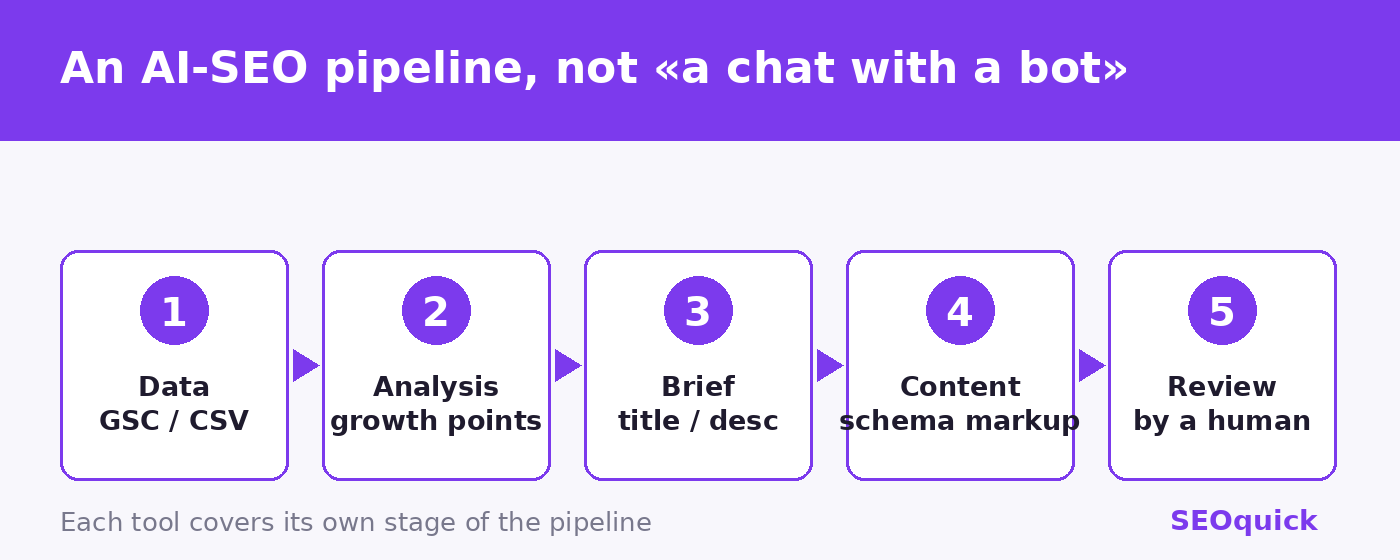
«Classic SEO is dying. We turn 5 hours of boring analysis into 5–10 minutes of real momentum. But we're not just chatting with a neural net — we build a pipeline that finds growth points for the business».
How we picked the tools for this roundup
Three criteria. First, the tool solves a concrete task rather than being «AI in general». Second, it has transparent pricing you can see before signing up. Third, it works in 2026 under the new reality — AI Overviews, AI Mode and search inside LLMs, not just classic Google. That's why a whole new category appeared in this roundup: AI-visibility trackers, which didn't exist as a class a year ago.
Category 1. Data and technical SEO: Ahrefs and Semrush
This is the foundation of the stack. Without a data platform you work blind: no keywords, no competitors, no links, no technical errors. Two systems split the market.
Ahrefs is the choice of «data purists». Its crawler processes 8 billion pages a day and is considered the most reliable link index. Tasks: backlink analysis, keyword research, site audit, rank tracking. In 2026 it added a Brand Radar module to track brand mentions in AI results. Pricing: Lite — $99/mo, Standard — $199/mo, Advanced — $399/mo (Rosvelt, 2026).
Semrush is the most complete all-in-one: keywords, audit, links, rankings, social and PPC in one window, plus AI assistants and a «Copilot». Same tasks as Ahrefs, but leaning toward marketing versatility. To track ChatGPT and historical data you need the Guru plan — about $249/mo (BuildMVPFast, May 2026).
What to choose: Ahrefs if you value the cleanest link index and data; Semrush if you want one tool «for everything» with AI assistants. More on how we use such platforms — in our piece on AI services for SEO.
Category 2. Content optimization: Surfer SEO
The data platform tells you what to write. The content optimizer tells you how to write it to reach the top. Surfer SEO is the category leader: its Content Editor scores your text against top-ranking pages in real time and suggests keywords, length and heading structure.
Tasks: content briefs, optimizing text for the SERP, auditing existing pages. 2026 pricing: Essential — $99/mo (30 Content Editor articles), Scale — $219/mo, Enterprise — from $999/mo. There's a separate AI Tracker for brand monitoring in AI search — +$95/mo for 25 prompts (eesel AI, 2026).
Mind the limitation: an optimizer shows you how to match competitors, but it won't invent expertise for you. Unique experience and numbers are still your responsibility.
Category 3. Generative assistants: ChatGPT, Claude and Gemini
These are the «hands» of your pipeline — the part that does the routine: cleaning exports, writing titles and descriptions, drafting briefs and content. All three models can handle it, but each has its own character. At SEOquick, Claude became the main workhorse — right in the browser, via the Chrome extension:
«I recommend Claude to SEO specialists. It can work right in the browser: you open a page, type a sharpened prompt — and it does all the work. If you're not using it yet, you're wasting your time».
What generative assistants do: analyze CSV exports from Google Search Console and find «low-hanging fruit» (queries in positions 4–12 with below-average CTR), write meta tags with an eye on competitors, check for cannibalization, and generate content in semantic markup. Base plans run about $20/mo per vendor — enough to launch the whole pipeline. We gathered ready-made prompts for these tasks in our roundup of 50 mega-prompts for ChatGPT, Gemini and SEO.
Next — the specifics: how exactly these three tools come together into one workflow at our agency.
Category 4. AI-visibility trackers: Profound and Otterly
This is the new category of 2026. Classic tools count rankings in Google but can't see whether ChatGPT, Perplexity or AI Mode (already past 75 million users, per Google) cites you. AI-visibility trackers fill exactly this gap — and so far only 14% of marketers use them, which makes it a window of opportunity.
Profound is enterprise-grade: multi-language, multi-country, with a Conversation Explorer for share-of-voice analysis in AI answers. Pricing: Starter — $99/mo (ChatGPT only, 50 prompts), Growth — $399/mo (3 engines, 100 prompts), Enterprise — custom (Perplexity AI Magazine, 2026).
Otterly is the affordable entry point: it tracks your brand in ChatGPT, Google AI Overviews, AI Mode, Gemini, Perplexity and Copilot, plus a GEO audit across 25+ factors and Semrush integration. Pricing: Lite — $29/mo (15 prompts), Standard — $189/mo (100 prompts), Pro — $989/mo (1,000 prompts) (Otterly, 2026).
Why you need this right now — we covered it in our guide to GEO, promoting a site in GPT and LLMs and in our overview of 2026 SEO trends.
How much it costs: building a stack for the task and budget
You don't need to buy everything. The stack is assembled per task. Here are three working configurations:
| Scenario | What's included | Budget/mo |
|---|---|---|
| Minimal (freelancer / small business) | Generative assistant (Claude or ChatGPT) + Otterly Lite | $30–50 |
| Working (in-house specialist) | Ahrefs Lite or Surfer Essential + assistant + Otterly Standard | $220–320 |
| Agency (full cycle) | Semrush Guru or Ahrefs Standard + Surfer Scale + assistant + Profound Growth | $650–870 |
The logic is simple: data + content + assistant + AI visibility. Remove any layer and a hole opens up in the pipeline.
Our experience: how we assembled this stack at SEOquick
We're not paraphrasing someone else's reviews — this stack works for us every day. Here are the three tools our own process runs on.
«Most entrepreneurs use AI at 5% of its potential: "write a post", "come up with a headline". Stop thinking of AI as a smart search engine — it's an employee that works 24/7, never asks for vacation and covers several roles at once, from copywriter to analyst. But you have to hire it, train it and put it on rails».
Claude Cowork — our content pipeline. A large share of this blog's articles, in all three languages (RU/UA/EN), is assembled by an agent in Claude Cowork: it takes a topic from the content plan, pulls quotes from our own videos and Telegram posts, fact-checks, draws infographics and OG cards in code, validates the files and sends a draft for review via Git. A human always does the final check — exactly as it should be.
Claude with the Chrome extension — analysis right in the browser. You open your own page or a competitor's — and get a title and description breakdown, a cannibalization check and a ready rewrite brief, without switching between tabs and services. It's the very routine that used to take hours.
Gemini and Google Antigravity. Gemini powers our on-site chat assistant, SemChat, trained on our own content — it answers questions about our services and articles. And we run the site project itself inside Google Antigravity, where we also build and test our internal tools — a semantic clusterer, GSC export analyzers, cover generators.
The takeaway from our experience is simple, and it matches what I keep telling clients:
«These days a specialist has to work alongside any AI. In their hands the tool speeds up work many times over, and the result can be checked and corrected. AI won't replace humans — it will replace those who don't know how to use it».
The biggest mistakes when working with AI tools
A tool doesn't do the work for you — it amplifies whoever knows how to configure it. The most common failures:
- «A chat instead of a system». One-off prompts give one-off results. You need a system of prompts, memory and a project database so the AI doesn't invent facts.
- Scaling junk. Thousands of near-identical pages with repeating boilerplate are a direct route to a penalty. In June 2026 Google finished rolling out its second spam update of the year and explicitly called manipulating AI citations spam (Search Engine Land).
- Blind trust. AI makes mistakes, grabs wrong data, mixes languages. Human review in the first months is unavoidable.
«AI penalizes junk. All the secrets lie in how you set up your system of prompts, memory and agents. AI is great, but you have to configure it well».
If you're just figuring out where to start the move to AI processes, see our breakdown of how to stop just blogging and launch AI tools.
Frequently asked questions
Which AI SEO tool should a solo specialist choose on a minimal budget?
The combo «generative assistant (Claude or ChatGPT for ~$20) + Otterly Lite for $29». For $50 a month you cover both content generation and AI-visibility control.
Does AI replace the SEO specialist?
No. AI removes the routine and speeds up analysis tenfold, but strategy, fact-checking and system setup are still done by a human. The best result comes from «specialist + properly configured AI».
Will Google penalize AI content?
Google penalizes junk, not AI: mass, cookie-cutter pages with no value. Unique experience, your own numbers and facts, no repeating boilerplate — and there will be no sanctions.
Do you need separate AI-visibility trackers if you already have Ahrefs or Semrush?
Yes. The base platforms have only just started adding AI modules (Brand Radar, Copilot). Specialized Profound and Otterly cover more engines and countries and offer depth the all-in-ones don't have yet.
Technology changes faster than you can update your subscriptions. What matters is not the number of tools but a well-built process. Assemble a minimal stack, debug the pipeline on one project, and scale. Need help setting it up — that's exactly what we do at SEOquick.
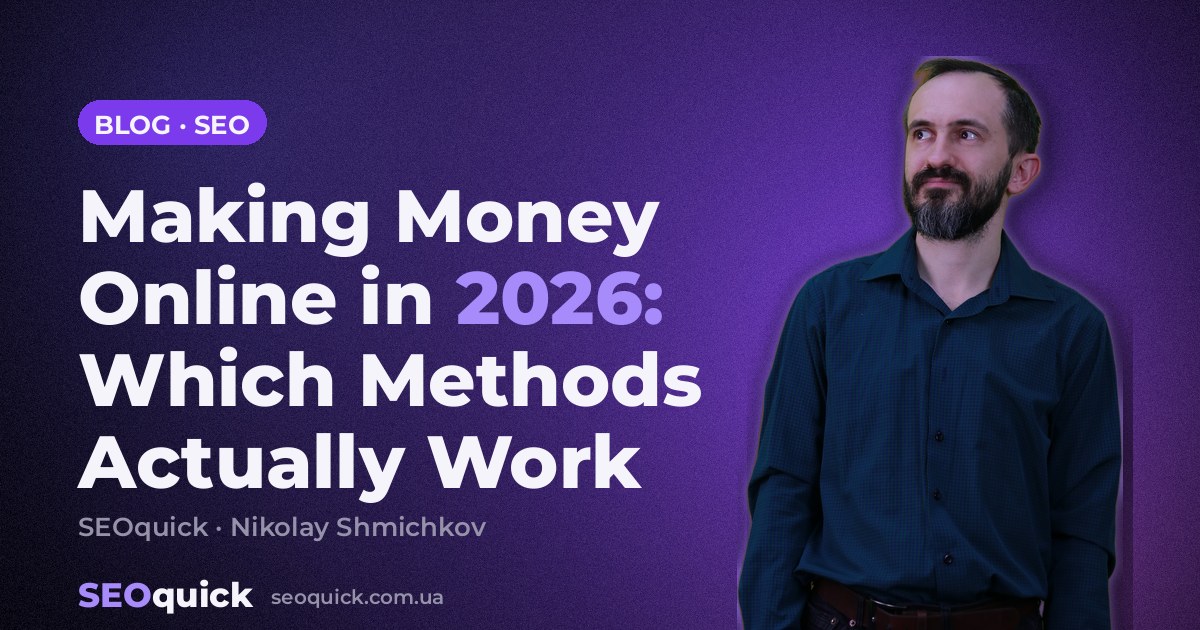
Making Money Online in 2026: Which Methods Actually Work
An honest breakdown of making money online in 2026: why 'easy money with no investment' is a myth, 5 models that actually work, and how to monetize your own site with affiliate and CPA — by SEOquick.
Read →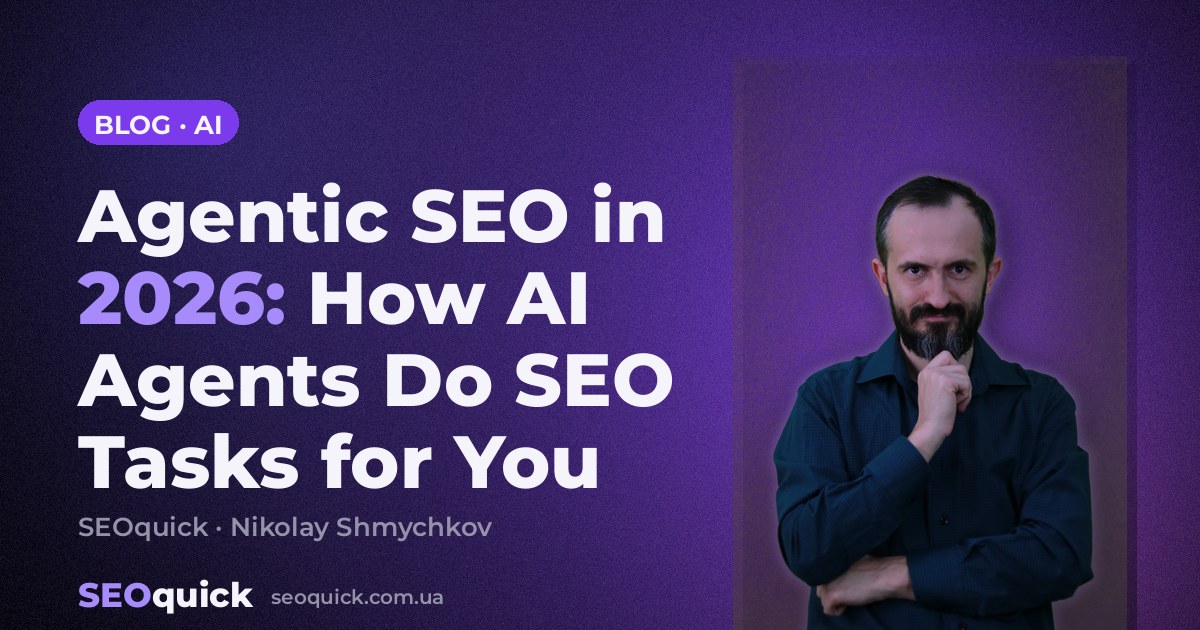
Agentic SEO in 2026: How AI Agents Do SEO Tasks for You
What agentic SEO is and which tasks AI agents already handle themselves: research, optimization, monitoring. Real examples, 2026 numbers and Gartner's warning — a breakdown from SEOquick.
Read →
SEO Trends 2026: 10 Changes You Need to Prepare For Right Now
The key SEO trends of 2026: AI Overviews on 48% of queries, 68% zero-click, the rise of ChatGPT and Google AI Mode. What is changing in search and how to prepare your site — a breakdown by SEOquick.
Read →Want to apply this to your site?
We will review the current situation, find the first growth levers, and suggest a practical working format.