Best B2B SEO agencies and what they really charge
A US B2B retainer starts at about three thousand dollars a month and runs to fifty. Here is who actually competes, what you pay for at that price, and what an agency closes beyond ordinary SEO — with our own prices and cases placed on the same chart, honestly.


I will look at your site and answer your questions on the topic of this article. 30 minutes, no slide decks, no pressure.
Book a consultationI measured two things before writing this, and the second one changed what the page is about.
The first is the price. A B2B SEO retainer in the US starts around $3,000 a month and the top of the published range is $50,000 — Directive Consulting quotes $20,000 to $50,000+, iPullRank's minimum project is $50,000. That is a wider spread than SaaS SEO, where I measured the ceiling at $40,000 a few days ago.
The second is why. I pulled the SERPs where B2B buyers actually compare products, and the pattern is the same every time: the pages that decide your deal are written by your competitors, and you are not on them. That is the job a B2B SEO agency is really being hired for, and it explains the price better than any feature list.
Key takeaways
- $3,000 to $50,000+ a month is the published range. Entry is around $5,000 for an agency that only does B2B; $10,000 buys a team; above $20,000 you are buying blended demand generation, not SEO.
- Your competitors own the comparison layer. On «hubspot alternatives», eight of the top fifteen results are rival vendors and HubSpot is not in the top fifteen at all. On «asana alternatives», seven of fifteen are rivals and Asana sits at number eleven on its own brand query.
- This SERP is not thin. Unlike the SaaS equivalent, «best b2b seo agency» has sixteen-plus genuine results, ads and an AI Overview. Positions one to five are agency service pages; the lists start at six.
- The work is mostly not SEO. Sales-call mining, ICP definition, CRM attribution, review-site presence, enablement collateral. An agency that only touches your blog cannot move a B2B pipeline.
- Every list you will read was written by an agency on it. Including the two I used to build this one. I am not first on mine.
Why B2B SEO is a different job, and what it actually involves
This is the section the other lists skip, and it is the one that tells you whether a proposal in front of you is serious.
The comparison layer belongs to your competitors
I pulled two representative SERPs on 13 October 2026. Not agency keywords — the queries a real buyer types the week before they sign.
| Query | Rival vendors in the top 15 | Where the brand itself ranks | Community threads |
|---|---|---|---|
| hubspot alternatives | 8 — Salesforce, Creatio, Insightly, Salesflare, BigContacts, LeadsBridge, Encharge, Reevo | not in the top 15 | Reddit, LinkedIn |
| asana alternatives | 7 — Teamwork, Plaky, Lark, Kanbanchi, Infinity, Lovable, ProProfs | 11th, on its own brand query |
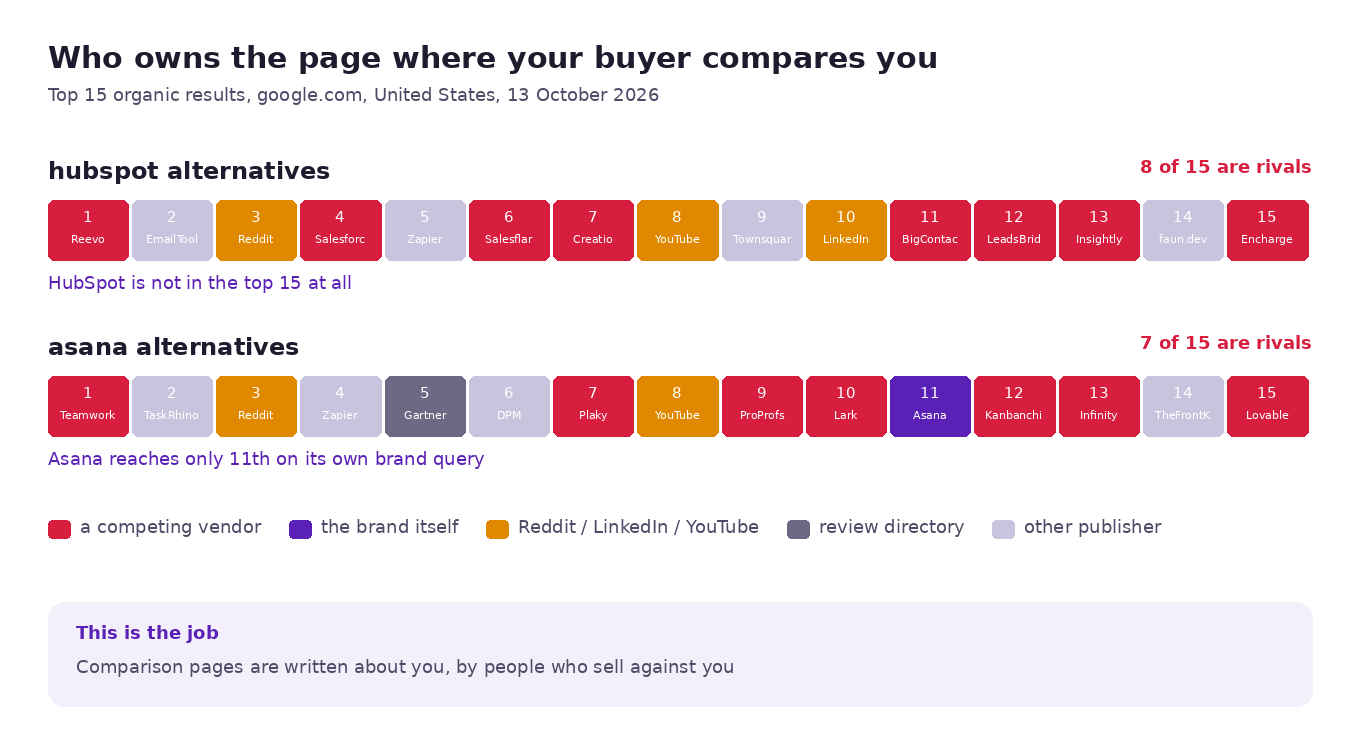
Read that again. Salesforce ranks fourth for «hubspot alternatives». Asana publishes its own comparison and still only reaches eleventh place on a query containing its own name.
So the first real deliverable in B2B is not a blog calendar. It is an owned comparison layer: your own «alternatives», «versus» and «switching from» pages, written about named competitors, with claims a lawyer can live with and a practitioner cannot laugh at. That is an editorial and legal process, not a keyword task — someone at your company has to approve saying out loud what your product does better and worse than a named rival.
Most agencies will not push for this because clients resist it. Ask any agency on this page what they would put on your comparison pages in the first ninety days. The answer separates the two kinds of vendor instantly.
Attribution runs through the CRM, not through analytics
A B2B deal closes over months, through several people, after a demo that someone booked from a page nobody remembers. Last-click reporting in GA4 will tell you the demo came from a branded search. It did not.
What a serious B2B agency sets up instead: lead source captured at form level and written into the CRM, content touchpoints kept against the account rather than the session, and reporting against deal stages — not sessions, not rankings. If the agency cannot read your CRM, it can only report traffic, and traffic is the one number in B2B that proves nothing.
This also means the agency needs access you may not be used to giving: the deal pipeline, the lost-reason field, sometimes call recordings. An agency that does not ask for these is not planning to measure anything.
The keyword list comes out of sales calls
Tools give you volume. Sales calls give you the words. The phrase a prospect uses for their problem is almost never the phrase the category uses, and the objection that kills your deals is usually a page you have never written.
The process looks like this: listen to recorded calls, pull the recurring objections and the competitor names, check which of those have search volume, and write the page that answers the objection. Volume is the filter, not the source. An agency that opens with an Ahrefs export and no questions about your sales team is guessing.
Lead quality is the metric, and it needs the sales team to define
A thousand signups from students is worse than ten from target accounts, because the first number makes everyone feel good and the second pays salaries. Defining what counts as a good lead is not a marketing decision the agency can make alone — it comes out of a session with sales, and it is revisited when the sales team says the leads are poor.
Concretely, this changes which keywords get written at all. «What is category» brings volume and students. «Category for regulated industries» brings four visits a month and two of them are buyers.
Content has to survive a practitioner
Your buyer does this job for a living. Generic content does not just underperform in B2B — it actively costs you credibility, because the reader concludes you do not understand the work.
The only way around it is interviews with your own experts: engineers, implementation leads, support. Which means your side has to commit calendar time, and the agency has to be able to turn forty minutes of a tired engineer into something publishable. When an agency quotes $10,000 a month, a large part of that is this process, not writing.
What else the studio ends up owning
In B2B, an agency hired for SEO almost always ends up working on five things that are not SEO. If a proposal mentions none of them, the agency has not done this before.
Positioning and ICP. You cannot pick keywords for a product whose category is unclear. Half the first month is usually this.
The conversion path. A demo form with eleven fields will undo any amount of traffic. Someone has to own what happens between the article and the calendar invite.
Sales enablement. The same comparison research that makes your «versus» pages makes your battlecards. Doing it once for both is the cheapest thing in this list.
Nurture and retargeting. B2B readers do not convert on the first visit by design. The content only pays if there is an email sequence and a retargeting audience behind it.
Third-party presence. G2, Capterra, Gartner Peer Insights, and increasingly Reddit, which ranked third and third on the two SERPs above. Your own site is not where the comparison happens, so part of the budget has to go outside it.
And the unglamorous one: analytics and CRM plumbing. Nobody sells this and every real engagement starts with it, because without it month three has nothing to report.
Send me the proposal you are holding
I will read it against the list above and tell you which parts are real work, which are filler, and what is missing — about the agency you are considering, not about me. If their comparison-page plan is empty, you will know in ten minutes.
Free, and it commits you to nothing.
Book a consultationWhat it costs, agency by agency
Published figures only, pulled 13 October 2026. Eleven of the agencies on this page state a number somewhere; the rest say «custom».
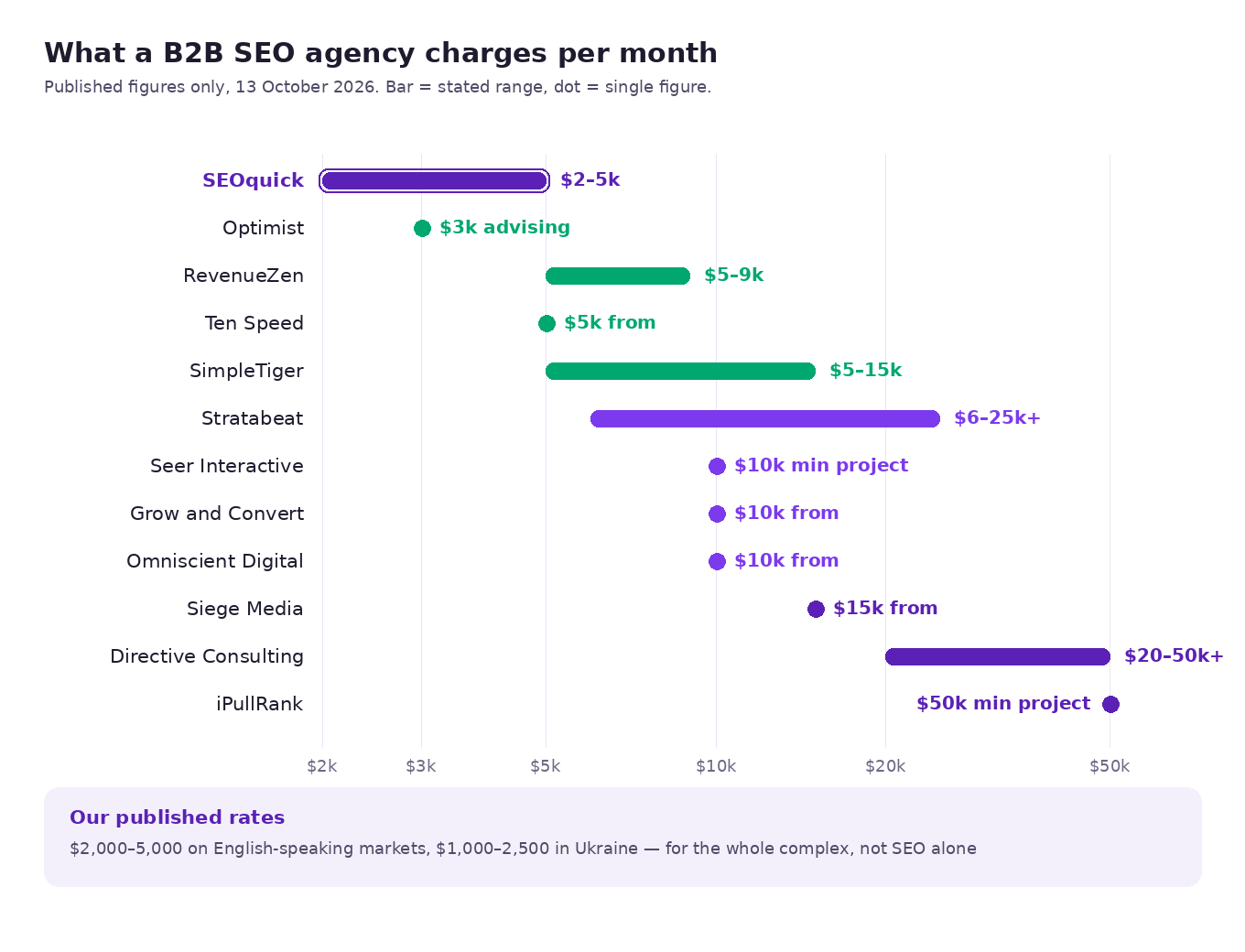
Grizzle, which publishes one of the lists I used, puts the market range at $2,500 to $20,000+ a month in its own FAQ. That matches what I found, with a longer tail at the top.
The useful way to read this: below $5,000 you are buying part of one specialist's week. At $10,000 you are buying a small team and the interview process described above. Above $20,000 the engagement has usually stopped being SEO and become blended demand generation — which may be exactly right, but you should know you are buying it.
Our own published rates are on the same chart, so you can put them in context rather than take my word for it: $2,000 to $5,000 a month on English-speaking markets, $1,000 to $2,500 in Ukraine. Two things about that number. It is for the whole complex — the comparison layer, the interviews, the attribution setup, the enablement collateral — not for SEO as a line item. And it is low because our costs are in Odesa, not because the scope is smaller; that is a fact to check rather than to enjoy, and the section below tells you how.
The shortlist, cheapest first
Sorted by published entry price, low to high. That is a price sort, not a quality ranking — the agency at the bottom of this table is the right answer for a lot of companies, and the one at the top is wrong for most enterprises. Read it together with the previous section.
| Agency | Price per month | Best for | Standout |
|---|---|---|---|
| SEOquick | $2,000–5,000 | budgets under the US floor, Europe and the States together | published prices; the whole complex, not SEO alone |
| Optimist | from $2,500 project, $3,000 advising | early stage, project work | cheapest credible US entry point here |
| RevenueZen | $5,000–9,000 | teams that want month-to-month | interview-based, no long lock-in |
| Ten Speed | from $5,000 | high-volume publishing programmes | content operations at scale |
| SimpleTiger | $5,000–15,000 | SaaS that wants defined tiers | published tiers, SEO and PPC together |
| Stratabeat | $6,000–25,000+ | SaaS, fintech, cybersecurity | regulated and technical categories |
| Grow and Convert | from $10,000 | mid-market B2B | interview-led content, no AI writing in client work |
| Omniscient Digital | from $10,000 | established B2B with a content operation | named on every B2B and SaaS list I checked |
| Siege Media | from $15,000 | mid-market and enterprise | content plus genuine earned links at scale |
| Directive Consulting | $20,000–50,000+ | Series B–D, blended paid and organic | the top of the market; «customer generation», not SEO |
| Powered by Search | custom | high-ACV B2B SaaS | demand generation and organic in one team |
The agencies
Omniscient Digital
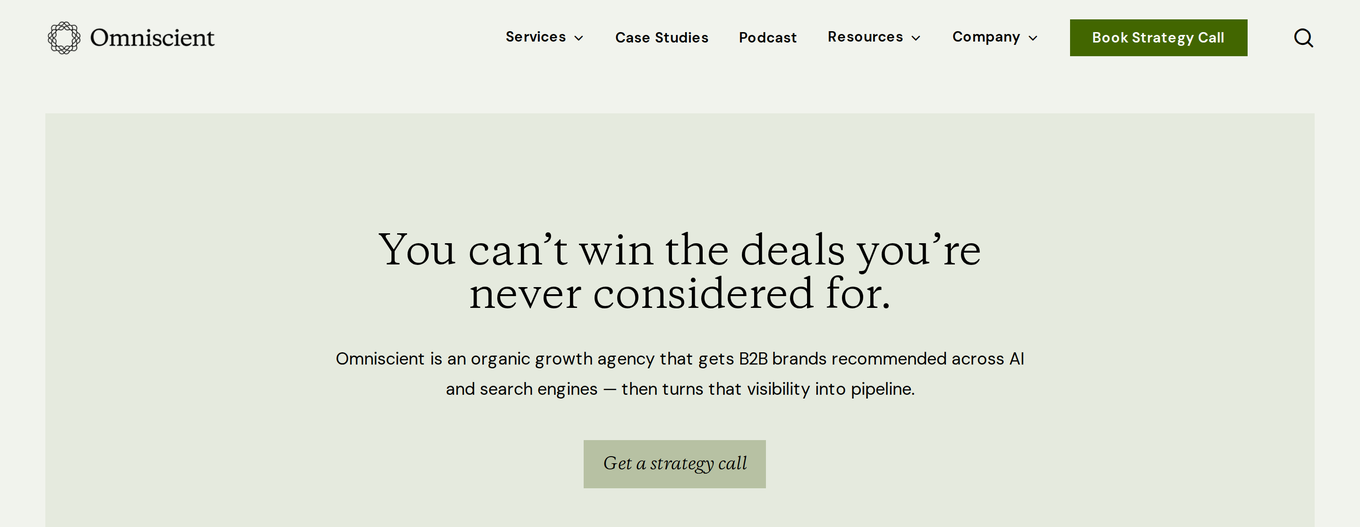
From $10,000 a month, for B2B companies that already have a content operation and want it tied to pipeline. The only name that appeared on every B2B and SaaS list I checked, which is the closest thing to an independent signal in this market.
Directive Consulting
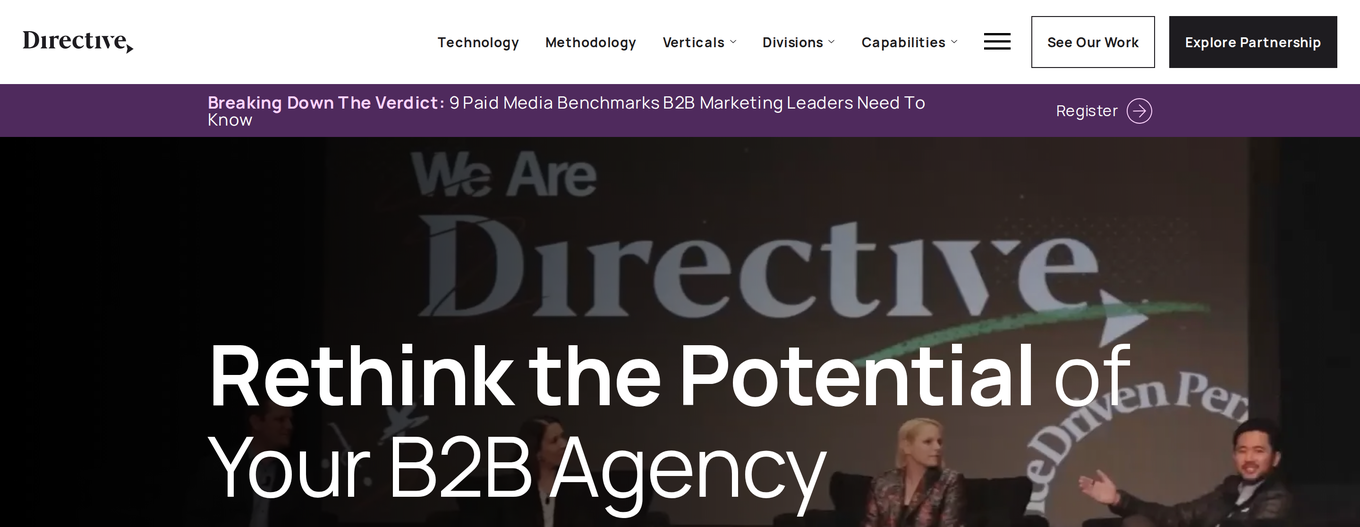
$20,000 to $50,000+ a month, Series B to D. They call it «customer generation» rather than SEO, and at that budget the label is accurate: paid and organic run as one programme. If your board is asking why pipeline is flat, this is the tier that answers it — and the tier that will not take you below a certain size.
Siege Media
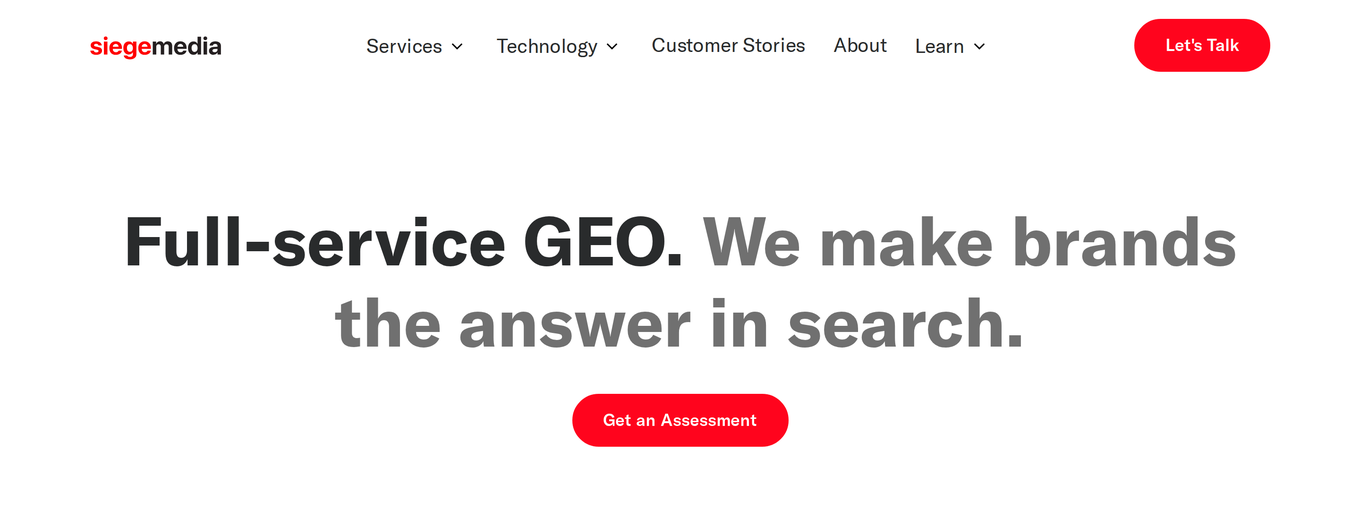
From $15,000. Design-led content and earned links, with Airbnb, Asana, Audible, Healthline, Instacart, Intuit, Kraken and PayPal on the homepage. Note the headline: a content and links agency now calls itself a full-service GEO agency.
Stratabeat
$6,000 to $25,000+, aimed at SaaS, fintech and cybersecurity. The widest useful range on this page, and the one I would look at first for a regulated category where the content has to survive a compliance review as well as a practitioner.
Grow and Convert
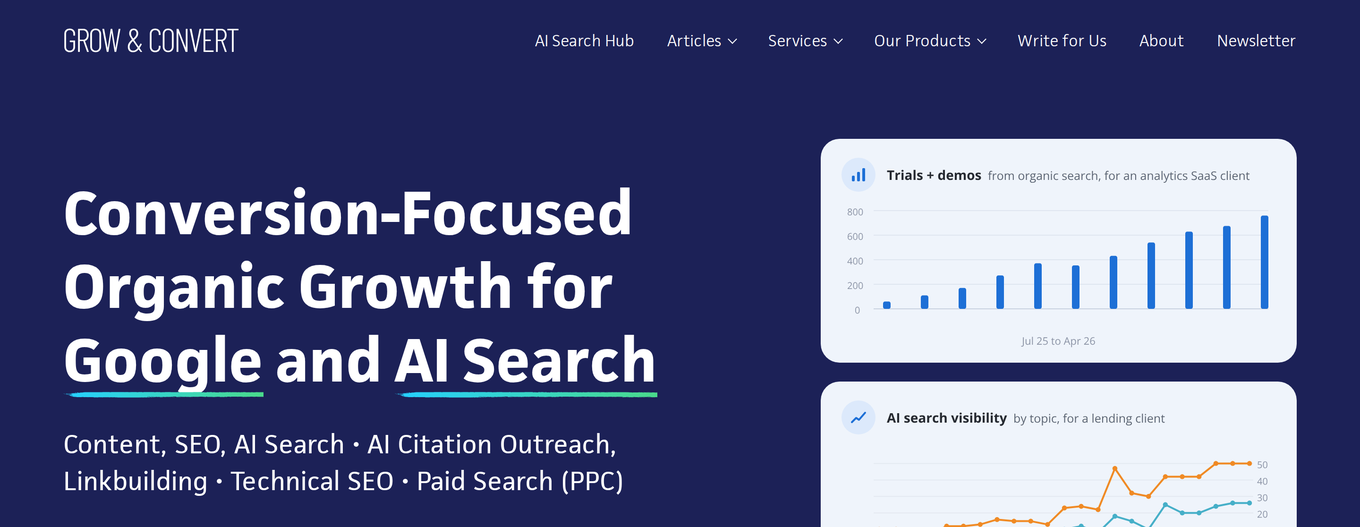
From $10,000, interview-led content for mid-market B2B, with a stated policy of no AI writing in client work. In 2026 that is a position rather than a footnote, and worth asking every agency on this page about.
RevenueZen
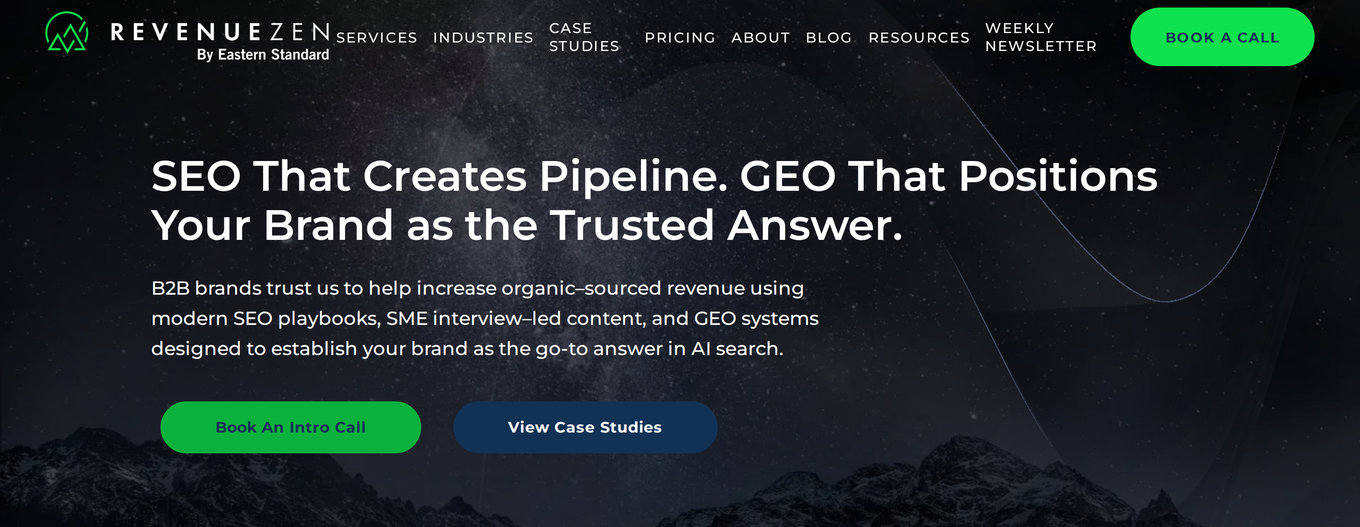
$5,000 to $9,000, month-to-month. The lowest-risk way to find out whether an agency relationship works at all, because you can stop after thirty days. Their homepage also now leads with GEO.
SimpleTiger
$5,000 to $15,000 across published tiers, SEO and PPC in the same team. Publishing the tiers at all puts them ahead of most of this page on transparency.
Where SEOquick fits, and where it does not
We are an agency in Odesa, Ukraine. Sixty-one paid projects on English-speaking markets. Published rates: $2,000 to $5,000 a month on English-speaking markets, $1,000 to $2,500 in Ukraine, for the whole complex rather than for SEO alone.
Earlier on this page I told you to ask any agency for a named client, a date, and a number you can verify yourself. So here is ours, run through the same test — including the part that fails it.
| Client | What we did, and when | Where the site is today | What we can honestly claim |
|---|---|---|---|
| Ponoma US, stainless steel shelving and countertops | six months, 2020–2021 | 2,006 US keywords, 482 of them in the top five; position 1 for «stainless steel shelves», «stainless steel kitchen islands», «stainless steel wall mounted shelves», «custom metal shelves» | the category and product pages that hold those positions are the ones we built; five subsequent years are not ours |
| CKitchen US, commercial kitchen equipment | one month, 2019 | 79,257 US keywords, about 15,500 monthly visits | nothing. One month in 2019 cannot claim a 2026 number. It is a category we have worked in, not a result we produced |
| Rental-Power Ukraine, industrial generators | twenty-two months, 2020–2026 | 7,088 keywords, 2,792 of them in the top five | this one is ours, and it is the engagement length that made it so |
Every figure above is from SE Ranking's public domain data for October 2026 and takes two minutes to check. I would rather lose the CKitchen line than keep a number I cannot defend — and you should apply exactly this to the proposals on your desk.
Our prices sit at the bottom of the chart. What that buys: senior attention, because the team is small and I am on the account. What it does not buy: a US-based outreach team with existing newsroom relationships, a content studio, or a name your board recognises.
Do not hire us if your engagement is really demand generation with a paid budget attached — that is Directive or Powered by Search. If your category is regulated and technical, Stratabeat has done more of it. If content strategy is the product, Grow and Convert.
Talk to us if you want the person doing the work on the call, if your budget is real but under the US floor, or if you sell into Europe as well as the States — we have paid projects in Poland, Latvia, Greece, Cyprus, Canada and the US, and outreach economics differ sharply between them.
How to choose, in the order that matters
Ask what goes on your comparison pages in the first ninety days. If the answer is vague, the agency is planning to write blog posts. See the first section for why that loses.
Ask what they will report in month three, and to see a real example. Deal stages and pipeline, or sessions and rankings. There is no third option in B2B.
Ask what access they need. CRM, call recordings, the lost-reason field. An agency that does not ask is not planning to measure.
Ask how much of your team's time they need. A serious answer is hours per month for expert interviews. «None» means generic content.
Ask for a named client in your category with a date and a number. Not «a B2B client grew 300%».
Ask who does the work. The person in the sales call is often not the person on the account.
Get scope in writing before money moves. We wrote a separate piece on what belongs in the contract, because that is where most of the regret lives.
Questions people actually ask
How much should B2B SEO cost per month?
$5,000 is the realistic floor for an agency that only does B2B. $10,000 buys a team and the expert-interview process. Above $20,000 you are usually buying blended demand generation. Below $3,000 in the US you are buying a freelancer's time, which can be right — just know which you are buying.
How is B2B SEO different from ecommerce SEO?
In ecommerce the transaction happens on your site and the metric is revenue per session. In B2B the decision happens across months, several people and several sites you do not own — comparison pages, review platforms, Reddit. The work moves accordingly: fewer pages, more of them about named competitors, and reporting that lives in the CRM.
Is bottom-of-funnel content really enough?
It is where the pipeline is, and it is what we would build first. But it runs out: there are only so many comparison and integration pages in any category. After that you are building authority on harder topics, which is slower and needs the expert interviews.
Do we need an agency if we have an in-house marketer?
Often the honest answer is no, you need a consultant and a writer. An in-house marketer who owns positioning and sales access covers the expensive half of this list already. Agencies rarely say this out loud.
What about AI search?
B2B research is moving into LLM answers faster than consumer search, because the questions are long and comparative. The work that gets you cited is the same work that ranks — clear extractable answers, real structure, named sources, an author with a track record. Be careful with anyone selling it as a separate product with its own price and no measurement.
How long before this shows up in pipeline?
Six months is the honest floor to see a trend, and in B2B the sales cycle sits on top of that: content read in month four can close in month nine. Anyone promising pipeline in month two is either working on an already-strong site or counting differently than you are.
Related reading
- Best SaaS SEO agencies — the neighbouring list, with three agencies in common and a thinner SERP
- How to choose an SEO agency — the general procedure, ten criteria with a check for each
- What SEO costs — our own market survey with every price list cited
- Link building and outreach — what a placement costs by market
Prices here are what the agencies publish, and they move. If you find one that has changed, or an agency that belongs on this page and is missing, tell me and I will check it.
Best SaaS SEO Agencies in 2026: the nine that actually compete, and what they charge
Nine pages seriously compete for this search in the US — after that Google pads the results with the IAEA and DARPA. The real price range starts at $5,000 a month and runs to $40,000, nine of seventeen agencies rebranded around AI search this year, and I am not first on my own list.
Read →
How Much Does SEO Cost in 2026: 21 Ukrainian Price Lists and Our Own Quote
The entry point on the Ukrainian market runs from $111 to $2,000 a month — an 18x gap. A quarter of price lists never say what period the figure covers. I break down what the sum is made of and show my own quote line by line.
Read →
Website audit cost in 2026: what the price is built from
31 prices from 13 Ukrainian pages: $33 to $2,035 for the same word. How a report differs from an audit, which free tools still work, which are dead — and what we charge.
Read →Want to apply this to your site?
We will review the current situation, find the first growth levers, and suggest a practical working format.