Google Ads Click Cost in 2026: Average CPC Benchmarks and How to Calculate Your Budget
"Why does a click cost more than my product?" — a question I have been hearing since 2010. Here is how the click price in Google Ads is formed in 2026: the auction and Ad Rank, average CPC by niche in Ukraine, Smart Bidding strategies where the algorithm sets the bid, and a formula for calculating a test budget.


When I was setting up paid search for my own online store, my boss at the time demanded that we show up for every transactional query. We sometimes paid more per click than the product itself cost — and it baffled everyone.
Imagine: you sell an iPhone screen protector for $3.50 and a click costs 7 cents — the profit is obvious. But what if a click costs more than $1? One client will say that is insane. Meanwhile another — in the legal services niche — pays $5–8 per click, and for him it is the only way to get leads in a fiercely competitive market. Both are right: there is no such thing as an “expensive” or “cheap” click in isolation from the economics of the business.
In this article we will break down how billing works in paid search advertising, what a click really costs in Ukraine in 2026, and how to calculate a budget that will not bankrupt you during testing.
TL;DR: in Ukraine in 2026, a Google Ads click costs from 3–7 UAH (
$0.07–0.17) in low-competition local niches up to 80–150 UAH ($2–3.60) in insurance, healthcare and B2B (per Ukrainian agency market reviews). The price is set by an auction: Ad Rank = bid × ad quality + the effect of ad assets. The right cap for your bid comes from your unit economics: max CPC = target cost per lead × website conversion rate.
How the Google Ads auction works
Paid search has two basic billing models: per click (CPC) and per 1,000 impressions (CPM, mostly in the Display Network and video advertising). In search campaigns you pay for the visit.
Every ad impression is the result of an auction Google runs in real time within a fraction of a second. The winner is not the highest bid, but the highest Ad Rank.
Ad Rank is a score Google calculates at the moment of every auction. Simplified, it is made up of:
- Your bid (the max CPC you are willing to pay).
- Ad quality at auction time: expected CTR, ad relevance to the query, and landing page experience.
- The effect of assets (extensions): callouts, sitelinks, prices and promotions raise the rank.
- Auction context: device, location, time, and the nature of the query.
Two important conclusions follow.
First: a high-quality ad can rank above a competitor who bids twice as much. Quality is a “discount” on every click.
Second: you do not pay your bid — you pay the minimum needed to win. The actual click price is calculated by the formula:
Actual CPC = Ad Rank of the closest competitor / your Quality Score + $0.01
That is why, at the same position, an advertiser with a 9/10 Quality Score pays noticeably less than one with 5/10.
Since 2017 Google has also applied minimum Ad Rank thresholds: even if there are no competitors for a query, a low-quality ad simply will not be shown. This answers the common question “why does my long-tail query get no impressions” — you need to raise quality, not the bid.
What Quality Score is
Quality Score is a diagnostic rating from 1 to 10 at the keyword level that shows how relevant your ads and landing pages are to queries compared with other advertisers. It consists of three components, each rated “above average”, “average” or “below average”:
- Expected CTR — the likelihood of a click on your ad when shown.
- Ad relevance — how well the copy matches the query intent.
- Landing page experience — relevance, speed and usability of the page the ad leads to.
An important nuance for 2026: Quality Score itself is not a direct multiplier in the auction but an indicator in the interface. However, the components it is built from are exactly the quality signals Ad Rank weighs at the moment of every auction. So the rule is simple: “fix” any component rated “below average” — and your click price goes down.

What a Google Ads click costs in Ukraine in 2026
There is no universal price list: the cost per click is the result of an auction in a specific niche, region and moment in time. But market benchmarks do exist.
According to reviews by Ukrainian agencies (Dash, WebSonix, 2025–2026), the market looks like this:
| Segment | CPC benchmark |
|---|---|
| Low-competition local niches (cafes, household services in regional cities) | 3–7 UAH (~$0.07–0.17) |
| Typical e-commerce, mid-competition services | 10–40 UAH (~$0.25–1.00) |
| Competitive niches: insurance, healthcare, IT, B2B services, finance | 80–150 UAH (~$2–3.60) and above |
Two multipliers that move the price most within a niche:
- Geography. In Kyiv a click can cost 50–100% more than in regional cities — the auction is denser.
- Niche margins. Clicks are expensive where one customer brings in thousands of dollars (lawyers, healthcare, B2B). Where the average order is capped (food delivery, local services), clicks are cheaper too.
For comparison, the global benchmark: per WordStream/LocaliQ data (2026, a sample of 13,000+ search campaigns), the average search CPC across all industries is $5.42. In most niches the Ukrainian auction is several times cheaper than the US one — one of the reasons paid search in Ukraine still pays off even for small businesses.
SEOquick case. For a window installation company in Odesa we built full-cycle search campaigns: strict keyword segmentation and a base of 7,093 negative keywords delivered a 10.93% CTR and a cost per lead of 73.71 UAH (~$1.80) — even though glazing is a competitive niche. Details in the case study on setting up full-cycle paid search for a service website (in Russian).
2026 CPC and CPA benchmarks by industry
The fresh WordStream/LocaliQ snapshot (April 2025 – March 2026, US market) is useful as a map of relative niche costs — the proportions between industries in Ukraine are similar, with lower absolute numbers.
Averages across all industries:
| Metric | 2026 average |
|---|---|
| CPC (cost per click) | $5.42 |
| CTR (click-through rate) | 6.64% |
| CPL (cost per lead) | $66.69 |
The most expensive clicks:
- Legal services — $9.87;
- Home improvement — $8.33;
- Dentistry — $8.00.
The year’s dynamics: for the first time in five years, the market-wide average cost per lead went down. Clicks got cheapest in education (−22.8%) and the beauty niche (−19%), while real estate showed the sharpest CPC growth (+27.3%).
The takeaway for a Ukrainian advertiser: if your niche sits at the top of the table (lawyers, healthcare, home services) — budget for an expensive auction and run the numbers before launch, not after.
Smart Bidding: when the click price stops being the key metric
The biggest change since the first version of this article: in 2026 most campaigns run on Smart Bidding, and the bid for every auction is set by an algorithm, not by you. You manage target economics, not CPC.
The main strategies:
- Maximize Conversions — the algorithm spends the budget to get the maximum number of conversions. Without a target CPA it tends to overpay per click; good for launch, when data is scarce.
- Target CPA (tCPA) — you set a target cost per conversion, and the system decides how much to pay for each click. The best choice for lead generation where all leads are roughly equal in value.
- Target ROAS (tROAS) — you set a target return on ad spend (e.g. 400% = 4 UAH of revenue per 1 UAH of spend). For e-commerce, where order values vary.
- Maximize Conversion Value — maximum conversion value within the budget, with no hard return target.
When running on tCPA/tROAS, the price of an individual click stops being a KPI. The algorithm may pay 200 UAH ($4.80) for one click if it predicts a high conversion probability, and 5 UAH ($0.12) for a doubtful one. Watch CPA, ROAS and conversion volume, not the “Avg. CPC” column.
But Smart Bidding needs data. Google’s guidelines: for tCPA — at least 30 conversions in the last 30 days, for tROAS — 50 conversions with value tracking. With less, the algorithm “guesses” and results fluctuate. Hence the practical ladder:
- Launch: Maximize Clicks or manual CPC — accumulate statistics and clean traffic with negative keywords.
- 15–30 conversions per month: Maximize Conversions.
- 30+ conversions per month: tCPA with a target 10–20% looser than your actual CPA.
- 50+ conversions with values: tROAS.
And remember the learning period: after switching strategies or sharply changing the target, the algorithm needs 1–2 weeks to readjust — do not poke the settings every three days.

Doing the math: from LTV to your maximum cost per click
Before arguing whether a 40 UAH (~$1) click is expensive, calculate how much a click can cost for your business specifically. Here is the algorithm on a hypothetical example.
Say a business makes $10,000 of revenue per month, brought in by 100 customers. Returning customers account for 25% of purchases, so there are 75 new ones. One new customer brings $133 of revenue.
Fixed costs excluding advertising are $4,000 per month, so net profit before advertising is $6,000 — that is $80 per customer. This is the ceiling: spending more than $80 to acquire a customer means operating at a loss.
Next, factor in the desired profitability. If we want at least a 30% return on ad spend, we spend no more than $50 to acquire one customer. This value is called CAC (Customer Acquisition Cost), and the allowable maximum is derived from LTV — the total profit from a customer over the entire relationship. If customers come back and buy again, LTV is higher than one-off profit, and you can afford a more expensive customer than your “one-and-done” competitors. This is the legitimate way to win expensive auctions.
Now the funnel:
- Not all leads become payments. If 60% of leads convert to money, the target cost per lead = $50 × 0.6 = $30.
- Not all clicks become leads. Average website conversion to lead is 3–5%. At 3%, the maximum cost per click = $30 × 0.03 = $0.90.
The final formula:
Max CPC = LTV × share allocated to ads × lead-to-payment rate × website conversion rate
Plug in your numbers — and the “is the click expensive” argument is over in five minutes. A $2 click in a niche with $1,000 LTV is cheap. A $0.10 click with a 0.5% website conversion rate and a $10 order is ruinous.
SEOquick case. For a network of psychological help centers we set up multi-region search campaigns split by city and intent. The result: CTR up to 18% and ROAS ≈7.4 — 7.4 UAH of revenue for every hryvnia spent on ads. Case study: setting up multi-region search campaigns (in Russian).
Budget forecasting with Keyword Planner
You can estimate future spend before launch for free — in the Google Ads Keyword Planner (Tools → Planning → Keyword Planner).
Step by step:
- Build a list of keywords. You can generate a draft list with our free Keyword Generator, then group it with the Keyword Grouping tool.
- In the Planner, choose “Get search volume and forecasts” and paste the list.
- Set the region (Ukraine or specific cities), language and period.
- On the forecast tab, review expected impressions, clicks, average CPC and spend. You can switch the metric to “Conversions” and play with the target CPA.
- Under “Historical metrics”, assess seasonality and the spread of demand across regions and devices.
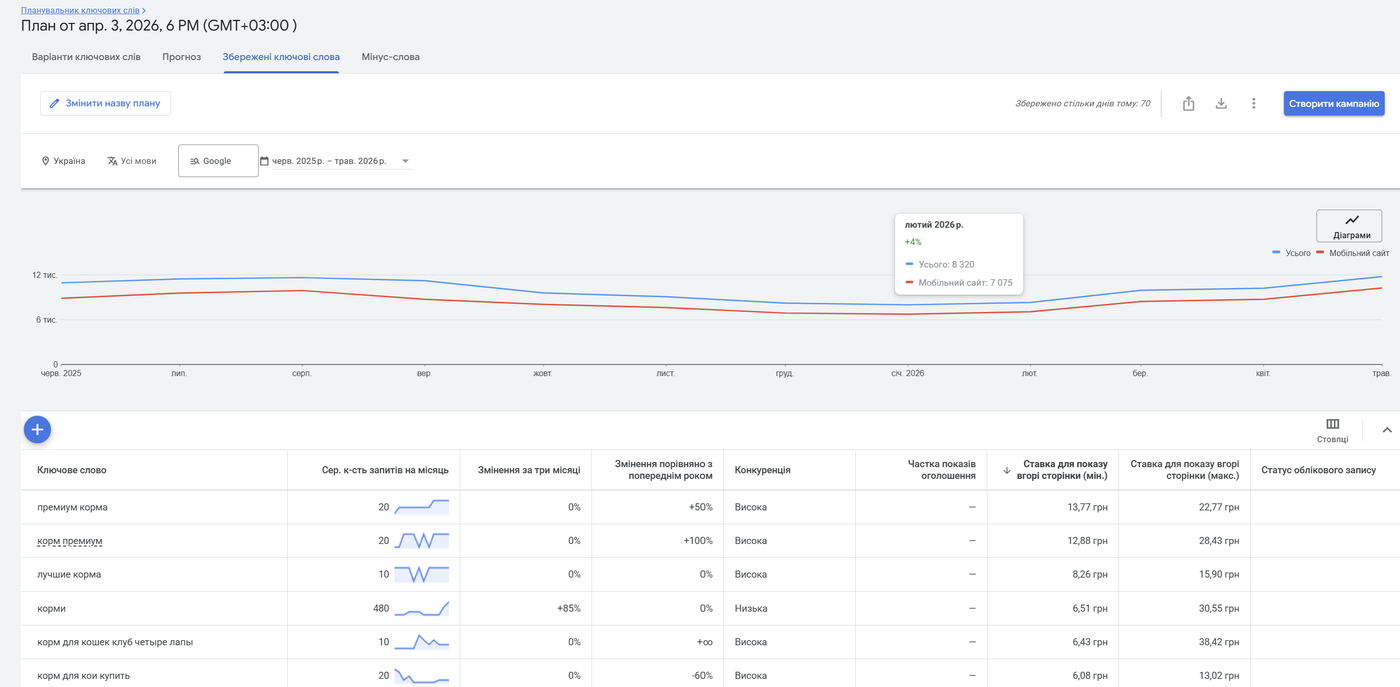
What to know about accuracy. Forecasts are recalculated daily based on auction data from the last 7–10 days, adjusted for seasonality. It is a snapshot of the current market, not a guarantee: in our audit experience, real campaigns get roughly 60–80% of forecast clicks — budget caps and impression share get in the way. So use the Planner’s forecast as a lower bound for CPC and an upper bound for traffic.
And be sure to add negative keywords at the forecasting stage: broad phrases without negatives show sky-high prices and irrelevant volume.
How much to budget for a test: the calculator
The most frequent client question: “How much money do I need to find out whether paid search works?” Here is the calculation logic we use.
Step 1. Determine the expected CPC. Take it from the Keyword Planner forecast for your keywords and region. Say, 25 UAH (~$0.60).
Step 2. Determine the minimum clicks needed for a verdict. At campaign level you need at least 300–500 clicks to judge the website’s conversion rate: at a 3% conversion rate that is 9–15 leads — no longer a fluke.
Step 3. Calculate the click-based test budget.
Test budget = expected CPC × 300–500 clicks
In our example: 25 UAH × 400 = 10,000 UAH (~$240). That is the minimum for a 2–4 week test of a search campaign in a mid-competition niche.
Step 4. Cross-check against the Smart Bidding learning threshold. If you plan to use tCPA, the budget must allow ~30 conversions per month:
tCPA budget = target CPA × 30
At a 300 UAH ($7) target cost per lead that is 9,000 UAH ($215) per month — the numbers line up with the click-based calculation. If your budget is 3–4 times smaller than the calculated one, do not spread it over six months: narrow the geography or the keyword set so statistics accumulate fast, otherwise the test will give no answer at all.
Step 5. Set aside a 20–30% reserve for cleanup: in the first weeks part of the budget will inevitably go to queries you will later exclude. That is not a loss — it is the price of data.
How to lower your cost per click: 6 working methods
- Negative keywords. The fastest effect: every junk query you cut off means impressions and clicks that no longer hurt CTR or burn budget. Pull the “Search terms” report weekly and keep expanding the base (7,093 negatives in our window installation case).
- Relevance of the “query → ad → page” chain. Tight ad groups, the keyword in the headline, a landing page built for the specific intent. This lifts the quality components — and Ad Rank grows without raising the bid.
- Ad scheduling. Check in the reports which hours and days bring cheaper leads, and shift budget there. Night traffic converts worse in most service niches.
- Geo segmentation. Split Kyiv and regional cities into separate campaigns: the auctions are different, and a single bid means overpaying in one place and losing impressions in the other.
- Assets (extensions). Sitelinks, callouts, prices and promotions enlarge the ad and raise CTR — and expected CTR directly affects Ad Rank and the actual CPC.
- Pruning underperforming keywords. Keywords with consistently low CTR and no conversions drag down the quality of the whole group — pause them or move them into separate campaigns.
A separate note on the Display Network: control your placements — exclude mobile apps and irrelevant sites, otherwise reach-driven algorithms will absorb any budget. A detailed breakdown of typical problems is in the article 25 Google Ads mistakes.
And one last thing: more and more often the customer journey starts not with search but with AI answers. If you are building traffic for the long run, work on optimizing your website for AI search in parallel with paid ads — it reduces your dependence on ever-pricier auctions.
Conclusions
The cost of paid search advertising is not a price list but the result of an auction in which you control half of the equation. The market dictates the bid; the quality is up to you.
The healthy calculation algorithm:
- Do the math: LTV → allowable CAC → target CPA → maximum CPC.
- Pull a Keyword Planner forecast for your keywords and region.
- Compare: if the forecast CPC is above your maximum — work on the website’s conversion rate and average order value before launch, not after the budget is gone.
- Budget a test of 300–500 clicks plus a 20–30% reserve.
- Once you accumulate 30+ conversions per month, switch to tCPA/tROAS and manage the cost per lead, not per click.
And the main point: an expensive click is not the one that costs 100 UAH (~$2.40), but the one that does not pay back.
FAQ
How much does a Google Ads click cost in Ukraine in 2026?
From 3–7 UAH ($0.07–0.17) in low-competition local niches to 80–150 UAH ($2–3.60) and above in insurance, healthcare, finance and B2B (per Ukrainian agency market reviews for 2025–2026). In Kyiv a click is 50–100% more expensive than in regional cities. For an exact range on your own keywords, check the Keyword Planner forecast — it is free.
What determines the cost per click in paid search?
The auction density in your niche and region, your bid, and your ad quality: expected CTR, ad and landing page relevance, and the presence of assets. Actual CPC = the closest competitor’s Ad Rank / your Quality Score + the minimum increment, so a high-quality ad pays less for the same position.
What is the minimum budget for a Google Ads test?
The minimum is a budget for 300–500 clicks at your niche’s forecast CPC, plus a 20–30% reserve for query cleanup. For example, at a 25 UAH ($0.60) CPC that is about 10,000–12,000 UAH ($240–290) for 2–4 weeks. A smaller budget will not produce enough statistics for conclusions — better to narrow the geography or keyword set than to spread the money thin.
Which is better: manual bidding or Smart Bidding?
It depends on the data volume. Below 30 conversions per month, use manual CPC or Maximize Clicks and build up statistics. From 30 conversions per month, tCPA usually outperforms manual management; from 50 conversions with value tracking — tROAS. On Smart Bidding the KPIs are cost per lead and ROAS, not the click price.
Why is my click more expensive than the “niche average”?
Most often because of low quality: weak CTR, irrelevant ads, a slow landing page — and Google compensates for it with price. The second reason is overly broad keywords with no negatives: you are competing in other people’s auctions. The third is a single campaign covering both Kyiv and the regions: the bid averages out to the most expensive market.
Can a click cost more than the product — and is that normal?
Yes, if the economics work out through LTV. When a customer returns and buys again, their total profit is many times higher than the first purchase — and an expensive first click pays off. Compare not “click price vs product price” but “customer acquisition cost vs lifetime profit per customer”.

H1 vs Title: how many H1 tags you need and how they differ
H1 in SEO 2026: how many H1 headings are acceptable, optimal length, how it differs from title, empty H1 and H1 as an image. Based on a measurement of 77 pages from the Ukrainian top and data on how often Google replaces your title with the H1.
Read →
Pagination SEO: how to index list pages without breeding duplicates
Pagination SEO in 2026: canonicals on list pages, noindex, rel=next/prev, infinite scroll, crawl budget. Based on a check of 36,000 traffic-driving URLs across twelve Ukrainian retailers, plus a teardown of pagination at Foxtrot, Epicentr and our own blog.
Read →
URL Structure: The Full Guide to Addresses You Can't Change After Launch
How to get URLs right: transliteration or Cyrillic, slug length, duplicates from case and filters, pagination, UTM tags, redirect maps. A breakdown of Rozetka, Comfy, Prom and Makeup URLs plus 2026 research data.
Read →Want to apply this to your site?
We will review the current situation, find the first growth levers, and suggest a practical working format.