E-E-A-T in 2026: How the March Core Update Boosted Author Experience
The March 2026 core update rewrote the weight of the first letter in E-E-A-T — Experience. Google stopped trusting reviews written 'based on the top 10' and started rewarding those who actually did it, tried it, and showed the result. Here is what changed and how to build author experience into your content.


I will look at your site and answer your questions on the topic of this article. 30 minutes, no slide decks, no pressure.
Book a consultationThe March 2026 core update cranked up the first E in E-E-A-T — Experience — harder than any previous signal. Google started rewarding content with real primary experience: proprietary data, tests, case studies, and verifiable authors. Top-10 recap reviews with zero unique value ended up as the biggest losers, while sites lacking experience signals in YMYL niches dropped 20–35% in rankings.
Every time a core update hits, clients message me with the same line: "We didn't change anything, why did traffic tank?". In 2026, there's a dead-specific answer to that. Google no longer pays for a "well-written article." It pays for what you can prove: that you actually did it yourself. Below is what's behind the Experience letter and how to show it so both the algorithm and AI actually believe you.

What is E-E-A-T and where did the second E come from
E-E-A-T isn't a ranking factor in the literal sense; it's a framework Google uses to judge content quality: Experience, Expertise, Authoritativeness, and Trust. Trust is the centerpiece here—the other three work to support it.
The first E — Experience — is the newest kid on the block. Google tacked it onto the acronym in late 2022, turning E-A-T into E-E-A-T. The logic is simple: being an expert isn't enough; it matters if the author interacted with the subject personally. A vacuum cleaner review from someone who actually vacuumed with it is worth more than a perfectly polished text from someone who’s never seen the thing in real life. Until 2026, this was a recommendation. After March, it became a matter of survival.
What exactly the March 2026 core update changed
The update rolled out from March 27 to April 8, 2026—twelve days, making it one of the fastest broad core updates in the last two years (Google Search Status Dashboard). But it’s not about the speed. It’s about the fact that it boosted the weight of the Experience signal specifically.
According to an analysis by Amsive, noticeable ranking shifts affected over 55% of tracked sites in the first two weeks. Meanwhile, DigitalApplied notes that YMYL niches—health, finance, law, local services—got hit the hardest: pages without primary experience signals slumped by 20–35%.
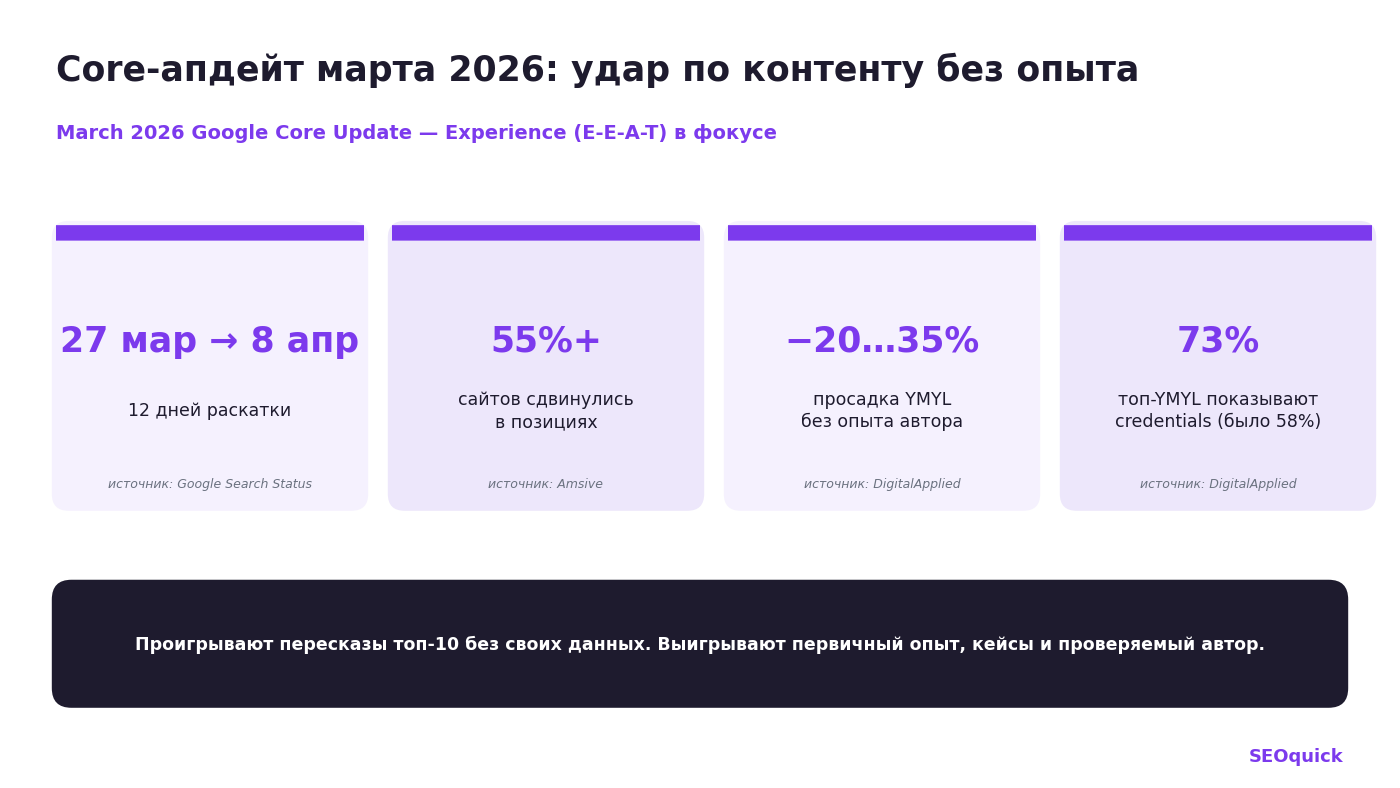
As for who won and who didn't, Evertune puts it bluntly: the most consistent losers of all 2025–2026 core updates are pages that just rehash the top 10 without their own data, primary experience, or a unique perspective. Moving up are original research, proprietary data, in-house tests, and case studies based on real client results.
Why "unpolished" experience beats polished content
You can't fake experience with fancy layout—and here’s a case I handled myself during a consultation.
“A client came to me who was selling prepared meats in Western Ukraine via TikTok—steaks, smoked meats, all from the smokehouse. He was making these beautiful, Photoshopped, polished posts—and they were getting way less engagement. But where he just recorded a 'dirty' video of him smoking meat in a barrel—there weren't dozens, but hundreds, thousands of likes, and a ton of comments. Half the people wanted to buy the barrel, the other half were asking what he was doing and for how much.”
That’s Experience in its purest form. A raw video of a person actually doing the work sells better than a glossy image—because it proves experience rather than performing it. In 2026, Google learned to read this same signal in text. It catches specific details that are impossible to make up without doing the work: numbers from your project, a screenshot of your dashboard, a mistake you made, and how you fixed it.

How to show author experience in an article
Experience isn't just an "about the author" paragraph at the end. It should be woven through the whole page. The strongest signal is your own numbers: not "conversion grew," but "conversion grew from 1.8% to 3.1% over six weeks on a furniture store project." You can't fake that kind of specificity without doing it. Next—original media: your GA4, your Search Console, your process, not stock photos and someone else's case studies. Mistakes and nuances are especially valued: someone who did it themselves knows where the pitfalls are, while a top-10 rehasher doesn't, so describe what went wrong. Write in the first person and include dates—"we tested this in May 2026" carries more weight than an impersonal "it is recommended." And tie it all to a verifiable author: real name, photo, profile, publication history, so Google and the reader can match the claims to a living person.
I wrote about this approach in detail in my piece on how to update old articles: old content usually tanks specifically because it lacks every single one of these signals.
Author pages have become SEO infrastructure
Showing Experience without an author to tie it to is impossible. After March, this stopped being cosmetic. According to DigitalApplied, 73% of top YMYL pages now show detailed author credentials—up from 58% before this update cycle. The market caught up because it works. The bare minimum you should do: a separate author page with a bio, field of expertise, and links to profiles; a byline on every article linking to it; and connecting author → organization via schema markup. This creates an entity that AI search understands and trusts—the same principle I broke down in the article on GEO optimization for GPT.
Why YMYL niches were hit the hardest
Health, finance, law, local services—these are topics where a content error hits a person’s wallet or health. Google holds them to the highest E-E-A-T standard, so when the update boosted the weight of Experience, these niches got the harshest re-evaluation. A medical article without a practicing doctor as the author or a legal breakdown without a legal expert lost rankings first. If you're in YMYL, the experience and authorship signal isn't an option; it's the price of entry. And the same goes for AI results: assistants cite sources they trust, and they build that trust from these same signals. I laid out how this connects to AEO and GEO in the AEO, SEO, and GEO material.
Where to start before the next update
Don't rewrite everything at once. Go through your key pages and find those that don't have a single proprietary number or screenshot—these are your first candidates for a drop. Add verifiable specifics to them: results, dates, project names that can be disclosed. Replace stock images with real screenshots and process photos. Create author pages and set up bylines with links. Describe real mistakes and nuances—stuff a top-10 rehasher would never write. And in YMYL, tie the content to a niche expert with verifiable credentials; there’s no way forward without it.
FAQ
How does Experience differ from Expertise?
Expertise is knowledge of the subject: a degree, qualification, being well-read. Experience is personal interaction with the subject: you did it yourself, tried it, walked the path. A surgeon has expertise in operations; a patient who survived an operation has experience. For many queries, Google now values the latter.
Does Google penalize AI content because of E-E-A-T?
No, not for the mere fact of using AI. Content that lacks primary experience and original value drops, and mass-produced "based on top-10" generation is devoid of Experience by definition. Details are in the piece on AI content and Google penalties.
My site dropped after March—what should I do first?
Find the pages with the biggest traffic loss, evaluate them for experience and authorship signals, and start there. Recovery after a core update usually comes with the next update, so it's important to get your edits in early rather than panic-rewriting the whole site at once.
For more breakdowns of fresh updates and trends, check out the SEO Trends 2026 section and the SEOquick blog.
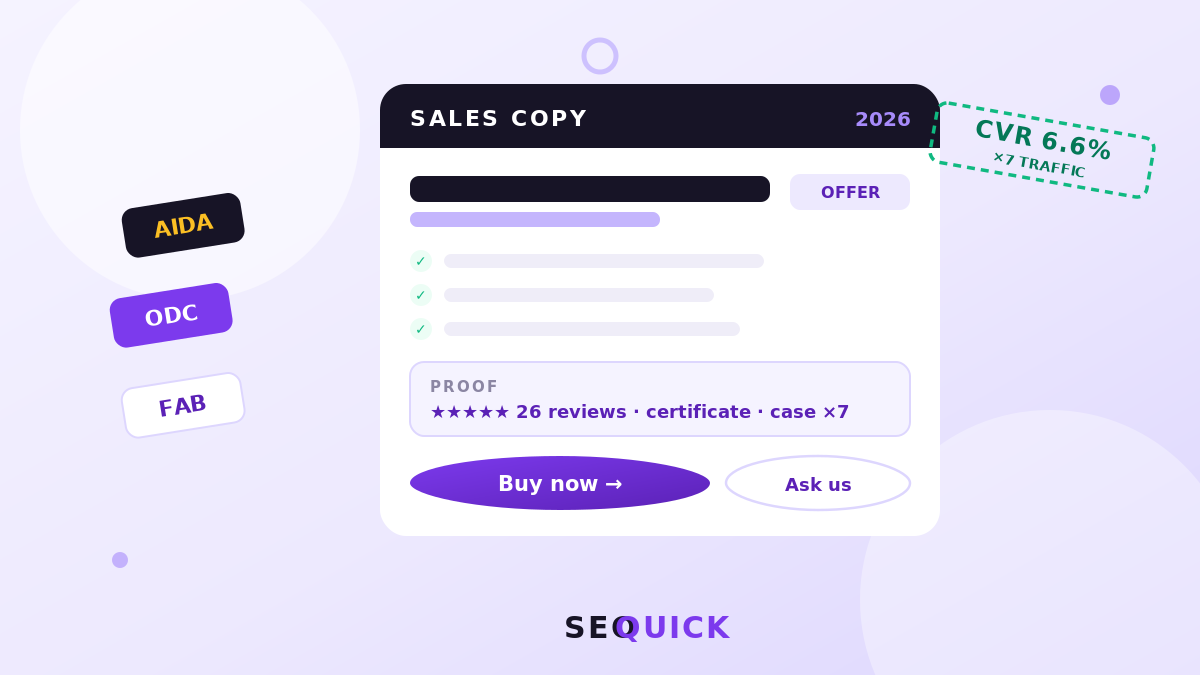
How to Write Sales Copy: Structure, 8 Formulas, Ready-Made Templates and Examples
Sales copy without fluff: the structure of a page that sells, 8 formulas (AIDA, ODC, PMHS…), a real first-screen breakdown, ready-made templates and prompts, SEO logic and metrics. SEOquick’s experience: a ×7 traffic case built on commercial pages.
Read →
Google AI Max in 2026: Should You Switch From Performance Max
What Google AI Max is, how it differs from Performance Max, and whether you should switch in 2026. Google's real numbers vs independent data, brand and geo controls, DSA migration. A breakdown by SEOquick.
Read →
How to Get Into Google AI Overviews: 7 Citation Factors
A breakdown of a 405,000 AI Overviews study: why the top 10 no longer guarantees a citation, whether schema helps, and what actually drives inclusion in Google's AI answer. SEOquick experience.
Read →Want to apply this to your site?
We will review the current situation, find the first growth levers, and suggest a practical working format.