Google AI Max in 2026: Should You Switch From Performance Max
AI Max is the headline Google Ads feature: keyword-less technology inside a regular Search campaign. Google promises +14% conversions, yet independent tests show 84% of advertisers see neutral or worse results. Here's what it actually is, how it differs from Performance Max, and whether you should switch.


I will look at your site and answer your questions on the topic of this article. 30 minutes, no slide decks, no pressure.
Book a consultationAI Max is not a replacement for Performance Max — it's an AI layer on top of a regular Search campaign. The phrase "switch from PMax to AI Max" is misleading: they're different tools. Performance Max automates ads across every channel; AI Max supercharges Search while keeping your keywords, reports and control. Choose by the job, not the hype.
In 2026, AI Max for Search campaigns left beta and became the default setting for new Search campaigns (Google Ads Blog). At the same time Google announced that classic Dynamic Search Ads will eventually migrate fully to AI Max. So the question is no longer "should I try it" but "how do I turn it on without wasting budget". Here's an honest breakdown with real numbers.
What Google AI Max is, in plain terms
AI Max is a set of AI features that switch on over your existing Search campaign and help you find conversions where plain keywords miss them. Technically it's three components (Google Ads Blog):
- Search term matching (query expansion). Broad match and keyword-less technology surface new high-performing queries that weren't in your keyword list.
- Text customization (asset optimization). AI tailors headlines and descriptions to each user's context and sends them to the most relevant page.
- Final URL expansion. Google picks the best landing page for each search — not only the one you specified.
The key difference from Performance Max: you don't lose your keywords and you stay in Search. AI Max is a "smart co-pilot" for a Search campaign, not a separate multichannel machine.
AI Max vs Performance Max: the difference
This is the big confusion of the year. People hear "AI Max" and assume it's "the new Performance Max" they must rush to. It isn't. Let's compare on the substance:
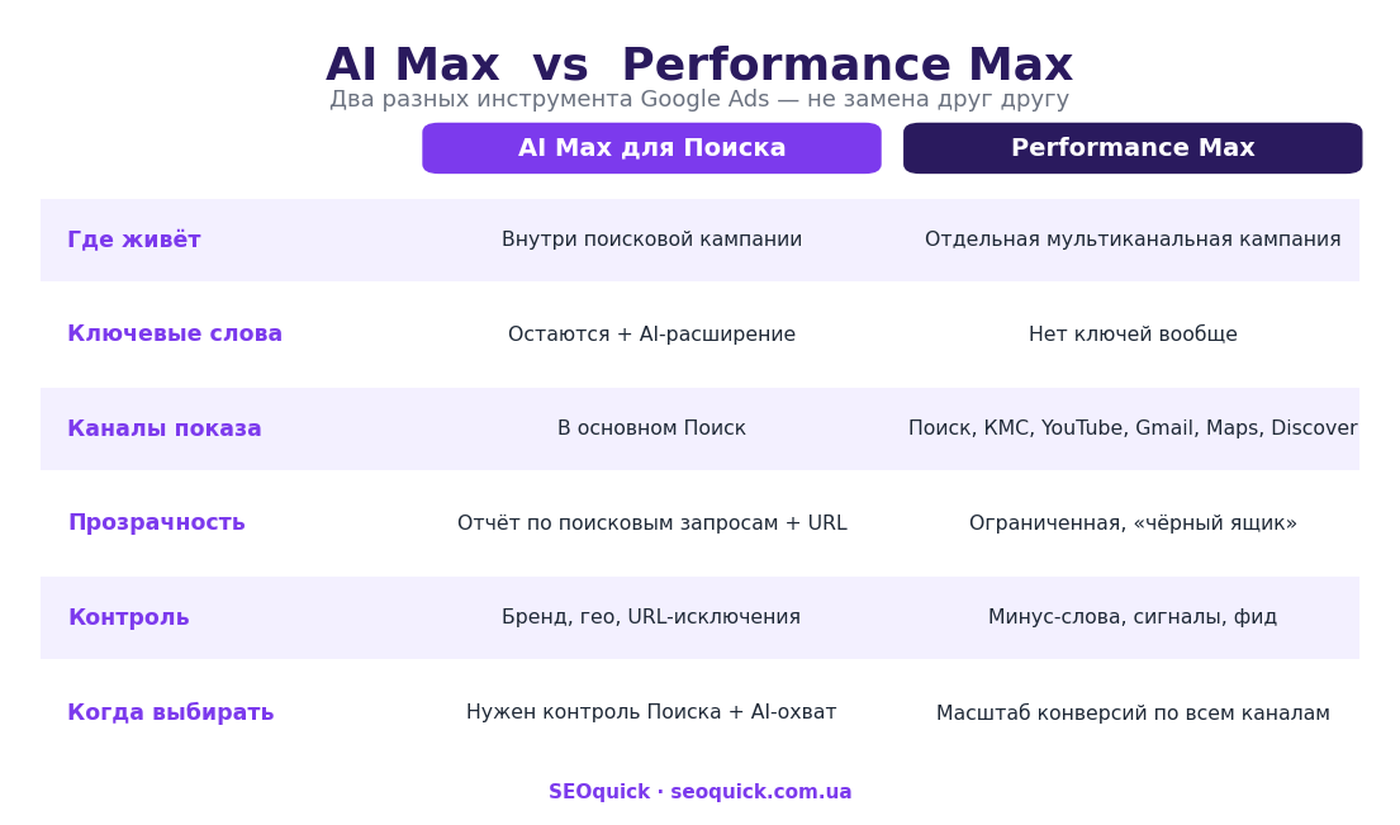
As our PPC specialist Alena Poliukhovych explains, using the logic of Google's automation, the difference is a philosophy of control:
"The foundation of Performance Max isn't keywords — it's artificial intelligence. You give it audience signals, search themes and content type — a product feed or your site's pages — and the algorithm does the rest."
AI Max works differently: it keeps your keywords and search-term reports but adds AI reach on top. So the correct question isn't "PMax or AI Max" but "which tool for which job". We covered the PMax campaign itself in detail in Performance Max in 2026: setup, feeds and control.
How much AI Max actually delivers: Google's numbers vs independent data
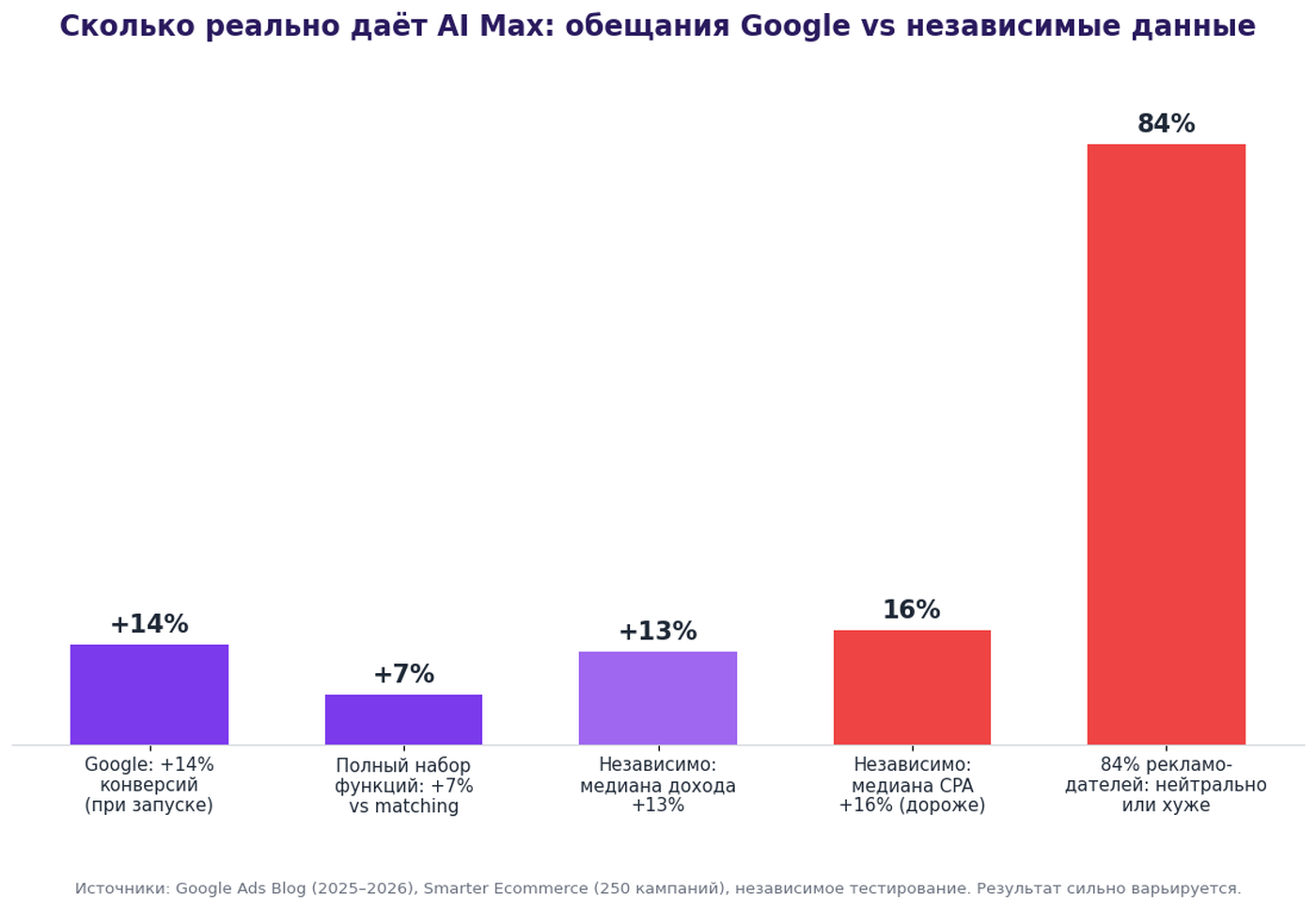
Short answer: per Google, an average +14% conversions at the same CPA/ROAS — but independent research shows a huge spread, and most advertisers see no uplift at all.
Officially, Google says advertisers who enable AI Max typically see +14% more conversions or conversion value at a similar CPA/ROAS, and for campaigns still tied to exact and phrase match the uplift can reach +27% (Google Ads Blog, 2025). The full feature suite adds +7% over search term matching alone (Google for Business).
Now the independent data. An analysis of 250+ retail campaigns by Smarter Ecommerce found a median revenue uplift of +13% — but also a median CPA increase of +16%, i.e. more expensive. ROAS ranged from +42% to −35% (ALM Corp / Smarter Ecommerce). And independent testing suggests around 84% of advertisers report neutral or negative results.
A separate risk is traffic quality. Lunio's analysis of 900 Search campaigns recorded invalid traffic rising from a 3.7% baseline to 5% with AI Max on — roughly a 35% relative increase. The takeaway is simple: test AI Max on your own data, don't just turn it on "because Google recommends it".
What controls AI Max gives you in 2026
The main complaint about Google automation was always the same — loss of control. In 2026, AI Max gained levers it never had before (Google Ads Help):
- Brand controls. Three modes: show on all relevant searches, control branded searches with inclusions/exclusions, or show only on unbranded searches. This protects you from cannibalizing cheap branded clicks.
- Locations of interest. Target users by geographic intent at the ad-group level — without building a separate campaign per region.
- URL inclusions/exclusions. Exclude sensitive pages (cart, system pages) from landing pages and set allowed URLs at ad-group level.
- Search terms report with headlines and URLs. You finally see which queries drove traffic to which pages — the transparency Performance Max lacked.
Plus the 2026 additions: the AI Brief tool to steer messaging and targeting, text disclaimers (required text always appears in the ad, even with URL expansion), and AI Max expanding to Shopping and travel formats (Google Ads Blog).
DSA are going away: what you need to know about the migration
If you still run Dynamic Search Ads — get ready. Google is moving DSA to AI Max, but the timeline shifted in advertisers' favor (Search Engine Land):
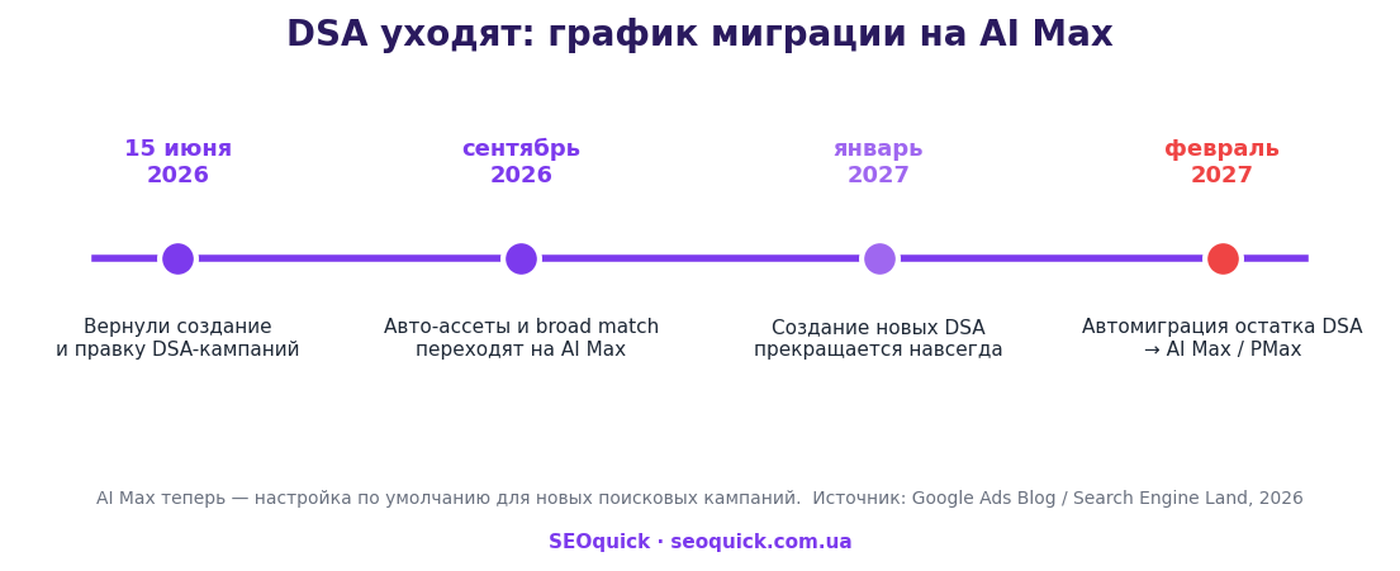
Key dates: June 15, 2026 — creating and editing DSA campaigns was restored; September 2026 — automatically created assets and campaign-level broad match move to AI Max; January 2027 — creating new DSA ends permanently; February 2027 — automigration of remaining DSA to AI Max or Performance Max begins. Don't leave your tests to the last month.
Should you switch from Performance Max to AI Max?
Short answer: in most cases you don't need to "switch", because they're different tools. If Performance Max is working — keep it for multichannel scale. Turn AI Max on for your Search campaigns as a separate test.
Performance Max fits when you need to scale conversions across several channels at once — Search, YouTube, Display, Gmail, Maps. As Alena Poliukhovych puts it:
"Performance Max is very fitting when you need to scale conversions across several channels at once and open extra demand beyond Search. But we don't recommend it to every client right away — it all depends on whether your conversions are set up correctly."
AI Max is about something else: keeping focus on Search and control over queries while adding AI reach and customization. Not either/or — it's job-dependent. In practice, at SEOquick we enable AI Max selectively — as a standalone experiment on Search campaigns with clean analytics — rather than as a replacement for a working Performance Max.
"AI Max isn’t a revolution — it’s a bundle of existing features under a single toggle: broad match, DSA and automatically created assets. I’m skeptical of Google’s +27% conversions claim — the tests were run on large advertisers like L’Oréal, and for small and mid-sized businesses it just doesn’t work that way. On one account, after switching it on, we saw Search performance drop by half: 42 conversions in May, 22 in June — with even 15% fewer clicks. Test AI Max carefully — on secondary campaigns and with split traffic via an experiment."
How to enable AI Max without wasting budget
The control philosophy here is the same as with Performance Max — analytics first, automation second. A practical checklist:
- Tracking first. Without accurate conversions, their value and attribution, the AI has nothing to learn from. Verify conversions register correctly.
- Enable it on one campaign as an experiment. Use a Google Ads A/B experiment and compare against a control group for at least 2–4 weeks.
- Set up brand controls immediately. Otherwise AI Max will eat cheap branded clicks and paint you a pretty but fake uplift.
- Exclude system URLs. Cart, thank-you and account pages must not become landing pages.
- Read the search terms report. It's your main tool against invalid traffic — cut the junk in time.
- Give it time to learn and don't touch the budget.
That last point is the most common and expensive mistake, which Alena flags about any Google automation:
"The most common problem is bailing too early. The campaign isn't cheap and takes a while to learn, but it's effective. Clients often try to turn it off or cut the budget — you must not do that. The campaign needs time to learn."
FAQ: Google AI Max in brief
Is AI Max the same as Performance Max?
No. AI Max works inside a Search campaign and keeps your keywords and reports. Performance Max is a separate campaign that automates all channels without keywords.
Do I need to switch to AI Max right now?
No. But from 2026 it's the default for new Search campaigns, and DSA migrate to AI Max by 2027. It's worth testing now — on one campaign, as an experiment.
Google promises +14% conversions — is that true?
That's Google's figure. Independent research shows median revenue +13% but also CPA +16%, and ~84% of advertisers see neutral or worse results. Outcomes depend heavily on niche and setup.
How do I stop AI Max wasting budget on junk traffic?
Enable brand controls, exclude system URLs, read the search terms report and minus out the irrelevant. Test via an A/B experiment, not across the whole account at once.
When will Dynamic Search Ads finally disappear?
Creating new DSA ends in January 2027; automigration of the rest to AI Max/PMax starts in February 2027.
If you're unsure which fits your project — Performance Max, AI Max or classic Search — send us your current campaigns for a free audit: we'll show where you lose money and what to enable first. And for how AI agents are changing the PPC specialist's job itself, see Agentic SEO.
Ecommerce SEO in 2026: A Checklist for AI Search and Zero-Click
An ecommerce SEO checklist for 2026: a product feed tuned for AI Mode, Product schema, AI-citable product content, technical SEO for checkout and cart. A hands-on breakdown with real numbers from SEOquick.
Read →
Agentic SEO in 2026: How AI Agents Do SEO Tasks for You
What agentic SEO is and which tasks AI agents already handle themselves: research, optimization, monitoring. Real examples, 2026 numbers and Gartner's warning — a breakdown from SEOquick.
Read →
How to Get Into Google AI Overviews: 7 Citation Factors
A breakdown of a 405,000 AI Overviews study: why the top 10 no longer guarantees a citation, whether schema helps, and what actually drives inclusion in Google's AI answer. SEOquick experience.
Read →Want to apply this to your site?
We will review the current situation, find the first growth levers, and suggest a practical working format.