Google AI Mode in 2026: What It Is and How to Prepare Your Site for Conversational Search
Google is no longer a list of ten blue links. In AI Mode a user asks a question in plain language and gets a ready answer with sources — and fewer and fewer clicks reach websites. Here is what the mode is, why CTR is dropping and how to make AI pick you.


Google AI Mode is a conversational search mode where Google answers your query with a full text and source links instead of ten blue links. To get cited in its answers you need original expert content, clean schema and a strong brand: chasing position №1 alone is no longer enough.
On the SEOquick channel we break down what changes in search every month. But AI Mode is not just another algorithm update — it is a change in the format of the results page itself. Below is what the mode is, the numbers behind it in 2026, and a working checklist for getting into it. With quotes from my own breakdown and links to sources.

What is Google AI Mode in plain words?
AI Mode is a separate Google search mode where, instead of a page of links, you get a detailed answer assembled by AI, with a set of sources, videos and buttons to save, share and send to a Google Doc. It is essentially a dialogue with search: you can ask follow-up questions, just like in a chat.
"Today every user can simply ask any question that comes to mind right inside Google. They don't have to google it — they can ask Google and get a full answer. And that answer may well be enough for them."
— Nikolay Shmichkov, SEOquick
Don't confuse AI Mode with AI Overviews. AI Overviews is an AI answer block above the normal organic results. AI Mode is a whole separate tab-mode where there are no organic results as you know them: just an answer and the sources beneath it. For the difference between AEO, SEO and GEO, see our guide to GEO optimization for GPT.
How mainstream is it already?
This is not an experiment for geeks. At Google I/O 2026 the company said AI Mode surpassed 1 billion monthly users, with queries doubling every quarter since the July 2025 launch. The mode is available in nearly 200 countries in about 100 languages, and more than one in six AI Mode queries is multimodal (voice or image). On May 19, 2026 the default model became Gemini 3.5 Flash.
Why are traffic and CTR falling?
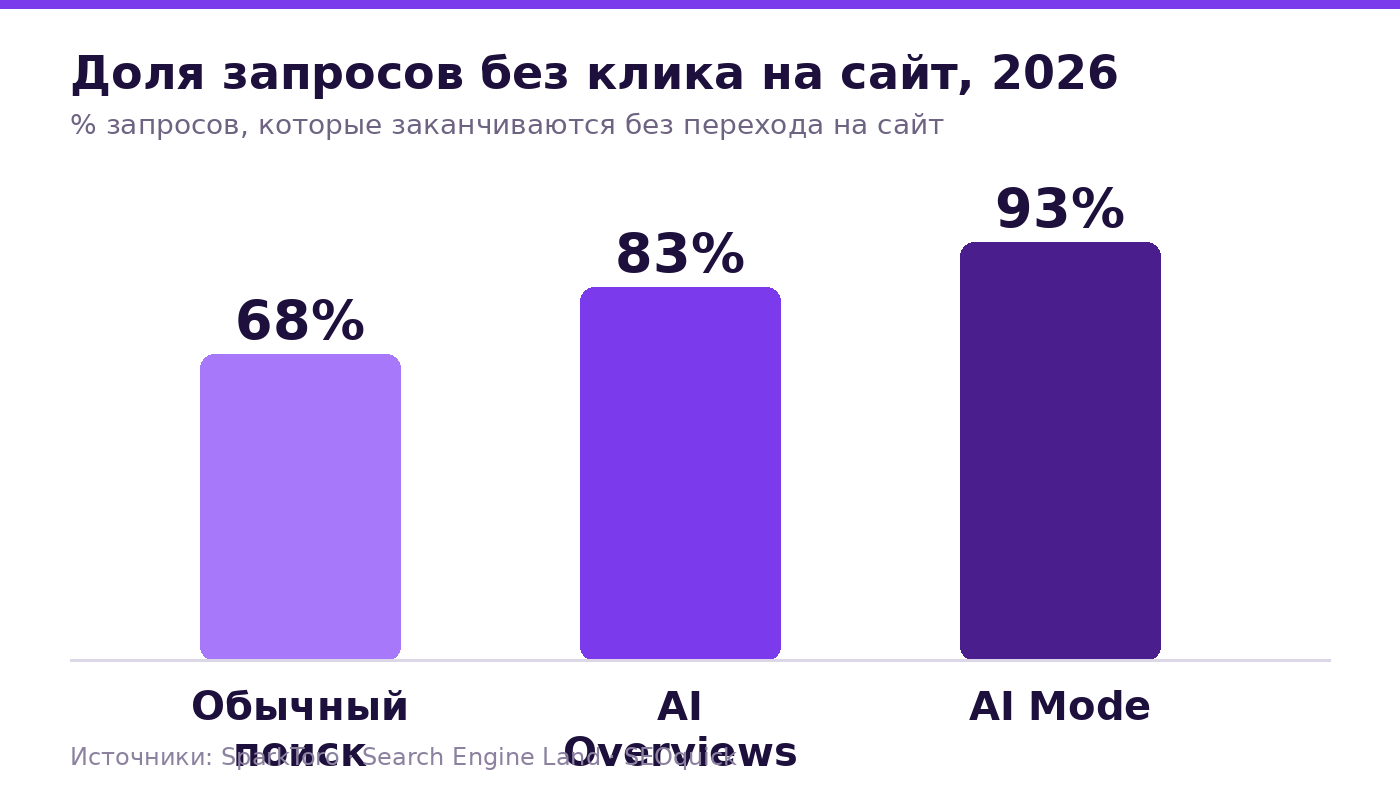
Because the answer satisfies the need right on the results page. According to SparkToro and Similarweb, in the first four months of 2026 about 68% of Google searches ended without a single click. And in AI Mode itself, per Search Engine Land estimates, up to 93% of queries end with no click — almost all traffic stays inside the answer.
You can see it on real projects too. Here is what I observe in clients' Search Console:
"CTR dropped to catastrophic numbers — from 4.5% down to one and a half percent on one of our Ukraine projects. And the average position holds high: we didn't fall in the rankings, the answer is intercepting the click."
— Nikolay Shmichkov, SEOquick
The conclusion is unpleasant but honest: the "position" metric has decoupled from the "traffic" metric. You can sit in the top 3 and still lose visits. That makes presence inside the answer itself, and brand strength, more important than ever. For more on the changing rules, see our 2026 SEO trends review.
How to get into Google AI Mode answers?
First, what Google itself says. In its official guide to optimizing for generative features (May 2026) Google states plainly: there are no special requirements, and no dedicated AI schema or llms.txt file is needed. You need the same SEO fundamentals plus the "extractability" of your answer — how easy it is to pull a ready chunk from your page. Search Engine Journal made the same point: AEO and GEO are "still SEO."
In practice it comes down to one principle I repeat in every breakdown:
"Someone else can write the content — but it has to look like you wrote it. Not rewrites and not generated articles, but content only you could have written. Generated articles don't make it into AI answers."
— Nikolay Shmichkov, SEOquick
Broken down into steps, here is the checklist:
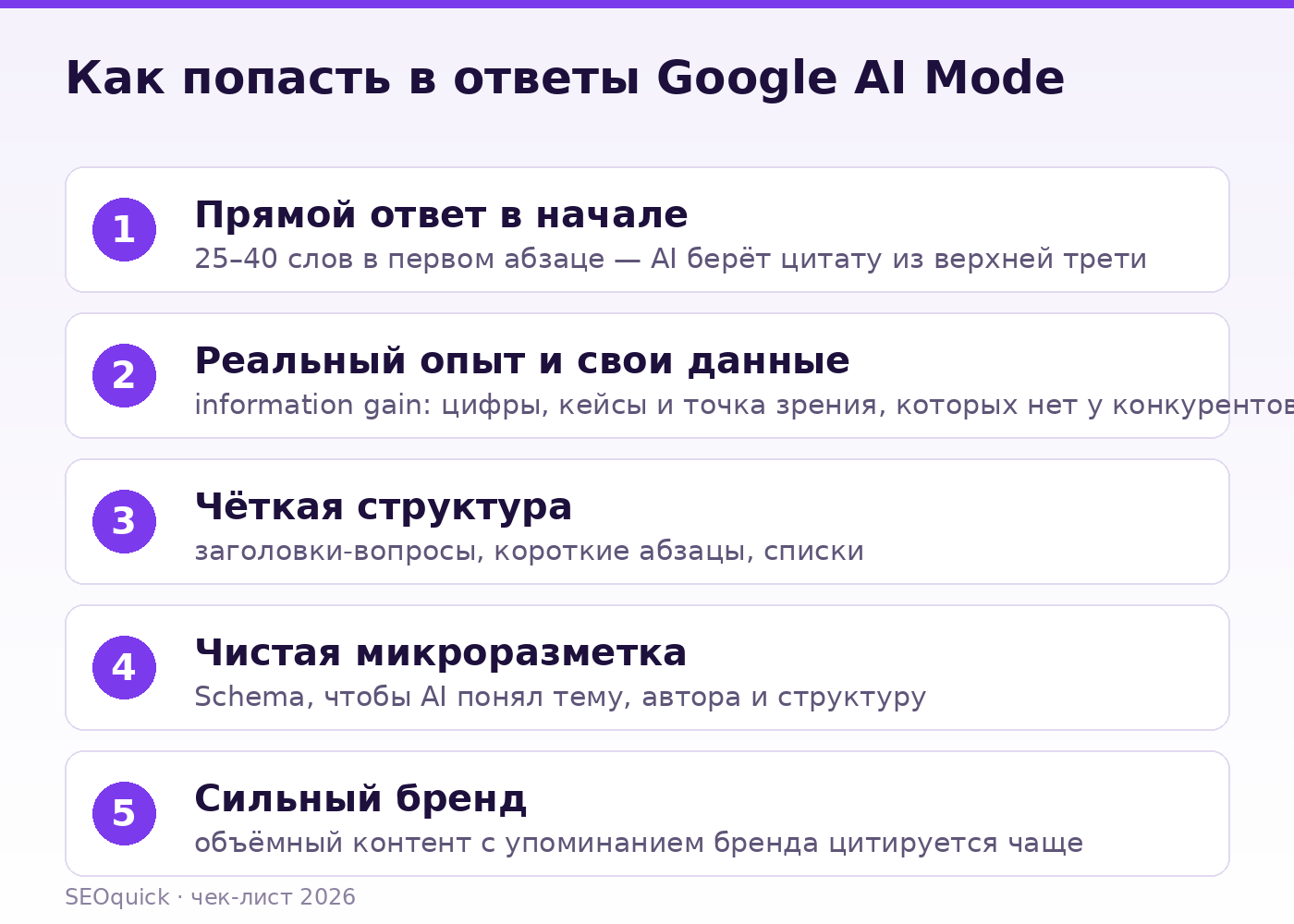
1. A direct answer up top. The first paragraph should answer the question in 25–40 words — AI pulls quotes from the top third of the text. If the answer is buried in the middle, it won't be found.
2. First-hand experience and a unique angle. Google prioritizes "information gain" — new data competitors don't have: your own numbers, cases, expert quotes. Studies show AI answers still pull 94–97% of sources from the organic top 20, but the entry bar is uniqueness.
3. A clear structure. Question-style headings, short paragraphs, lists. You can check structure in a minute: save the page code (Ctrl+S) and ask any AI to rate the headings, presence of short answers and schema.
4. Clean structured data. Schema helps AI understand what the page is about, who the author is and how it is structured. Validate it with a validator or a browser extension.
5. A strong brand. AI more often cites substantial content from known resources that mentions the brand. The brand signal has become a direct factor for getting into the answer.
What about FAQ schema in 2026?
One nuance that confused many people. As of May 7, 2026, Google stopped showing FAQ rich results in search, and the reports for them are being removed from Search Console. But that doesn't make FAQ blocks useless: Google confirmed it still uses FAQPage schema to understand page content — such pages are reportedly 3.2x more likely to appear in AI Overviews. So keep a visible FAQ block on the page (it helps both people and AI), but don't count on stars and accordions in the snippet anymore.
Where to start right now?
My main advice — don't put it off. The window of opportunity in the new format is open only briefly:
"If you aren't optimizing your content for AI yet — you might simply miss the train. I'd pause part of the current work and focus on repackaging content: tidy up commercial pages, clean the blog of clutter and run everything through the checklist."
— Nikolay Shmichkov, SEOquick
The practical minimum for the coming month: take 5–10 key commercial pages and top blog posts, add a direct answer at the top, reinforce them with your own data and cases, and check schema and structure. In parallel, connect the new Search Console AI search report (rolling out from June 2026) — it shows how pages perform specifically in AI Overviews and AI Mode.
Frequently asked questions about Google AI Mode
How is AI Mode different from AI Overviews?
AI Overviews is an AI block above the normal organic results on a standard results page. AI Mode is a separate tab-mode where there is no familiar organic listing: just a conversational answer and the sources beneath it.
Do I need special schema or llms.txt to appear in AI Mode?
No. Google officially stated that no special AI schema and no llms.txt file is required — the usual SEO fundamentals plus extractability and uniqueness of content are what matter.
Why are my positions stable but traffic is falling?
Because the AI Mode answer satisfies the need right on the results page. Up to 93% of AI Mode queries end without a click, so CTR drops even at high positions.
Do AI-generated articles get into AI Mode?
Usually not. Google doesn't treat templated AI content as a worthy source. Content with real experience, unique data and a recognizable brand wins.
Want your pages to appear in AI Mode answers? At SEOquick we run content audits: we find weak spots and repackage your cases and pages for the new search format. Read more breakdowns on the blog or get in touch — we'll review your site.
SEO Trends 2026: 10 Changes You Need to Prepare For Right Now
The key SEO trends of 2026: AI Overviews on 48% of queries, 68% zero-click, the rise of ChatGPT and Google AI Mode. What is changing in search and how to prepare your site — a breakdown by SEOquick.
Read →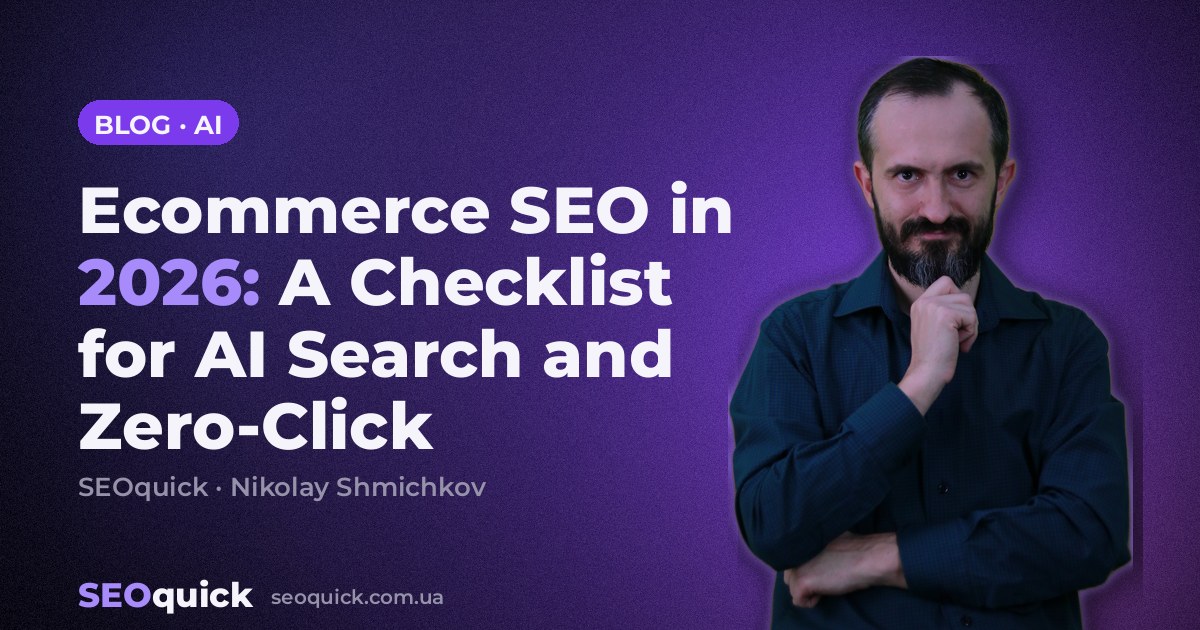
Ecommerce SEO in 2026: A Checklist for AI Search and Zero-Click
An ecommerce SEO checklist for 2026: a product feed tuned for AI Mode, Product schema, AI-citable product content, technical SEO for checkout and cart. A hands-on breakdown with real numbers from SEOquick.
Read →
Voice Search and SEO in 2026: How to Optimize Your Site for Voice and AI Assistants
How to optimize your site for voice search in 2026: conversational queries, local near-me intent, featured snippets, Schema, and Core Web Vitals. SEOquick practice over 18 years.
Read →Want to apply this to your site?
We will review the current situation, find the first growth levers, and suggest a practical working format.