How to Become an SEO Specialist from Scratch in 2026: SEOquick Guide
SEO specialists did not disappear when AI arrived — the skill set changed. A realistic path from zero: what to learn, where to practice, and what SEO pros earn in Ukraine and on Western projects in 2026.


Working in IT still pays well, and the demand for digital professions proves it. But search engine optimization has a catch: decent courses and learning materials are hard to find, and becoming a strong specialist takes serious self-education.
In 2026, a whole new layer was added to the classic skill set — working with AI. Google Search has changed more than in the previous ten years combined: AI Overviews and AI Mode appeared, and neural networks took over part of an SEO’s routine. This didn’t kill the profession — it raised the entry bar and, at the same time, opened a shortcut for newcomers: those who learn to work with AI tools from day one overtake the “old-timers” who ignore them.
To become an SEO specialist from scratch, learn how Google Search works, master the core tools (Search Console, GA4, Ahrefs or Serpstat, Screaming Frog), learn to build a keyword semantic core, run technical audits, and work with neural networks — then cement that knowledge on your own website or a small freelance project. With consistent study, reaching junior level is realistic in 4–6 months.
What an SEO specialist is and what they do
SEO (Search Engine Optimization) is the process of improving a website’s visibility in search engines to grow traffic and conversions.
An SEO specialist is someone who analyzes, optimizes, and promotes websites: they work with keywords, content, technical optimization, and the backlink profile. The job requires HTML and CSS basics, an understanding of ranking algorithms, and fluency with analytics tools like Google Analytics.
SEO specialists roughly fall into several categories:
- Junior SEO — beginners, usually newcomers looking for work at agencies or in-house, ready to take on any routine task — and there are plenty of those in this field.
- Middle SEO — juniors who have mastered one or several areas (technical audits, content, semantic core research, link building) and no longer need a constant mentor — an SEO lead is enough.
- Narrow specialists — those who do strictly one job. Link builders find websites and negotiate link placements. Data analysts work with Search Console and analytics. Content managers optimize content based on search engine guidelines.
- SEO Team Lead (the equivalent of a Senior among developers) — a team leader who either builds a team from scratch or joins an existing one.
Each category earns differently. This article is for those who want to become an SEO specialist from scratch and grow into senior roles.
How much an SEO specialist earns in Ukraine in 2026
A quick note for international readers: Work.ua is Ukraine’s largest general job board, and Djinni is the country’s main anonymous job platform for IT roles, mostly remote and English-speaking. Together they give a good picture of the market.
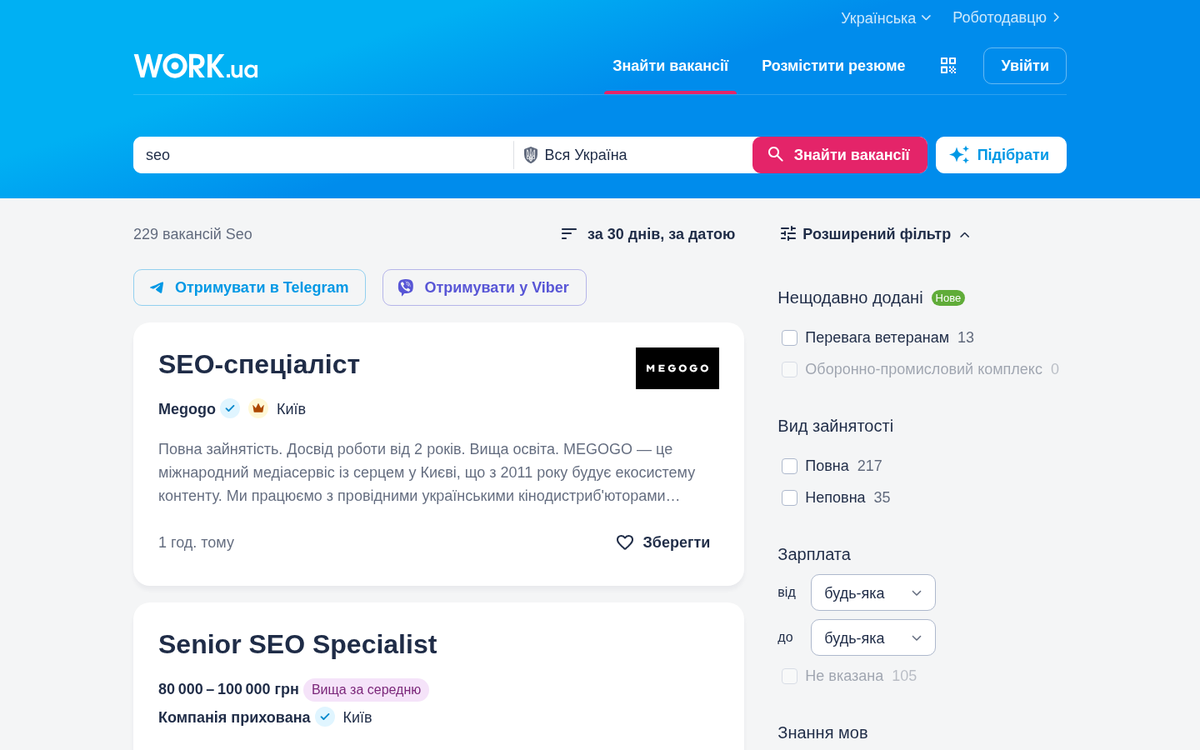
According to Work.ua (2026), the average SEO specialist salary in Ukraine is about UAH 35,000 per month (Ukrainian hryvnia — roughly $830), calculated across 253 vacancies over the last three months. In Kyiv the figure is higher — UAH 37,500 on average.
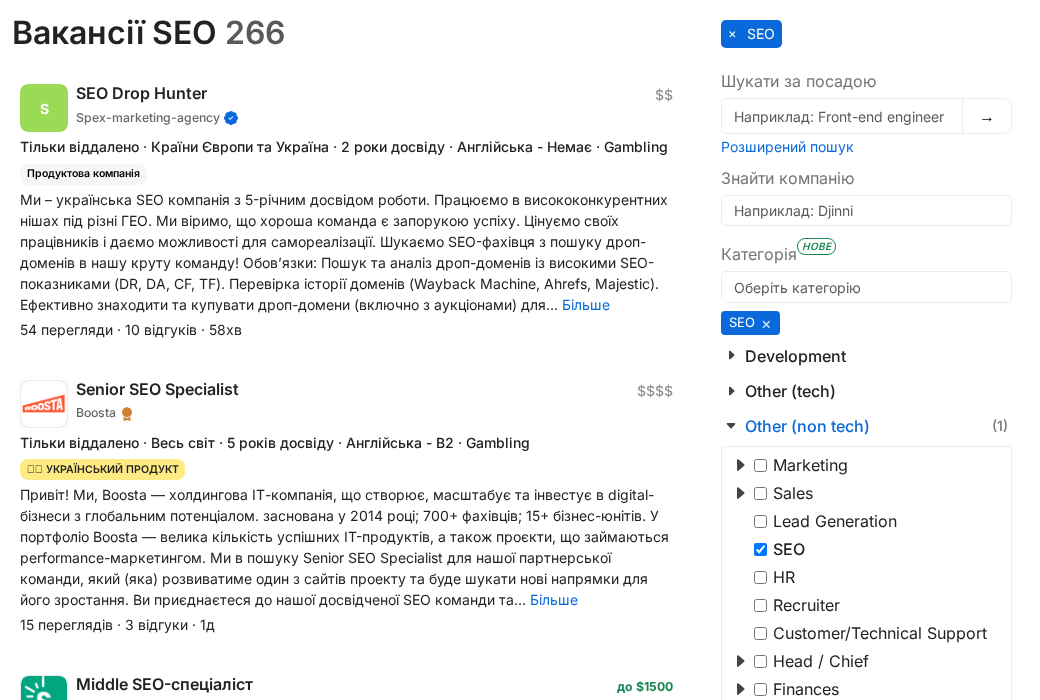
On Djinni, which aggregates mostly IT jobs with English and remote work, the picture is different: the median range in SEO vacancies is $1,000–2,000, with about 280 open positions in the SEO category at the same time. That’s a healthy demand indicator: the profession is not stagnating.
The spread by level, based on 2025 Ukrainian market overviews (InTime, Homester):
| Level | Monthly range |
|---|---|
| Junior (under 2 years of experience) | $400–800 |
| Middle | $800–1,500 |
| Senior / Team Lead | $1,500–3,000+ |
Two factors influence income the most:
- English. Specialists at Upper-Intermediate level and above who work with Western markets earn $1,500–3,000 — one and a half to two times more than on local projects.
- Remote work and English-speaking projects. Most high-paying SEO vacancies on Djinni are full remote for US and European markets. Geography is no longer a limit.
Is it hard to learn SEO
In theory — no. The learning materials in this field are well structured, and you can study them from scratch without knowing how to code.
The goal of your studies is to understand these fundamentals:
- How to build a semantic core (a structured keyword map).
- How to work with content: meta tags, structure, structured data markup.
- How to run a technical audit.
- How to do competitor analysis.
- How to perform a usability audit.
- The basics of link building.
- How to set up internal linking on a website.
- AI tool proficiency: prompting and using ChatGPT, Claude, and Gemini in everyday tasks.
Understanding HTML and CSS basics is a bonus — many terms overlap. You don’t need to go deep, just the fundamentals. Besides, ChatGPT can now write the code for you.
In practice, many people make mistakes and pick the wrong priorities, which leads to sad outcomes. So let’s go step by step.
Learning the SEO basics
First, you need to understand how search engines work. Start by studying how Google Search works. Figure out how Google crawls web pages with its bots, indexes their content in its database, and then serves the most relevant results based on the query and the user’s personal data.
Second, study — and memorize — the principles Google uses to consider websites useful and well optimized. There aren’t many of these factors; the details are in the official documentation:
- Links to your site on other resources. Other web pages should link to your site, preferably useful topical resources.
- Enough text. Page content and headings should not exist only as images or video.
- Regular updates. The site should stay current and contain fresh information.
- Content relevance. Update content to match the season, trends, and new offers.
- Complete information. Provide as much information as possible about the content, products, or services you offer.
- A structured website. Pages should have meaningful titles, and different topics, products, and services should live on separate pages.
Talking to candidates every day, I realized that 60% of applicants don’t know the basic facts covered in Google’s documentation. I consider studying it mandatory.
You will likely run into a huge number of terms. So the third step is learning the terminology — I recommend the Ahrefs SEO glossary. Among the top terms, pay special attention to structured data, redirects, HTTPS, responsive design, meta tags, robots, sitemap, site speed, and link types.
Ivan Paliy, SEOquick: Some experts will tell you: read Google’s documentation and do as it says. Others will claim the documentation exists to distract you from the real ranking factors. Where’s the truth? Hard to say — it isn’t even in the middle. What is definitely true: you need to start running your own experiments as fast as possible, with every variable you can influence — content, its structure, internal linking and anchors, external links, content updates, and dozens of other factors. Gradually you will build an understanding of what actually works. But remember: the algorithm is dynamic. If you managed to “hack” Google today, tomorrow it may punish your page or your site.
SEO theory
Once you have the basics, learn what makes an SEO specialist valuable: the ability to assemble knowledge into a single action plan and turn it into real tasks.
As a simple bridge, I made a video for beginners — it has a detailed table of contents and plenty of links to learning materials (in Russian):

For the theoretical foundation, I would stick to the big industry guides from well-known authors:
- Moz’s Beginner’s Guide to SEO
- The complete SEO guide by Ahrefs
- The SEO section on Search Engine Journal
- The Backlinko SEO tutorial — regularly updated, with a current 2026 version
- What is SEO by Neil Patel
- Content optimization for SEO by RankMath
There really is a lot of material here, and I would spread it over several months.
SEO specialist skills in the AI era
This is the most important new section of the guide. If you are entering the profession in 2026, AI skills are not a “bonus” — they are part of the baseline qualification. Let’s break down what exactly changed and what to learn.
What AI Overviews and AI Mode changed
Google now answers a significant share of queries by itself. AI Overviews (AI summaries above the results) and AI Mode (a full chat-style search experience) intercept clicks that used to go to websites.
The numbers speak for themselves. According to Pew Research Center (2025), when an AI summary is present, only 8% of users click a regular result — versus 15% when there is none. An Ahrefs study (2025) showed that an AI Overview cuts the CTR of the first organic position by 34.5%, and its updated late-2025 version recorded a drop of as much as 58%.
Does that mean SEO is dead? No. According to Seer Interactive (2025), sites cited inside an AI Overview get roughly 35% more organic clicks than those that aren’t cited. The battle has shifted: it used to be about rankings — now it’s also about being cited in AI answers.
GEO and AEO — the new disciplines to learn first
GEO (Generative Engine Optimization) is optimizing a website and a brand for generative engines: ChatGPT, Gemini, Perplexity, and Google’s AI Mode. The goal is to get neural networks to mention and cite you in their answers.
AEO (Answer Engine Optimization) is optimizing content for direct answers: clear definitions, self-contained paragraphs, FAQ blocks, and structured data that make a page easy to extract and quote.
Good news for a beginner: there are no “gurus with 20 years of experience” in GEO yet — everyone started learning at the same time, in 2024–2025. This is a rare window when a junior can compete with seasoned specialists on equal footing. What to master:
- Structuring content for answer extraction: a direct answer up front, definitions in the “X is…” format, numbered step lists.
- Schema.org structured data (FAQ, HowTo, Article, Organization) — it helps machines understand content.
- Monitoring brand visibility in AI answers — how to track mentions in ChatGPT, Perplexity, and AI Overviews.
- Working with E-E-A-T: author, experience, proof — generative engines are more willing to cite sources with obvious expertise.
SEOquick’s experience. GEO skills already convert into real results: in our dental clinic case study we brought the site to TOP-2 for the highly competitive “dentistry Kyiv” query, and its pages appear in Google’s AI answers for 26,714 queries — details in the medical website promotion case study. And the services website from another of our case studies gets leads directly from ChatGPT.
LLMs as a working tool: what neural networks do for an SEO
The second layer of skills is using neural networks themselves in your routine. ChatGPT, Claude, and Gemini already cover a noticeable share of daily tasks:
- Keyword research: clustering keywords, generating ideas to expand the semantic core, breaking down search intent.
- Content: copywriter briefs, meta tag drafts, FAQ blocks, checking text completeness against competitors.
- Analytics: upload a Search Console export — get conclusions about declining pages and growth points. What used to take 5 hours can realistically be compressed into minutes.
- Technical work: regular expressions, spreadsheet formulas, mini-scripts, robots.txt and .htaccess edits — LLMs write all of this faster than you can google it.
I broke down in detail how I build such AI workflows at the agency in my article on AI in SEO tasks, and collected ready-made prompt templates in 50 mega-prompts for ChatGPT and Gemini — for a beginner, this is the fastest way to learn prompting on real SEO tasks.
A fresh example of what this looks like in practice is in my video (in Russian):

The key skill here is not “knowing which button to press” but verifying the output. Neural networks hallucinate: they confidently invent numbers, sources, and “facts.” A specialist who blindly copies an LLM’s answer into a client report is unfit for the job. A specialist who can set the task, verify the output, and fine-tune it by hand is worth more than before the AI era.
Which skills protect you from being replaced
Neural networks take over the routine, but not the responsibility. Here is what will stay with humans for the foreseeable future:
- Strategy. Deciding where to take a project, which pages to create, and where to get links — AI can’t do that for you; it has no business context.
- Data interpretation. A machine can pull the numbers; understanding what they mean for a specific business and making the call is still human-only.
- Communication. Client negotiations, defending a strategy, working with developers and copywriters.
- Fact-checking and quality. The more generated content there is around, the more valuable the specialist who vouches for accuracy.
- Experiments. Algorithms change faster than the models’ training data. Your own tests are the only source of up-to-date knowledge.
The 2026 career formula is simple: SEO fundamentals + AI tools + English. Each of the three elements multiplies the value of the other two.
Mastering SEO tools
An SEO specialist without tools can do nothing — that’s a fact. The ability to find the information you need in them within seconds is a skill you must develop.
The basic set by category:
- Search Console — mandatory, and the first one to learn.
- Google Analytics — the best option for free website analytics.
- Keyword Planner — Google’s free keyword research tool.
- Ahrefs — great for studying competitors and backlinks.
- Serpstat — a good fit for Ukrainian-language and Eastern European projects.
- Semrush — an option for experienced users.
- AnswerThePublic — for researching question-based keywords.
- Screaming Frog — the best choice for finding technical issues on a site.
Separately — web services for everyday work:
- PageSpeed Insights — checks page speed issues.
- Structured data validator — finds problems in structured data.
Learning Google Tag Manager and Looker Studio (formerly Data Studio) is also useful — for setting up events and building reports.
You can also browse the huge collection of 275 SEO tools we’ve gathered on our website!
Start with Google’s video lesson series on Search Console. Then move on to Google Analytics — you need to understand everything about traffic and the basics of analyzing it.
Taras Gushcha, SEOquick: An SEO specialist must understand the following. How search engines and their algorithms work: ranking principles change from time to time, and a specialist must spot the changes quickly and adapt. Programming basics — HTTP, JavaScript, and PHP — and the specifics of popular CMS platforms. Analytics services: effective promotion is unrealistic without them, and a good specialist can work with paid and free services that go beyond Google Analytics and Search Console. And copywriting basics: ranking in search is largely about content, so you need to be able to write a proper brief for a copywriter and review the finished work.
The list could be much longer, but this is the necessary minimum to apply for an SEO specialist job. Some tools are quite expensive — explore their trials and free versions to understand how they work.
Practice on your own project
None of this will work unless you apply the knowledge in practice. You might land a junior job right away and get a project with tool access.
If not — build your own website. For example, on WordPress: deploy it on a hosting plan or assemble it with a website builder. Let it be an informational site about your hobby, whether that’s fishing or board games.
Write content according to the guidelines, build links, monitor site health, fix errors, pay attention to meta tags and structure. Watch your competitors and make your pages better than theirs. I optimized my personal blog and succeeded: one of the articles started ranking above Wikipedia.
The second way is freelance. Take on a very small project and work on it for the sake of a case study, even if the pay barely covers the tools. Get results and grow your portfolio: take screenshots from analytics and Search Console.
If you have to work with many contractors — learn to write task briefs properly. People will love you if your briefs and reports are clear on the first read.
And write case studies. On a personal blog, as LinkedIn articles — anywhere. Your case studies will help you immensely later. You can see formatting examples in mine:
- Medical website SEO case study
- Promoting a website on Google in the US
- Services website promotion
- Promoting a website built on a site builder
Level up your resume and LinkedIn
A resume with bare “work experience” is the most ordinary and least trustworthy kind. It may turn out you were just warming a chair at your last job (probably 70% of applicants were).
So work on your LinkedIn profile. Fill it out completely, list your skills (SEO, Google Analytics, GEO, working with AI tools), and back them up with proof: LinkedIn shut down Skill Assessments back in 2023, so what works now is public case studies, posts with project results, recommendations from colleagues and clients, and certificates — for example, the free Google Skillshop certifications in Analytics and Ads.
A profile with two or three well-presented case studies and genuine activity beats a profile with a dozen empty lines of “responsibilities” in interviews.
Follow the news firsthand
SEO news breaks fast, and it’s best to get it from primary sources, not from a translation of a translation.
Create an X (formerly Twitter) account and build a list of profiles: Google Search Central, John Mueller and Danny Sullivan from Google, Barry Schwartz (Search Engine Roundtable), and the Ahrefs and Semrush teams. The Lists feature lets you see posts only from the accounts you need — that way you’ll learn about updates faster than by digging through dozens of Telegram channels.
For tracking articles, Feedly works well: add the major SEO publications — Search Engine Journal, Search Engine Land, Search Engine Roundtable, the Ahrefs and Moz blogs — and read everything fresh in one place, like a newspaper.
Subscribe to SEO YouTube channels
I figured out long ago that video content is absorbed remarkably well. My selection of top search engine optimization channels:
- Ahrefs
- vidIQ
- Semrush
- Income School
- Ranking Academy
- Google Search Central
- Craig Campbell
- Moz
- Backlinko
- Neil Patel
- Matt Diggity
And of course, don’t forget to subscribe to our SEOquick channel — it already has almost 49,000 subscribers and a huge library of webinars and video lessons, including fresh breakdowns of GEO and AI search (content mainly in Russian and Ukrainian).
If video isn’t enough — listen to SEO podcasts: you’ll find our podcast “SEOquick — Shkola Reklamy” by name in any podcast app.
Learn new SEO methods
A huge problem for most candidates is not working with fresh information. SEO is not a clear-cut lesson with documentation — it’s a set of rules on top of which you have to figure out the strategy yourself.
Stick to a few simple rules:
- Learn which SEO methods no longer work. Don’t waste effort on them.
- Learn which methods are prohibited. You need not only to avoid them but also to understand how to fight them if they are used against you.
- Study fresh case studies. Watch how new brands and projects grow.
- Always look for the original source of news. After reading the original, you’ll understand the story differently than its retelling in local media.
- Learn to filter out methods that don’t work. If someone is pitching you the importance of PBNs, increasing keyword density, or optimizing the keywords tag — you’ve run into the wrong kind of speaker.
It’s important to follow the trends: every year we update our SEO guide and focus on the priority areas. You can also read my piece on how to get a site to the TOP-1 in Google.
Anatoliy and I have rejected an enormous number of candidates who didn’t know modern promotion methods. There is no room for faith in SEO — you have to verify facts and knowledge. Knowing the current trends will set you apart from the gray mass of candidates.
Discipline yourself
The time when someone forced you to study ended at school. Now everything depends on you alone.
Rule 1. Set aside 1 hour a day to learn something new. Use a calendar. Yes, it sounds banal, but block an hour for learning every day and jot down what you’ve learned and absorbed.
Rule 2. Write down important information. Memory comes in short-term and long-term forms. To avoid losing what you’ve learned, record it — in Google Docs, Notion, or a plain notebook.
Rule 3. Keep improving your English. Google is an American company, and all the news comes out there first. The language barrier is your barrier: it’s exactly what separates you from salaries one and a half to two times higher on Western projects.
By applying all the methods above, you won’t just pass an SEO specialist interview — you’ll be in the running for salaries of $2,000 a month and up. I try to collect materials in every format on the SEOquick blog — from podcasts and videos to articles and webinars — and update the content regularly to keep it current.
FAQ
How long does it take to become an SEO specialist from scratch?
With consistent study of one to two hours a day, you can realistically master the junior-level basics in 4–6 months: how search works, the tools, keyword research, simple audits. Reaching a confident middle level usually takes another year to a year and a half of practice on real projects. The main accelerator is your own website where you drill every skill.
Can you become an SEO specialist without a technical degree?
Yes. Programming isn’t required to start — a basic grasp of HTML and CSS, which takes a couple of weeks, is enough. Most junior tasks are keyword research, content, meta tags, and analytics. And neural networks now help write code snippets, formulas, and regular expressions — you just need to be able to verify the result.
How much does an SEO specialist earn in Ukraine?
According to Work.ua, Ukraine’s largest job board (2026), the average is about UAH 35,000 per month (roughly $830). Juniors start at $400–800, middles earn $800–1,500, seniors and team leads — $1,500–3,000 and up. On the IT job platform Djinni, the median range in SEO vacancies is $1,000–2,000. English and working with Western projects raise income by one and a half to two times.
Will artificial intelligence replace SEO specialists?
No, but it has already replaced part of the routine: clustering, text drafts, basic analytics. The value has shifted to strategy, data interpretation, fact-checking, and GEO — optimization for AI search. A specialist who masters neural networks works faster and earns more; a specialist who ignores them is genuinely at risk.
Where should I start learning SEO?
Start with Google’s official documentation for webmasters — how search works and what the requirements for websites are. Then master Search Console and Google Analytics, learn to build a semantic core, and run a basic audit. In parallel, create your own test website and practice every topic hands-on.

H1 vs Title: how many H1 tags you need and how they differ
H1 in SEO 2026: how many H1 headings are acceptable, optimal length, how it differs from title, empty H1 and H1 as an image. Based on a measurement of 77 pages from the Ukrainian top and data on how often Google replaces your title with the H1.
Read →
Pagination SEO: how to index list pages without breeding duplicates
Pagination SEO in 2026: canonicals on list pages, noindex, rel=next/prev, infinite scroll, crawl budget. Based on a check of 36,000 traffic-driving URLs across twelve Ukrainian retailers, plus a teardown of pagination at Foxtrot, Epicentr and our own blog.
Read →
URL Structure: The Full Guide to Addresses You Can't Change After Launch
How to get URLs right: transliteration or Cyrillic, slug length, duplicates from case and filters, pagination, UTM tags, redirect maps. A breakdown of Rozetka, Comfy, Prom and Makeup URLs plus 2026 research data.
Read →Want to apply this to your site?
We will review the current situation, find the first growth levers, and suggest a practical working format.