How to choose an SEO agency and not buy air
We are an SEO agency ourselves, so you won't find a list of «the best» here — that list always ends with the author in first place. Instead: a verification procedure. What to ask a vendor, where to check the answer, and which answer means you should walk away.


Short answer: the best agency is not the one ranked highest, it's the one that shows results on projects like yours and is willing to back every number with a tool, a period and an export. Check five things: cases with signed data, account access in your name, who specifically will work on your project, a plan for the first 90 days, and the exit terms. Everything else is detail.
This page is not built the way you expected. You came for a list and you're getting a method. Below I explain why, and why the list would have been useless to you.
What makes an agency «the best» for you specifically
«The best SEO agency» is a meaningless phrase until you say what job it's for. An agency that grows a 40,000-SKU online store can fail at promoting a single dental practice in one district: different mechanics, different signals, different work with maps and reviews. And the other way round.
So instead of asking «who is best», ask five other questions. They close about 80% of the risk in the first call.
Why we wrote this, being an agency ourselves
The honest disclosure first: we sell SEO. Any «top agencies» list we published would put us in it, and you'd be right to discount everything after that.
So we're doing the opposite. This article gives you the procedure we'd want a client to run on us. If a vendor can't pass it, that includes us — and you should walk.
The one external assessment we'll point at is UBA.top, built by the Serpstat team on site metrics, reviews and brand metrics. It publishes no prices at all, only scores — which makes it harder to game and easier to explain.
Who earns what in agency rankings
Before you trust any «top 10 SEO agencies» page, understand how those pages are funded.
Clutch states on its own rankings pages that it may earn a fee for some placements. DesignRush says certain placements are paid, and sorts its lists by Sponsored by default. That doesn't make either useless — both carry real reviews — but the order you see is not purely a quality ranking.
The sharper problem is catalogues publishing prices that the agencies themselves don't publish. Two examples you can verify in two minutes:
- Inweb. The IT-Rating catalogue card says «SEO Від: 850 $». On inweb.ua the pricing section says the price is formed individually. The figure 850 appears nowhere on the agency's own site.
- UAATEAM. Catalogue: «від 900 $». The agency's own FAQ: there is no fixed price list.

Where does a precise number in a catalogue come from, then? Maybe an old email, maybe a three-year-old price list, maybe someone's estimate. You can't check — no source is given.
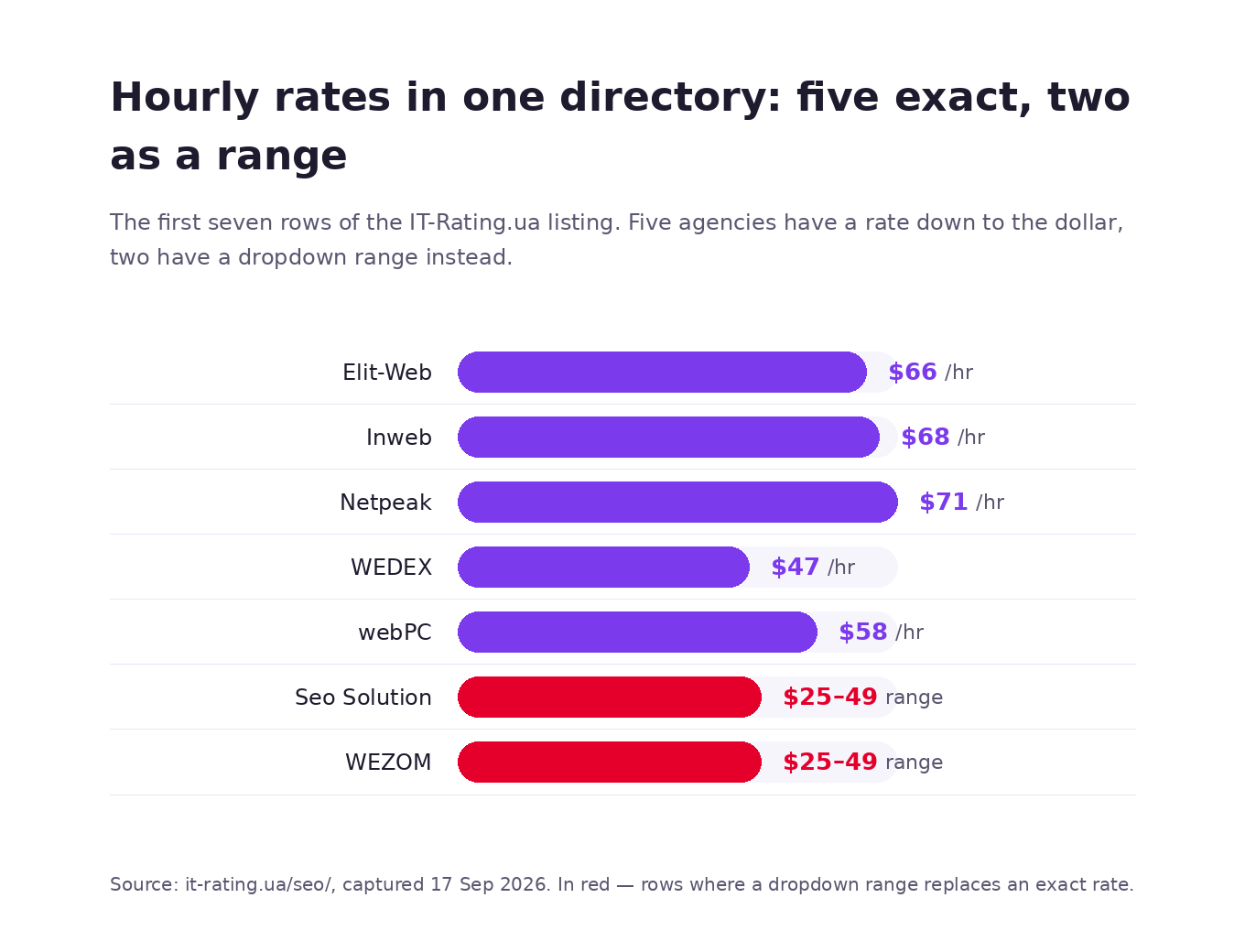
Practical rule: treat any price you didn't see on the agency's own site as hearsay. Ask for the number directly and ask where it's published.
Ten criteria and how to check each one
Each of these is a question plus a way to verify the answer. The verification is the part most buyers skip.
1. Cases on projects like yours
Ask: show me two cases in my vertical, with the numbers.
Verify: for every number, ask which tool it came from, over what period, and whether you can see the export. A case that says «traffic grew 300%» without a tool and a date range is a claim, not evidence.
Walk away if: the answer is «we can't show it, NDA» for every single client. Some NDAs are real; all of them being secret is not.
2. Accounts in your name
Ask: who will own the Search Console, analytics and Merchant Center properties.
The correct answer is you, with access granted to the agency. The reverse means that when you part ways, your historical data leaves with them — including the year of Search Console history that no tool can reconstruct afterwards.
Walk away if: the vendor wants to «set everything up on our side for convenience».
3. Who exactly works on your project
Ask: names and roles of the people on my account, and how much of their week I'm buying.
A common pattern is that a senior sells and a junior delivers. That's not automatically bad — juniors do good work under review — it's bad when it's not disclosed and there is no review.
Walk away if: you can't get names, or the answer changes between calls.
4. The first 90 days
Ask: what will be finished by day 30, day 60 and day 90.
Good answers are concrete: audit done, N pages rewritten, technical fixes shipped, a named list of what was found. Bad answers are «we'll start promotion».
Walk away if: the plan is identical to the one on their website. It means nobody looked at your site before quoting.
5. Who implements the fixes
Half of technical SEO work is changes in your templates. If nobody is assigned to implement them, you're paying for recommendations that sit in a queue. Make this explicit before signing.
6. How results are reported
Ask: what's in the monthly report and how deep does it go.
Rankings are an indicator, not a result. The report should reach traffic by section and, if you have ecommerce tracking, orders.
7. Link building approach
Ask: where do links come from, and can I see the last ten placements.
Real outreach produces named sites you can open. Open three of them and check whether anyone reads them: does the site have its own traffic, its own editorial, comments, a real author page. If the answer is vague about sources, assume a network.
Walk away if: the vendor refuses to name a single placement.
8. Content: who writes and who checks
Ask: who writes the texts, and who verifies facts in a regulated niche.
In medicine, finance and law the second half of that question is the important one. Ask specifically who signs off on factual claims, and what happens if your own expert disagrees with a draft.
9. What happens if a core update hits
Ask: tell me about a project that dropped after an algorithm update and what you did.
Anyone who's worked for several years has one. An agency where «everything always works» is either very new or not telling you everything.
10. Exit terms
Ask: how much notice, what stays with me, who hands over access and in what form.
People read this clause last and need it more often than they expect.
What a number you can trust looks like
Three lines have to sit under any figure: the tool, the database, and the period. Without them the number proves nothing — not because the agency is lying, but because you can't check it.
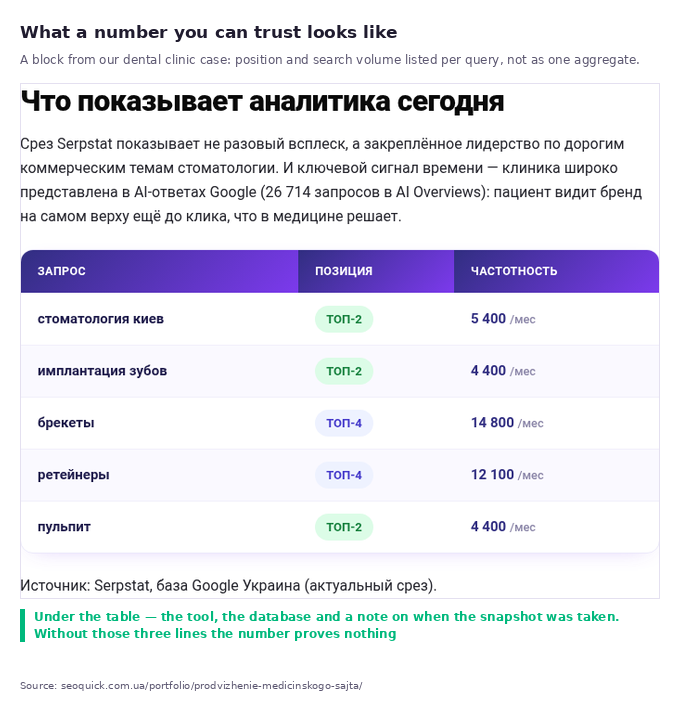
Our own cases are published that way on purpose, so you can hold us to the same rule: «Serpstat, Google Ukraine database» with the date of the snapshot, «Ahrefs and Serpstat, July 2023 — July 2024», «organic search and Ahrefs, March–October 2023».
What SEO actually includes in 2026
The scope has widened, and vendors mean different things by the same word.
- Technical: crawling, indexing, speed, templates, canonicals, structured data.
- Content: semantics, page structure, texts, updates to existing pages.
- Links and brand signals: outreach, mentions, reviews.
- Answer engines: being present in AI answers, not only in the ten blue links.
How to check a vendor really does answer-engine work
Ask: show me a query where a client of yours is cited in an AI answer, and tell me how you measure it.
A vendor doing this seriously will name the tool they track it in and show a before/after. A vendor who isn't will talk about it in general terms only.
Agency, boutique, freelancer or in-house
| Format | Strength | Weak spot |
|---|---|---|
| Full-service agency | Fixes what it finds; no second vendor needed | More expensive; focus spread across services |
| Specialist boutique | Depth in one area | Usually won't take development — fixes still queue on your side |
| In-house plus consultant | Cheaper long term, product knowledge inside | Speed limited by your own team |
| Freelancer | Price | No bench; a large catalogue doesn't fit one person |
Choose by your bottleneck, not by who is «best overall».
Hiring an agency in another country
Most «how to choose an SEO agency» articles assume the vendor is down the road from you. Increasingly they aren't, and the offshore option is usually the reason the price differs by a factor of three. Five things to settle before that becomes a problem.
Who exactly are you contracting with
Ask: what legal entity signs, in what country is it registered, and can you send the registration number.
The answer should be a specific company you can look up in a public register, not a brand name. If the entity is in a different country from where the team sits, ask why — there are legitimate reasons, but you want to hear them before signing rather than after a dispute.
How you pay and what the invoice looks like
Ask: what currency, what payment rail, and what does the invoice say the service is.
This matters more than it sounds. A wire that your finance team can't categorise creates friction every single month. Ask for a sample invoice with the first proposal, not after the first payment is due.
Timezone overlap, in hours
Ask: how many hours a day do our working days actually overlap, and who is reachable in that window.
Four hours of overlap is workable. One hour means every question costs you a day. This is the single most common reason offshore engagements feel slow, and it is entirely predictable in advance.
Who writes in your language
Ask: who writes the English content — a native speaker, a translator, or a model?
All three answers can be fine, but they produce different results and different prices. What you don't want is finding out from a client that your category pages read as translated. Ask for two published samples in your language and read them yourself.
Data protection and access
Ask: where is our data stored, who on your side has access to our analytics, and what happens to it when we part.
If you're in the EU or serving EU users, get the data-processing terms in writing at the start — retrofitting them is much harder.
What doesn't actually matter
Two things buyers worry about that rarely turn out to be the problem: the agency's country per se, and whether the team is in an office. What predicts outcomes is the overlap window, the clarity of reporting and whether fixes get implemented — none of which correlates with geography.
What it costs and what you're paying for
We ask vendors for pricing transparency, so here's ours first.
| Format | Monthly budget | Fits |
|---|---|---|
| Start | about $500 | Small site, one niche, no critical technical debt |
| Business | about $800 | Mid-size project, several directions, competitive niche |
| Premium | about $1,300 | Large catalogue, high competition, several regions or languages |
Important detail that usually goes unexplained: this is a budget, not a different set of services. The work is the same across tiers — technical, pages, texts, links, management. What changes is volume: how many pages and links per month. A bigger budget buys more done in the same month, not secret methods.
Hourly work runs $15 to $50 per hour depending on who does it. Reviewing an export is one level of skill; strategy for a 40,000-SKU catalogue, or diagnosing a drop after an update, is another.
If you have no developer and no content manager, buying SEO alone makes little sense — there's nobody to implement it. In that case we take development, content and promotion together, from $1,000 to $5,000 per month depending on scope.
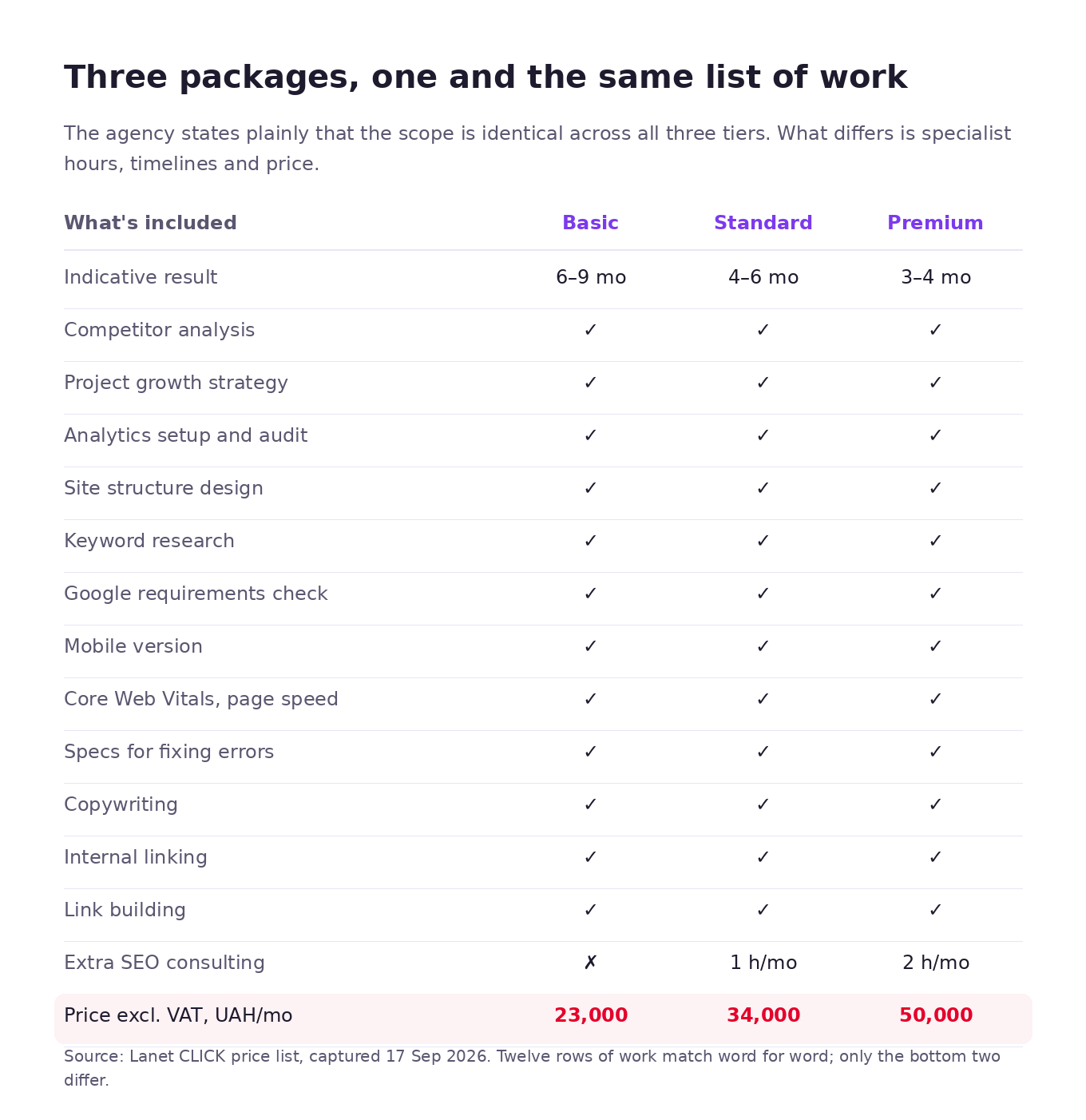
What the market publishes
| Source | What it publishes |
|---|---|
| Clutch, Ukrainian SEO directory | Minimum project $1,000+; hourly $25–49 |
| Ahrefs, survey of 439 SEO providers | Average retainer $2,917/mo; average hourly $98.90 |
| Searchbloom, US | $2,000–10,000 per month |
| IT-Rating.ua | Entry from 8,000 UAH/mo for small sites; 150,000+ UAH/mo for large stores; hourly $30–73 |
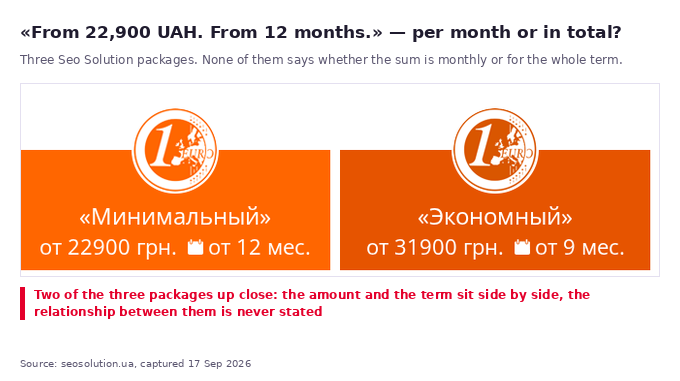
Note the spread in that last row: from 8,000 to 150,000+ UAH a month, one country, one year, one service. Any «market average» computed across that range describes nothing. If a vendor quotes you one, ask what sample it's from.
And yes — our Start at $500 sits below Clutch's $1,000 floor and well below the $2,917 average retainer. That's not a boast. It means a smaller volume of work, and if your site needs more, you should buy more rather than expect premium outcomes on entry budget.
The first 30, 90 and 180 days
Days 1–30. Audit, access, semantics, a prioritised fix list. Usually no growth yet, and that's correct.
Days 31–90. Technical fixes shipped, first pages rewritten, structure changes started. First movement on low-competition queries.
Days 91–180. Content at volume, links, measurable traffic change. This is where you judge whether it's working.
If someone promises growth in month one on a site that needs cleanup first, they either haven't looked at your site or they're telling you what you want to hear.
The contract: what decides everything at the end
- Notice period — and whether it's symmetric.
- What stays with you — texts, semantics, technical specs, link list.
- Handover of access — in what form and within what timeframe.
- Who owns content produced during the engagement.
- What is explicitly NOT included — ask for that list. A serious vendor produces it in a minute.
Red flags
- Guaranteed positions by a fixed date. Nobody controls the algorithm — we wrote about this separately in guarantees in SEO.
- A price quoted before anyone looked at your site.
- Case numbers with no tool and no period.
- Accounts registered to the agency.
- No answer to «what didn't work out».
- A ranking list where the author is first.
Where we sit in this picture
Since we're asking for honesty from the market, here's ours.
We have failures. There are problem niches where we got nowhere. There are projects where we could not outbid competitors in paid search — yes, those exist. Mistakes got corrected over long engagements, and after ten mistakes one success would come along that covered them. That's not a website-friendly sentence; it's how long-term work actually goes.
A vendor for whom everything always works is either in their second year or not telling you everything.
Building a shortlist in one evening
- Write down your one bottleneck: no strategy, nobody to implement, no content, or no data.
- Take three vendors whose published cases match your type of project.
- Send all three the same five questions from the top of this article.
- Compare the answers, not the presentations.
- Ask each one for the list of what is not included.
Frequently asked questions
Can I pay for results instead of work?
Such offers exist — read how «result» is defined. If it's «top 10 for a list of queries», the list is usually built from queries you nearly rank for already.
How long before SEO pays for itself?
It depends on your own arithmetic: average order value, conversion rate and margin against the monthly budget. By our cases, meaningful growth starts from six months. If someone tells you three, ask which case that happened on and with what dates.
Agency or in-house specialist?
In-house is cheaper long term if you have enough work for full-time employment, and more expensive if you don't — you pay for idle time and they work without a second opinion.
How do I check a case is real?
Ask for the tool, the database and the period, then ask whether anything in it can be cross-checked against public data. Positions and visibility usually can.
What to do next
- Run the ten checks above on whoever you're considering — including us.
- If the question is specifically about an online store's budget, we broke the money down separately in what ecommerce SEO costs.
- Want a number for your own site — book a call: we'll look at it and say which band it falls into and why.
- Or start from the data: our site audit tool is free and shows where the obvious problems are.
One last thing. Whatever price you're quoted, ask for the list of what it does not include. That single question saves more money than any other.

What ecommerce SEO costs in 2026 and what you pay for
Why the same question gets answered with $300 and $3,000, what actually drives the price, what agencies publish on their own sites, the five costs that are never in the quote, and how to work out whether it pays back on your catalogue.
Read →
What is a digital agency and how to choose one in 2026
Types of digital agencies, services, red flags, questions to ask, KPIs, SEO, Ads, UX, AI, analytics, and selection criteria.
Read →
SEO Guarantees in 2026: Do They Exist and What an Agency Really Guarantees
Can you guarantee a top ranking in SEO in 2026? We explain why a 'ranking guarantee' is a red flag, what an honest agency actually guarantees, and how to choose a contractor.
Read →Want to apply this to your site?
We will review the current situation, find the first growth levers, and suggest a practical working format.