B2B SEO in 2026: 9 Specifics of Lead-Focused Search Promotion
B2B promotion in 2026 is not about traffic for its own sake. It is about leads and getting onto the shortlist before the first contact with sales. Here are 9 specifics of SEO for a business that sells to businesses.

B2B SEO in 2026 is a long game played for lead generation, not a race for raw traffic. The average B2B sales cycle has stretched to 11.3 months, and roughly 70% of that time the buyer spends in anonymous research — reading, comparing, and building a shortlist before ever talking to your rep. The job of SEO is to land on that shortlist, and in the answers of AI search engines, ahead of competitors. Below are 9 specifics that set B2B site promotion apart from familiar B2C.
The ways you interact with traffic in B2C (business to consumer) and B2B (business to business) differ sharply. There are important nuances in site structure, in building the semantic core, in SEO optimization, and in content for decision makers.
According to B2B buying research, the vendor a buyer favors before ever speaking to a seller wins the deal roughly 80% of the time. That is exactly why early-stage organic visibility is your competitive edge.

Need B2B leads from search? SEOquick will bring targeted organic traffic!
SEO is your long-term, predictable source of leads from Google and Bing — and now from AI search as well.
We will run lead-focused promotion: intent content, solution pages, technical optimization, GEO, and link building.
Our SEO is white-hat, and the goal is your pipeline, not empty visits. That is exactly what you need, right?
1. What kind of site a "business for business" needs
A business-card site, a landing page, or a multi-page corporate website? For B2B the answer is almost always the same.
A business-card site covers the bare minimum: who you are, contacts, a couple of services. For SEO it is nearly useless — too few pages and too narrow a query coverage.
A landing page is a single-page site for paid traffic. It works great alongside contextual advertising, but it barely ranks organically: one keyword group and a risk of over-optimization.
A multi-page corporate website is your format. In B2B, spontaneous purchases are practically ruled out: the decision path is long, and it will not end with a single visit.
It is important to understand: a B2B site is built not for the mass user but for decision makers. Among them and those who influence the choice there are usually:
- the business owner (in a startup or a small company);
- the company director or a department head — chief engineer, head of procurement, IT lead;
- top managers and financial ratifiers who approve the budget;
- specialist "champions" who look for a specific tool for their work and bring it to management.
In the modern buying model, the biggest decisions are made inside the buying committee in more than 80% of cases before a seller even enters the scene. So your site must give a relevant answer to every link in that chain — and that takes plenty of pages.
Beyond the homepage and the "About", "Team", and "Contacts" pages, a B2B site almost always needs sections for each service and segment, an expert blog, case studies, industry sub-pages, and an FAQ. The more fully you cover your audience's real questions, the more entry points you get from search and AI answers — and the higher the chance you are found at the early, still-anonymous research stage.
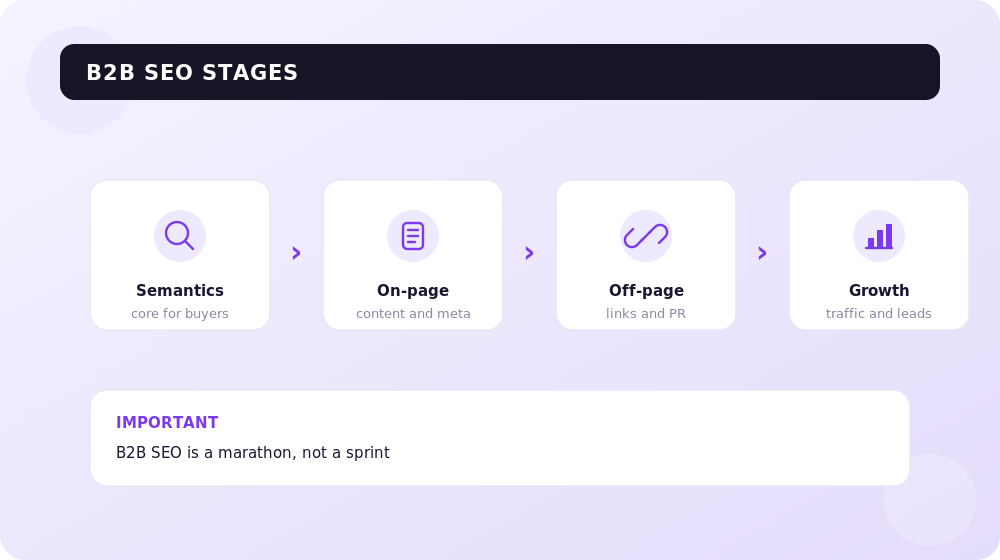
2. A long sales cycle changes the whole strategy
The average B2B sales cycle is about 11.3 months, and the buying journey is estimated to stretch to 272 days and 88 touchpoints. This means your content should not "hard-sell" on the first visit.
Build content for every funnel stage:
- Top of funnel — educational articles answering audience questions: "how to choose", "what is the difference", "what to keep in mind".
- Middle — comparisons, guides, ROI calculations, case studies, and industry benchmarks.
- Bottom of funnel — solution pages, pricing, "request a demo", "get a proposal".
72% of B2B buyers study at least three pieces of content before deciding. Your task is to be present in each of those touchpoints, not only on the final page.
3. Intent matters more than volume: semantics for solutions
In B2B, a high-volume head term with thousands of impressions often loses to a narrow query with clear commercial intent. 91.8% of all searches are long-tail, and they convert about 2.5 times better than short phrases.
That is why the semantic core for B2B is built not "by volume" but by intent:
- problem queries from decision makers;
- queries like "[solution] for [industry]", "[category] provider", "[technology] implementation";
- comparisons "X vs Y" and "alternative to [competitor]";
- transactional ones: "price", "demo", "integration", "wholesale".
Review the core quarterly — in 2026 buyer behavior and phrasing change too fast for an "once a year" approach.
4. Solution pages and technical content
In B2B the buyer evaluates not a "product" but how your solution closes their specific task. So the backbone of the structure is solution pages and technical content:
- a dedicated page for each solution / use case;
- technical specs, integration diagrams, implementation requirements;
- case studies and success stories that handle typical objections;
- a catalog with categories and cards — for better query matching;
- a suppliers/brands page if you are a dealer.
Make it possible to request a proposal, book a demo, or contact sales in one click from any solution page. The bottom of the funnel is queries like "price", "demo", "[solution] provider", and exactly these pages bring the hottest leads.
Technical content also builds trust: an engineer or IT director who sees detailed specs and an integration diagram understands that you speak their language. That removes half the objections before the sales conversation and speeds up sign-off inside the buying committee.
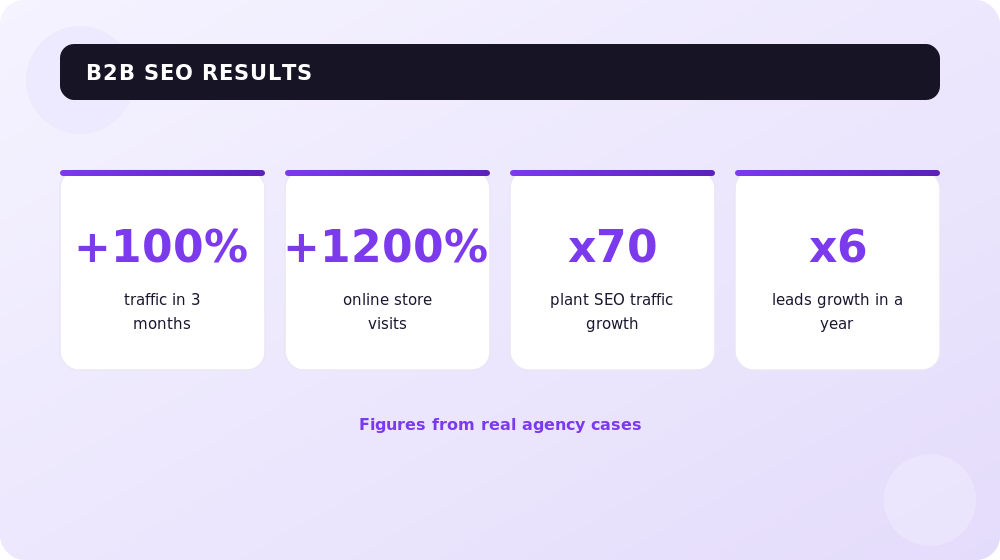
5. GEO: AI-search visibility for B2B
In 2026 a significant share of B2B research starts not with a blue link but with an AI answer — in Google AI Overviews, ChatGPT, Perplexity. A discipline called GEO (Generative Engine Optimization) has emerged — optimizing to be cited inside AI answers rather than to be clicked in the results.
This is critical for B2B: when a buyer reaches you via a link in an AI answer, they have already been "told" you fit their task. What raises the chance of being cited:
- clear, extractable answers at the top of pages (a "question to a short answer" format);
- structured data: Schema markup improves discoverability for LLMs by roughly 67%;
- expertise, numbers, and sources — high "entity density";
- brand presence across many platforms and content freshness.
The numbers speak for themselves: 92% of marketers plan to optimize for AI search, but only about 40.6% actually do — the window for early movers is still open, and well-executed GEO can lift AI visibility by up to 40%. Our own expertise helps here too: we build AI tools for next-generation search tasks.
6. ABM + SEO and intent data
Account-Based Marketing (ABM) and SEO work as a pair in 2026. Intent data shows which companies are "in-market" right now — searching for your solution. Businesses that use intent signals shorten the sales cycle by about 30%.
How to tie this to SEO:
- analyze which queries bring target accounts and strengthen exactly those pages;
- create content for the specific industries and segments on your ABM list;
- track intent spikes and quickly publish relevant material;
- hand marketing qualification to sales while interest is still hot.
7. LinkedIn, reputation, and "dark social"
A large part of B2B research happens off your site — on LinkedIn, in industry communities, chats, and personal recommendations. This is "dark social": touchpoints that classic analytics cannot see.
According to Forrester, around 78% of B2B leads are connected to LinkedIn in some way, and personal profiles get 5–10 times more organic reach than company pages. What to do:
- publish expertise from people, not just the brand;
- strengthen E-E-A-T: authored articles, reviews, case studies, mentions;
- work on reputation on review sites and in communities — 77% of buyers read reviews before deciding, and more than half talk to existing customers before buying.
SEO does not exist in a vacuum here: brand mentions, expert publications, and community discussions create the very "trust signals" that lift both search positions and citation frequency in AI answers. The more often your brand appears on quality platforms, the more confidently both search engines and language models "know" it.
8. Measure leads, not traffic
The main mistake in B2B SEO is reporting by traffic. In 2026 the metrics are different: qualified leads, pipeline contribution, and closed revenue.
Why organic deserves it: SEO leads close into deals at about 14.6% versus 1.7% for outbound, and the cost of an SEO lead is one of the lowest — around $31. What to measure:
- organic leads and their movement MQL to SQL to deal;
- organic contribution to pipeline and revenue;
- visibility in AI answers (mention rate), not just positions.
Imperfect pipeline data beats perfect traffic data every time.
9. Entering foreign markets
Many B2B companies grow by exporting services and products. This calls for a separate strategy: English-language SEO with localized semantics, hreflang, correct structure, and content for the habits of Western decision makers. It is not a word-for-word translation but a separate product for a different market and a different search intent.
Frequently asked questions about B2B SEO
How is B2B SEO different from B2C?
A long sales cycle, a buying committee instead of a single buyer, a focus on intent and solution pages, and measurement in leads and pipeline rather than traffic.
How long does it take to see results?
Given a sales cycle of ~11.3 months, the first content-driven leads appear in 3–6 months, and a stable pipeline usually after 6–12 months of systematic work.
What is GEO and why does B2B need it?
GEO is optimization to be cited in AI answers. For B2B it is a way to make the shortlist at the anonymous research stage, when the buyer asks an AI which solution fits them.
Which keywords should you collect for a B2B site?
Intent-oriented ones: decision makers' problem queries, "[solution] for [industry]", "X vs Y" comparisons, transactional "price/demo/provider". Long-tail converts about 2.5 times better.
Is it worth investing in LinkedIn if the focus is SEO?
Yes. Around 78% of B2B leads are linked to LinkedIn, and much of the research happens in "dark social". SEO and LinkedIn reinforce each other, building trust before the first contact.
How do you prove the value of B2B SEO to management?
With reports in business metrics: organic MQL/SQL, contribution to pipeline and revenue, cost per lead (~$31 for SEO), and conversion into deals (~14.6%).
SEO for a B2B site is a tool with almost inexhaustible potential — as long as you work for leads and visibility at the right moment rather than for traffic. In 2026 the winner is the one the buyer finds and trusts before the first call.

H1 vs Title: how many H1 tags you need and how they differ
H1 in SEO 2026: how many H1 headings are acceptable, optimal length, how it differs from title, empty H1 and H1 as an image. Based on a measurement of 77 pages from the Ukrainian top and data on how often Google replaces your title with the H1.
Read →
Pagination SEO: how to index list pages without breeding duplicates
Pagination SEO in 2026: canonicals on list pages, noindex, rel=next/prev, infinite scroll, crawl budget. Based on a check of 36,000 traffic-driving URLs across twelve Ukrainian retailers, plus a teardown of pagination at Foxtrot, Epicentr and our own blog.
Read →
URL Structure: The Full Guide to Addresses You Can't Change After Launch
How to get URLs right: transliteration or Cyrillic, slug length, duplicates from case and filters, pagination, UTM tags, redirect maps. A breakdown of Rozetka, Comfy, Prom and Makeup URLs plus 2026 research data.
Read →Want to apply this to your site?
We will review the current situation, find the first growth levers, and suggest a practical working format.