Keyword Density in 2026: Why the «Perfect Percentage» Is a Myth
There is no perfect keyword density percentage. Here is what density actually measures and what to replace this metric with in 2026.


I will look at your site and answer your questions on the topic of this article. 30 minutes, no slide decks, no pressure.
Book a consultationShort answer: there is no «ideal» keyword density, and in 2026 chasing a specific percentage is a waste of time. Google stopped ranking pages by how many times a phrase repeats long ago. NLP-based algorithms (BERT, MUM) and AI search (AI Overviews, ChatGPT Search, Perplexity) judge how fully your text answers the query, not how often the keyword appears. So the right goal is naturalness, topic completeness, and entities — and «spamminess» should be read as a signal of editorial balance, not a KPI.
If you have ever worked as a copywriter, you have probably heard a brief asking you to «reduce spamminess» or «keep density under 3». That used to affect rankings. But search engines have moved from lexical search (matching words) to semantic search (understanding meaning) — and the old formulas are obsolete.
What does your competitor have that you don't yet? Right — traffic. SEOquick to the rescue!
We will bring tons of traffic to your site through SEO.
We do it with white-hat methods only, with no Google filters or penalties.
We run deep optimization: strengthen content, grow links and reputation. And it all works out!
What keyword density and text spamminess are
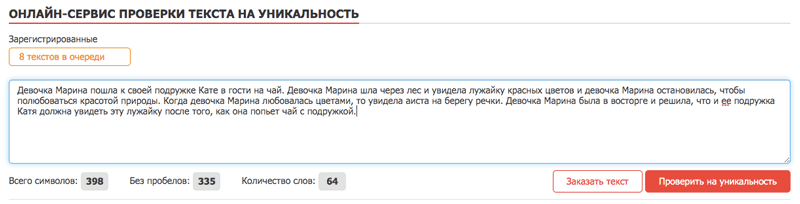
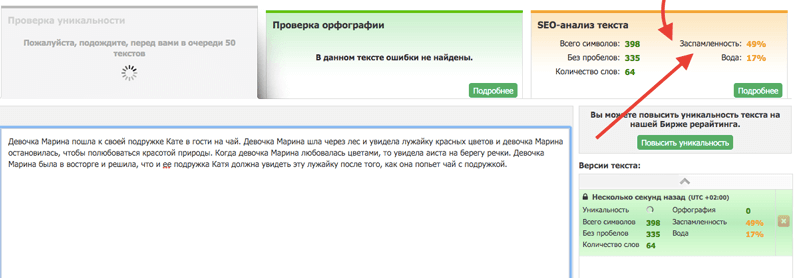
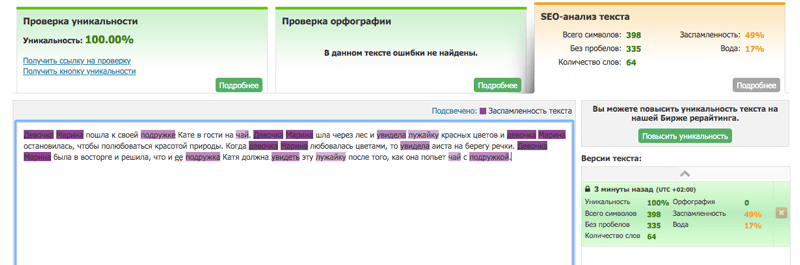
Keyword density is the share of repetitions of a specific word or phrase relative to the total text length. A close concept is «text spamminess» — the frequency of repetitions. Historically two metrics were used:
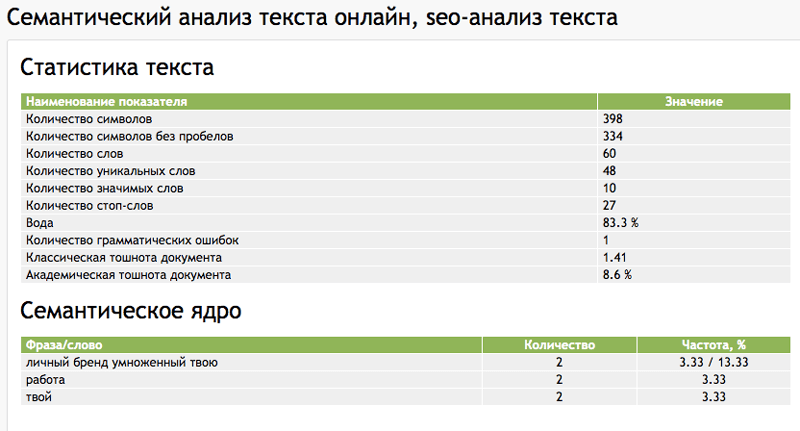
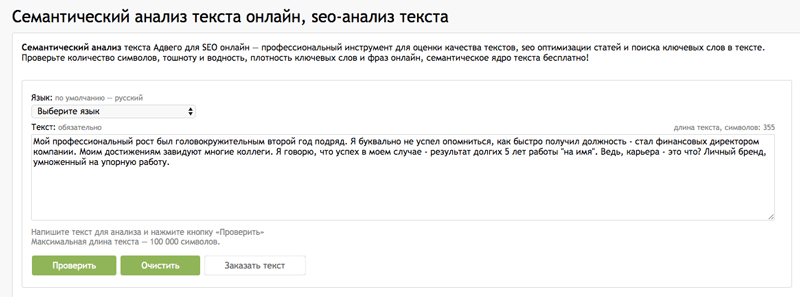
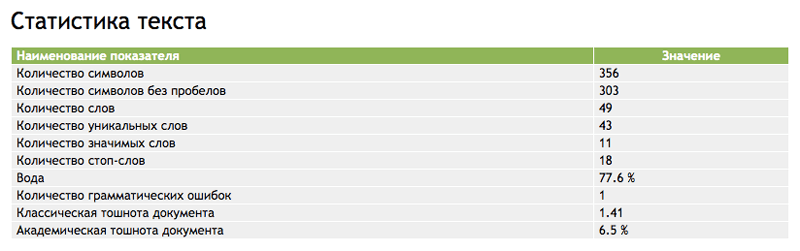
- Classic spamminess — the square root of the number of repetitions of the most frequent word. If a keyword appears 25 times, it equals 5, and the text length is ignored.
- Academic spamminess — the ratio of repetitions to the total number of words, as a percentage. 25 repetitions in 341 words give roughly 13%.
The problem with these metrics is that they are mechanical. They count words but know nothing about meaning. A text with «perfect» spamminess can be useless, while a living article with natural frequency can answer the user's query 100%.
Today experts agree there is no «magic» percentage. If you do need a benchmark, natural keyword frequency usually falls within 0.5–2.5% on its own, without forcing the text. But that is a result of good writing, not a target to bend every paragraph toward.
Why over-optimization hurts instead of helping
Google explicitly lists keyword stuffing among spam practices in its Spam Policies. This covers not only query repetition in the body, but also lists of cities and services with no value, stuffing in alt, meta and anchors, and hidden text. For this, a page can be demoted algorithmically or hit with a manual action.
In parallel, the helpful content system evaluates whether content was created for people or to manipulate rankings. Text written «for a keyword percentage» almost always looks unnatural — and algorithms read that.
Why does frequency get inflated at all? There are several reasons:
- Too much length on a narrow topic. When there is nothing more to say, fluff and repetition fill the gap. Better to cut the text but keep it informative.
- Not understanding the topic. If the author has not dug into the subject, they recycle the same phrasings. The fix is to study the topic deeper and add facts and examples.
- Trying to cram every keyword into a short text. 30 keywords in 3,000 characters will almost certainly cause over-optimization. In 15,000 characters the same 30 words dissolve naturally.
And if you have no fresh and interesting ideas at all and had to borrow something from other authors, then specially for you here is our unique video «How to fool a plagiarism checker».
Modern search understands not words but entities — people, brands, places, concepts — and measures their «salience»: how central they are to the text. So instead of 15 repeats of «buy sneakers», a cluster of entities works: brand, material, sole type, size chart, use cases. That is semantic SEO.
What to use instead of chasing density: 5 working tactics for 2026
Instead of asking «what is my keyword percentage?», ask a different question: «does my text fully answer the user's query?». Here are five tactics that work today.
1. Build a semantic core and topic clusters. A semantic core is not a list of keywords to stuff, but a map of meanings and subtopics. If you write about search engine promotion, cover adjacent questions: indexation, links, content, analytics. This gives the depth that makes Google and AI systems cite the page.
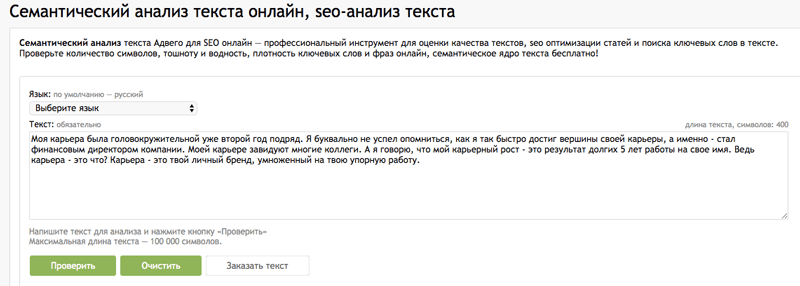
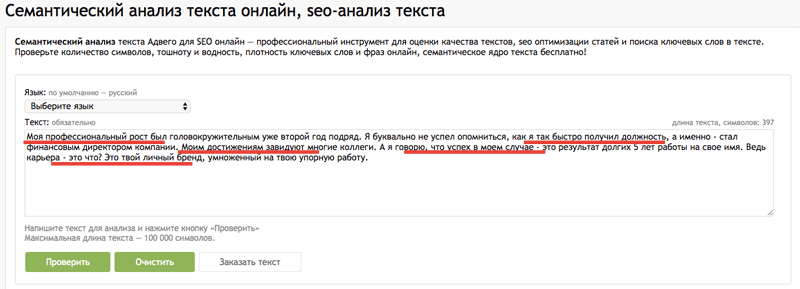
2. Use synonyms and entities, not repetition. If the word «career» appears too often, replace it with close meanings: «professional path», «growth», «development». Academic spamminess drops naturally and the text gets richer. That is exactly what Google's NLP models like.
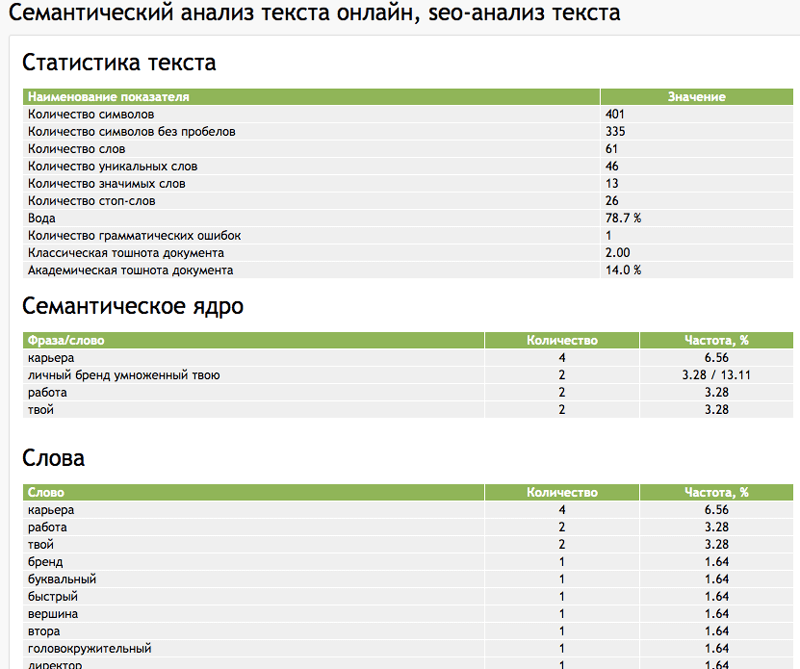
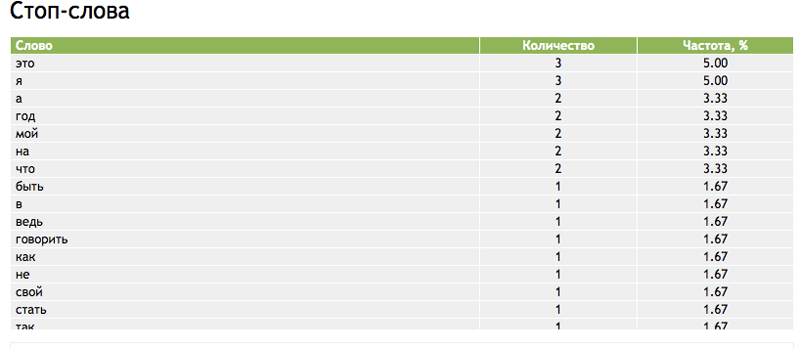
3. Trim stop words and fluff. Prepositions, pronouns, and empty phrases carry no meaning and inflate length. Removing «noise» raises information density — and that is precisely the signal valued by readers and by LLMs when they select passages for an AI answer.
4. Add experience and examples (E-E-A-T). The best way to «dilute» keywords naturally is to tell a case from practice. Concrete experience, numbers, screenshots, mistakes, and takeaways are signals of expertise and trust that cannot be faked by stuffing. AI search cites pages with real data and clear structure more willingly.
5. Rely on content score, not density. Modern platforms evaluate topic coverage completeness, not the percentage of a single keyword. Surfer SEO gives a 0–100 score and a list of relevant terms and entities; Clearscope gives an A–F grade for topic depth. These tools tell you which meanings to add, not how many times to repeat a keyword.
Recommended reading:
Keyword density and AI search: what changed
In 2026 a notable share of traffic goes to AI Overviews, ChatGPT Search, and Perplexity. These systems do not react to keyword density at all. They work with passages: they pull the specific fragment that answers the question most precisely. So content with clear structure, direct answers, question-style headings, and facts wins.
Practical takeaway: if you want to appear in AI answers, give a clear answer in the first paragraph of a section, split the text into meaningful blocks, and back up claims with data. We cover the tools for this in our AI tools section. Keyword stuffing here is not just useless — it lowers your chance of being cited because it breaks the naturalness of the passage.
FAQ: common questions about keyword density
What is the ideal keyword density in 2026?
There is no ideal number. Google does not rank by repetition percentage. If a keyword is used naturally, its share usually falls within 0.5–2.5% on its own — but that is a result of good text, not a goal.
Does text spamminess affect rankings in Google?
Not directly. Algorithms evaluate how completely you answer the query, plus entities and usefulness. But very high spamminess signals over-optimization, which violates Google's spam policies and risks a demotion.
What is keyword stuffing and why is it dangerous?
It is stuffing a text with keywords to manipulate rankings. Google treats it as spam: the page can be demoted algorithmically or hit with a manual action.
Do LSI keywords exist?
There is no LSI technology in Google's algorithm — Google confirmed this itself. «LSI keywords» usually means topically related terms and entities. Using them is useful, but not as magic — as a way to cover the topic more fully.
How do you measure text quality instead of density?
By topic coverage completeness and intent relevance. Content-score platforms help here — Surfer SEO, Clearscope, Semrush, Ahrefs. They show which meanings and entities to add, not how many times to repeat a keyword.
How do you write to appear in AI Overviews?
Give a direct answer at the start of a section, structure the text around questions, and add facts and examples. LLMs pull specific passages — clarity and completeness win, not keyword frequency.
Conclusion
Keyword density has gone from a goal to a side metric. In 2026 the winner is not who guessed the «perfect percentage», but who answered the user's query fully and naturally. Build semantics and clusters, lean on entities, add experience and examples, trim the noise — and let spamminess drop on its own as a by-product of good text. It is far better to write a deep, useful piece than a character-by-character text with no meaning or value for the reader.
Text Spam Level in 2026: Over-Optimization, Keyword Density and Google Penalties
What text spamminess and keyword density mean, whether chasing a perfect percentage risks Google penalties in 2026, how to check over-optimization and write natural, relevant content for people and AI.
Read →
SEO for Service Websites: A Real SEOquick Case Study and the 2026 Strategy
How to promote a service website in 2026: keyword structure, thin content, links, the Local Pack, and AI search. A real SEOquick case with a 10x organic traffic increase.
Read →
Why rewriting does not work in 2026: uniqueness ≠ value
Rewriting, synonymizing and spinning no longer deliver SEO results. We explain why text uniqueness is not the same as value, how Google penalizes scaled content, and what to do instead of rewriting.
Read →Want to apply this to your site?
We will review the current situation, find the first growth levers, and suggest a practical working format.