Link building: what a backlink actually costs
I checked 19 Ukrainian price lists. Eight name a price per link, two name their selection thresholds, and five answer the question of what is left after the vendor walks away. And separately — why you cannot trust the numbers in marketplace listings.


I will look at your site and answer your questions on the topic of this article. 30 minutes, no slide decks, no pressure.
Book a consultationShort answer: on the Ukrainian market, the word “link” is used to sell products whose prices differ by a factor of 170 — from $0.67 for a forum post to $114 for an article on a high-trust site. That makes “how much does a link cost” the wrong question. There are three right ones: what exactly am I buying, how do I check a publisher before I pay, and how much of my budget actually reached the publisher versus how much stayed with the vendor. Of the 19 price lists I checked, 8 name a price per link, 2 name numeric selection thresholds, and 5 say what happens to the links once the work ends.
This is not a review of link building tactics, and it is not an article about links being important. It is a breakdown of what you are paying for when you sign off on the “off-page optimization” line in a quote, and how to check that there is something behind that line.
Conflict of interest up front, because there will be a lot of our own numbers below. We sell SEO, and links are part of our promotion package. There is one link to our partners’ marketplace in this article — it is a referral link, and we get paid for sign-ups. I will flag it right where it sits. And separately: everything I describe below about vetting publishers, you can do yourself, without us and without paying anyone — the tools for it are free.
What I checked and how
Three sources, all pulled by hand on October 7, 2026.
Nineteen Ukrainian price lists — link building service pages at agencies and marketplace catalogs. I looked at the same things on each one: do they name a price at all, do they name a price per link, do they disclose the list of publishers before payment, do they state selection thresholds as numbers, what do they promise, and what do they say about the fate of the links after the work ends. I took only what was written on the page that day, with a link. Hryvnia figures are converted at the NBU rate for October 7 — 44.9453 per dollar.
My own sample of publishers. I have two marketplace catalogs on hand — “business and marketing” and “SEO and technology” — 1,453 unique sites together. I ran them through my own filters and through SE Ranking, and the result surprised even me. It is in the middle of this article, and it is the most useful part of the piece.
Google’s documentation — the primary sources, not someone else’s retelling. That matters: half of what gets written about paid links in SEO blogs does not match what Google says on its own pages.
What people actually sell under the word “link”
When a client gets a quote with a line reading “20 links per month,” they assume they bought twenty identical things. In reality those are five different products, and the gap between them is not measured in percentages.
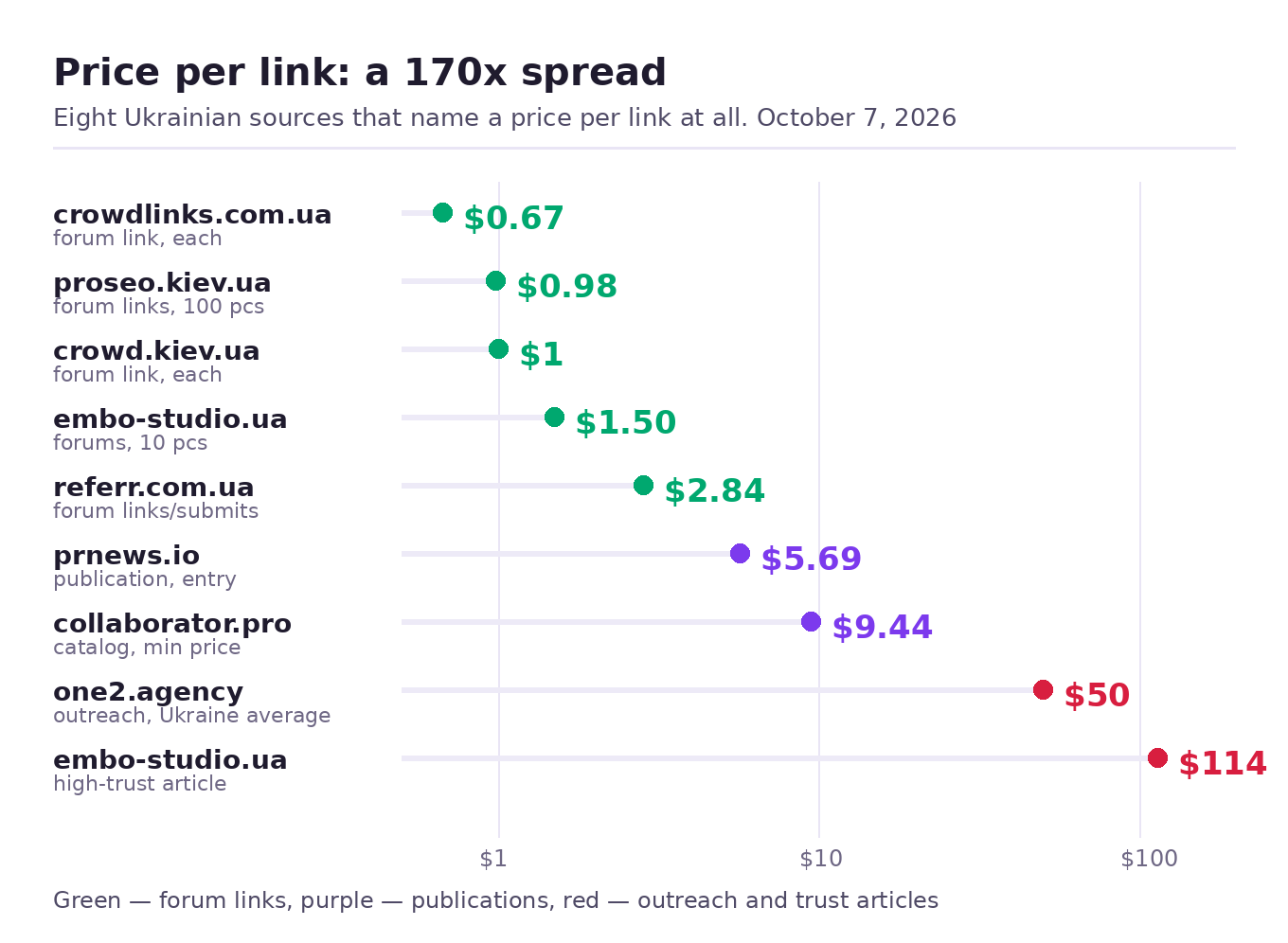
Forum links — a post on a forum or in comments. The cheapest thing on the market: UAH 30–65 apiece, under a dollar and a half. You usually do not pick the site, and the link sits in someone else’s thread among others just like it.
Submissions and directories — registering a site in listings. UAH 65–100 per placement. This is not link building, it is hygiene: it makes sense for a local business, so the name, address, and phone match across databases, and it makes almost no sense as a source of ranking credit.
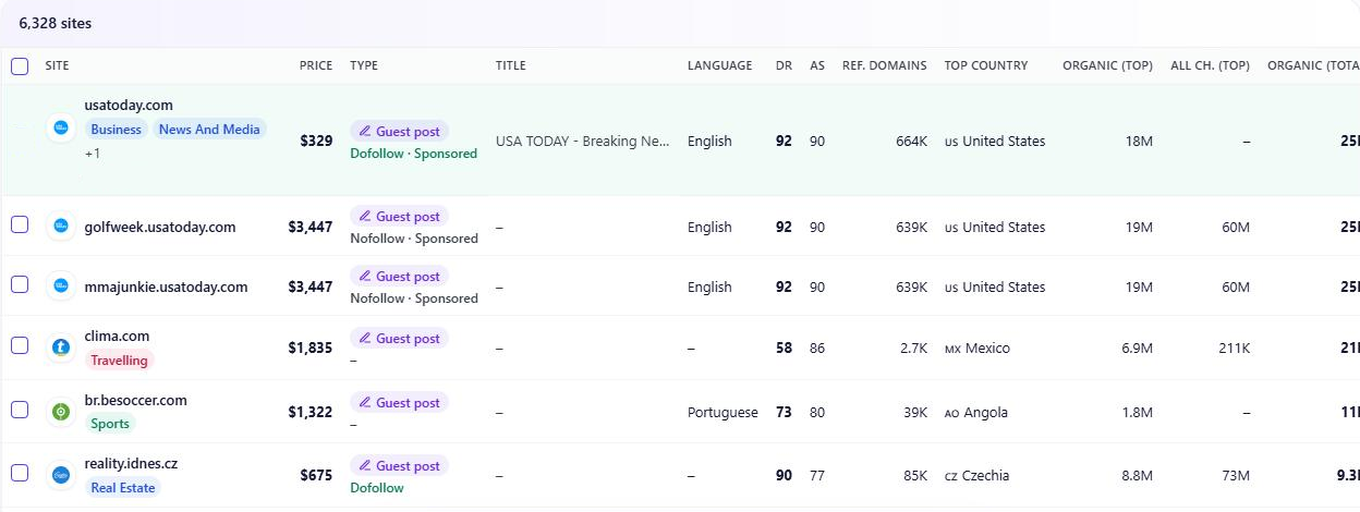
A guest post through a marketplace. You order an article on a site from the catalog, you see its metrics, and you pay for the placement. In the Ukrainian marketplace catalog I looked at, prices in the SEO vertical run from $9.44 to $90.91 per publication.
Outreach — direct correspondence with the site. You find a site that genuinely needs your material, find the editor’s email, write, and negotiate. It is the most time-expensive approach and the least predictable: half the emails go unanswered.
A PR placement — publication in the media. That is its own story with its own rules, and it usually lands in an SEO quote by mistake.
| What you are buying | Market price | What you end up with |
|---|---|---|
| Forum links — a post on a forum | UAH 30–65 ($0.67–1.45) | a link in someone else’s thread, you do not pick the site |
| Submissions and directories | UAH 65–100 ($1.45–2.22) | an entry in a listing, almost no ranking credit |
| Guest post through a marketplace | $9.44–90.91 per placement | your own article on a site with visible metrics |
| Outreach — direct correspondence | $50–150 per link in Ukraine | a placement you cannot get through a marketplace |
| High-trust editorial link | up to $114 apiece | a placement on a site with a real audience |
The spread inside a single sample is 170x: $0.67 for a forum post against $114 for an article on a high-trust site. So when a quote says “link” and the price is not broken out by type, you do not know what you are buying.
What it costs on the Ukrainian market
I went through nineteen sources and recorded everything they say about themselves. Here is the picture.
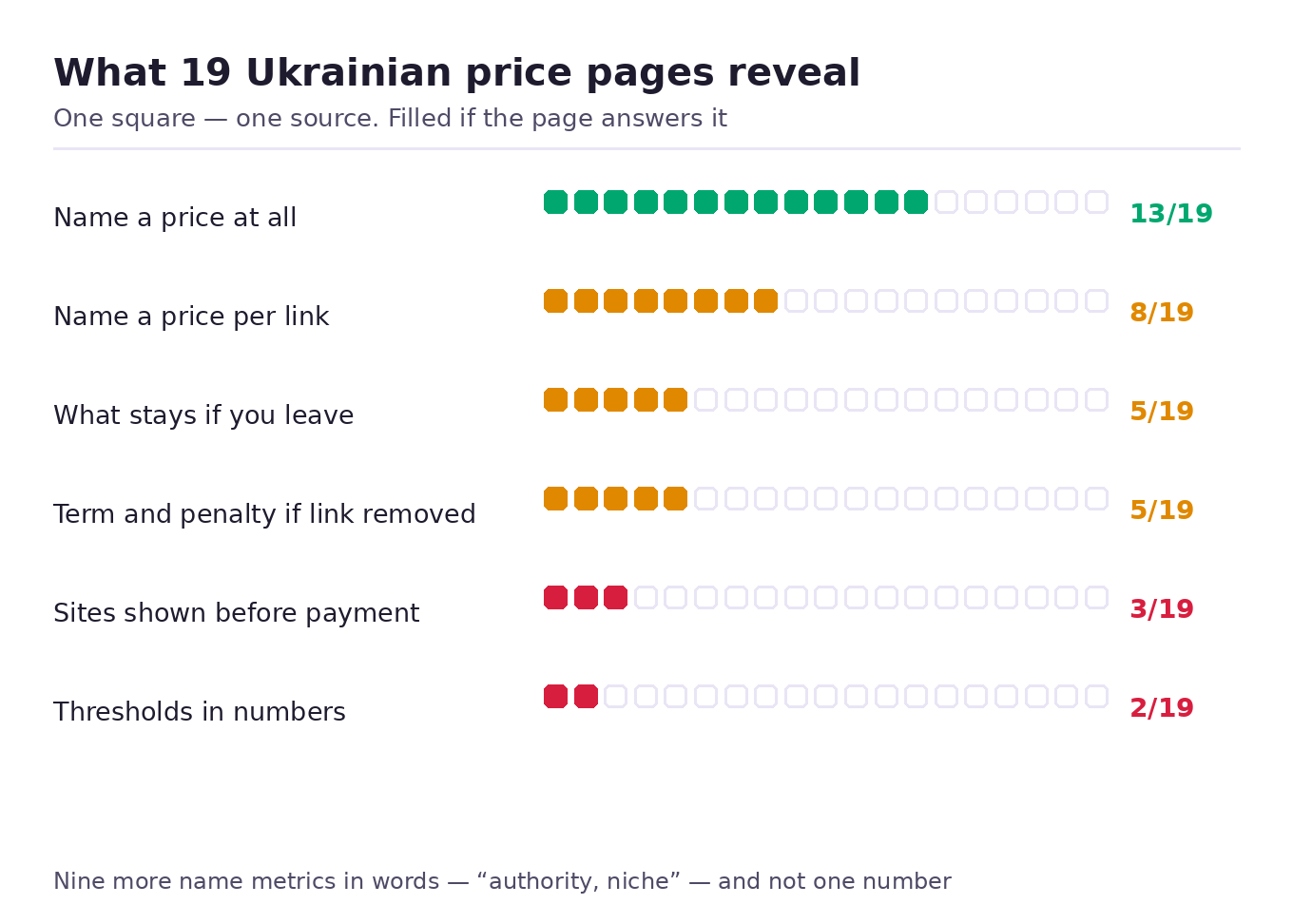
13 of 19 name a price at all. Six name none: they invite you to submit a request and promise to work it out. Among them are agencies with a dedicated “how link building pricing is calculated” block listing eight factors — and not a single number.
8 of 19 name a price per link. The rest work in monthly budgets. Monthly figures range from UAH 9,000 (about $200) to UAH 65,000 (about $1,446).
One find amused me enough to call out separately. One large agency has four pricing blocks on its page — UAH 30,000, 35,000, 40,000, and 60,000, by project type. And nowhere on the page does it say what period that money covers. A month? The whole project? One cycle of work? The page does not answer, and those are not small sums.
| What the client asks | Answer | Silence |
|---|---|---|
| What does it cost at all | 13 of 19 | 6 |
| What does one link cost | 8 of 19 | 11 |
| Will you show me the publishers before I pay | 3 of 19 | 16 |
| What thresholds do you select by | 2 of 19 | 17 |
| What is left after you leave | 5 of 19 | 14 |
| What happens if a link gets removed | 5 of 19 | 14 |
The most important row here is the fourth. Two of nineteen state their publisher selection thresholds as numbers. One writes “donor sites with DR above 10,” the other “average site DR above 30, indexation above 92 percent.” Nine more sources list metrics in words: “we account for the authority of the resource, topical relevance, traffic.” That reads nicely and means nothing: every site on earth fits that description.
And the second important row is the fifth. Five answer the question of whose links these are once we part ways. Fourteen stay silent, including both of the most visible agencies in the sample. Meanwhile one market participant writes outright on its own page that link building “more often uses rented links.” So the answer to that question exists, it just is not given.
Guarantees turned out unexpectedly well. Only five use the word “guarantee” — but all five name both a timeframe and a remedy: we will replace it, restore it, refund you. The timeframes diverge by a factor of a hundred, though: from 7 days to 2 years. Two more deliberately refuse the word, and I consider that an honest position: one agency writes plainly that it “promises no miracles in a day.”
What Google says — word for word
Here we need to clear up the market’s central confusion. Most texts about link building are built one of two ways: either “you must not buy links, you will get banned,” or “everybody buys them, do not worry.” Both claims are imprecise, and Google puts it differently.
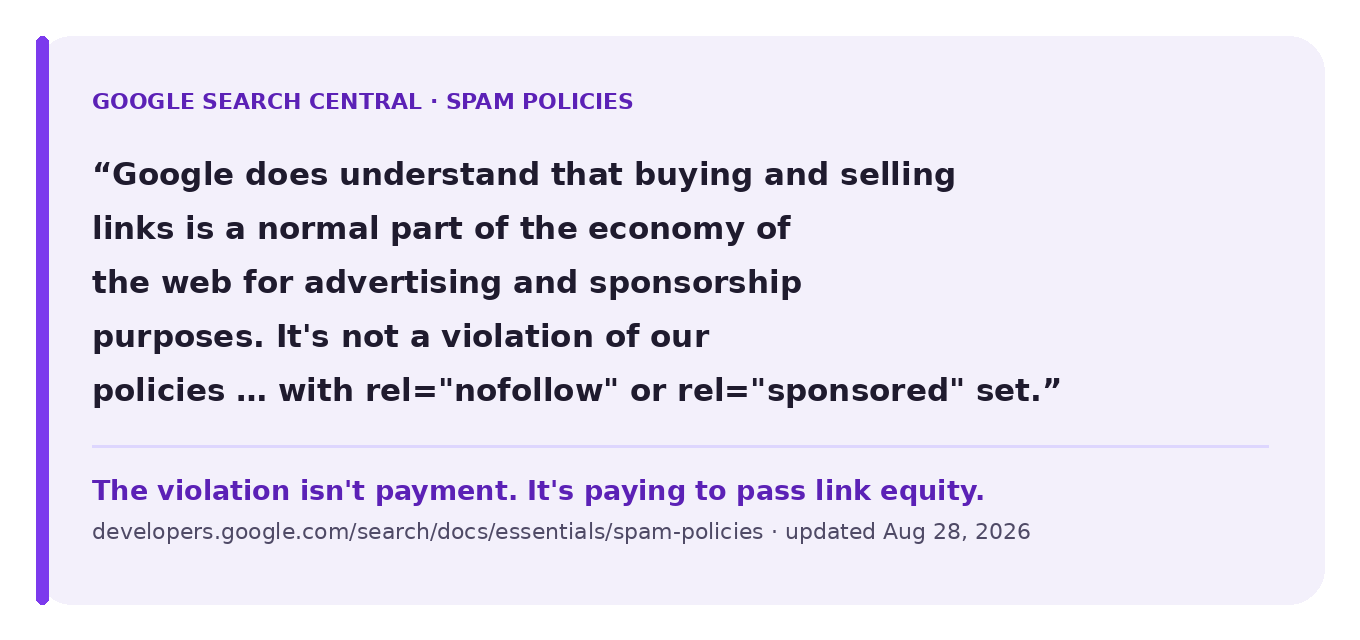
There is a paragraph in Google’s spam policies that almost nobody quotes: “Google does understand that buying and selling links is a normal part of the economy of the web for advertising and sponsorship purposes. It’s not a violation of our policies to have such links as long as they are qualified with a rel="nofollow" or rel="sponsored" attribute value to the <a> tag.”
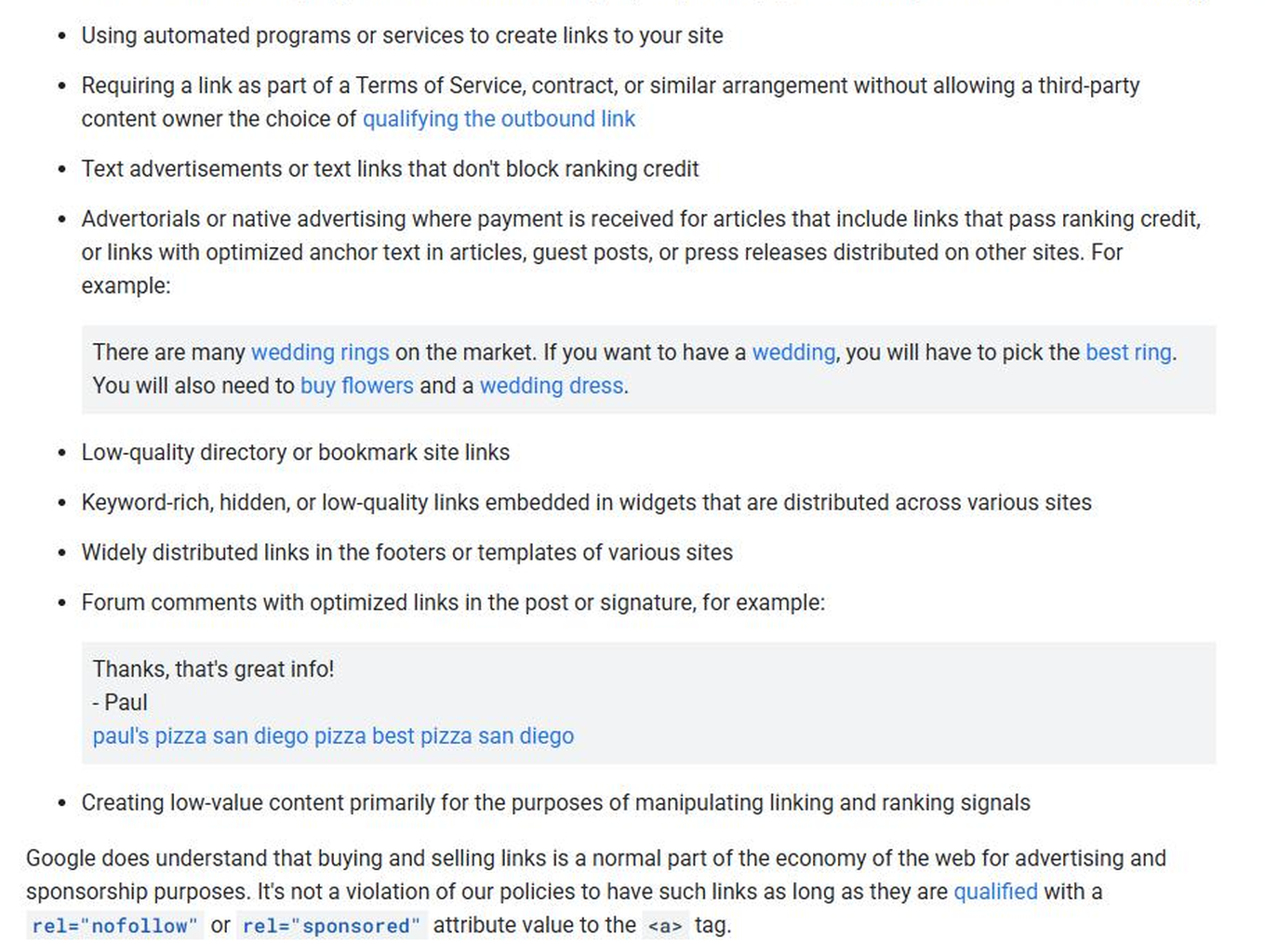
Read it carefully: the violation is not the fact of payment. The violation is passing ranking credit for money. A paid link marked sponsored is advertising, and it is legitimate. A paid link with no marking is a link scheme.
What else Google counts as link schemes, word for word from the same section: “Exchanging money for links, or posts that contain links; Exchanging goods or services for links; Sending someone a product in exchange for them writing about it and including a link.” In other words, the “we give you product, you give us a mention” barter is no different from a wire transfer as far as Google is concerned.
And one separate item that hits the most popular format on the market: “Advertorials or native advertising where payment is received for articles that include links that pass ranking credit, or links with optimized anchor text in articles, guest posts, or press releases distributed on other sites.” Note the “or”: a guest post with an exact-match commercial anchor fits the definition even with no payment involved.
Now, honestly: everybody buys links, us included. Denying that is silly. But there is a difference between “we buy and we understand which zone we are in” and “we buy because the vendor said it is safe.” This article is about the first one.
How much links weigh today
The freshest thing Google has on this is not in employee statements, it is in the SEO starter guide. There is a section there called, in those words, “Things we believe you shouldn’t focus on.” Right next to the myths about keyword density and word count sits PageRank: “PageRank. While PageRank uses links and is one of the fundamental algorithms at Google, there’s much more to Google Search than just links. We have many ranking signals, and PageRank is just one of those.”
At the same time, nowhere does Google say links do not work. On the “How Search Works” page the wording is different: “one of the factors used to determine quality is understanding if other prominent websites link or refer to the content. This is generally a good sign that the information is trustworthy.” The “or refer” matters here: a brand mention with no link counts as a signal too.
My practical conclusion from those two quotes is this. Links are not a lever you move rankings with. Links are confirmation that a site exists in its industry outside its own imagination. If there is nothing to confirm, no volume of placements will create it.
Why you cannot trust the numbers in marketplace listings
Here is the part that made this article worth writing.
I had two marketplace catalogs — “business and marketing” with 1,152 publishers and “SEO and technology” with 520. The overlap was 192, for 1,453 unique sites in total. In each listing, the marketplace shows the vertical, DR, and monthly organic traffic. It looks convincing: here is a site, here are 160 thousand visits a month, here is the price.
I ran the shortlisted publishers through SE Ranking and compared the claimed traffic with the real numbers.
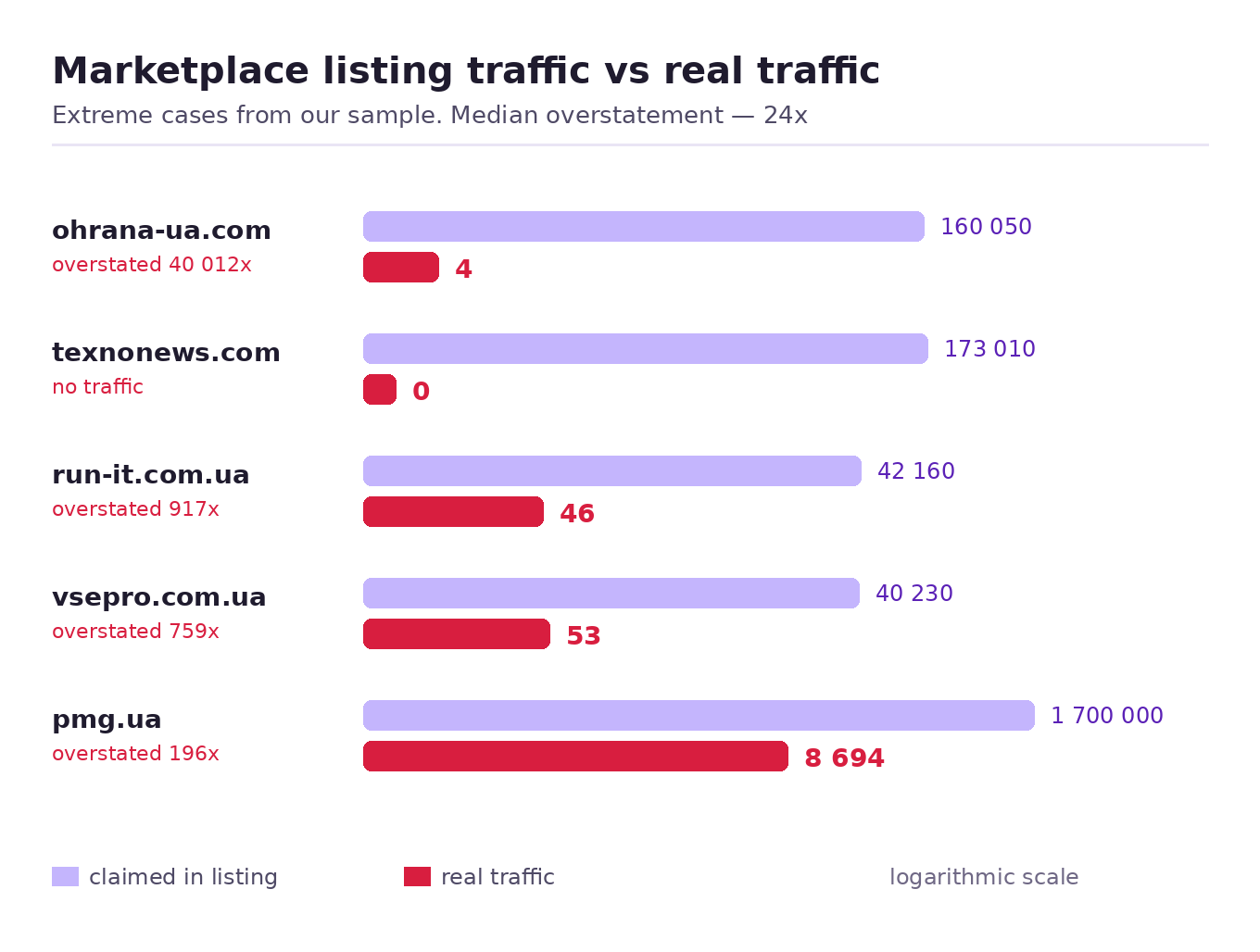
The median overstatement is 24x. These are not isolated outliers, this is the catalog’s norm.
Concrete examples from that sample. One publisher claims 160,050 visits a month — in reality it has 4. Another claims 42,160 — in reality 46. A third claims 40,230 — in reality 53. There are cases in the other direction too: a large media outlet claims 1,700,000 while actually having 8,694 — also an overstatement, just not as wild.
For scale: our own site, seoquick.com.ua, has 2,144 visits a month and 13,271 keywords in the search results. Which means a publisher that is “twenty times bigger than SEOquick by traffic” can in fact get fewer visits than a small blog.
Of the 53 shortlisted publishers, 29 cleared the “real traffic above 2,000” threshold. A little over half.
A separate class of junk: empty SEO blogs
In the “SEO and technology” catalog I found a whole class of publishers that pass any formal screen and are dead anyway.
The vertical in the listing matches yours perfectly — it is a blog about SEO and technology, after all. DR is fine. The price is reasonable. Then you look in SE Ranking: one site has 1 keyword in the search results and zero traffic. The second has zero against a claimed 173,010. Two more have nine keywords each.
These are sites built to sell placements. They do not rank, nobody reads them, nobody arrives through them. Without a real traffic check they pass any scoring model, because on formal signals everything about them looks fine.
The rule I derived for myself: check a publisher’s topic not by the marketplace category, but by the queries it actually ranks for. A publisher is usable if it ranks for your semantics. If instead of your vertical its top results are “buy a helicopter,” currency rates, or legal codes, the category in the listing means nothing.
Out of 1,453 publishers, eight were left
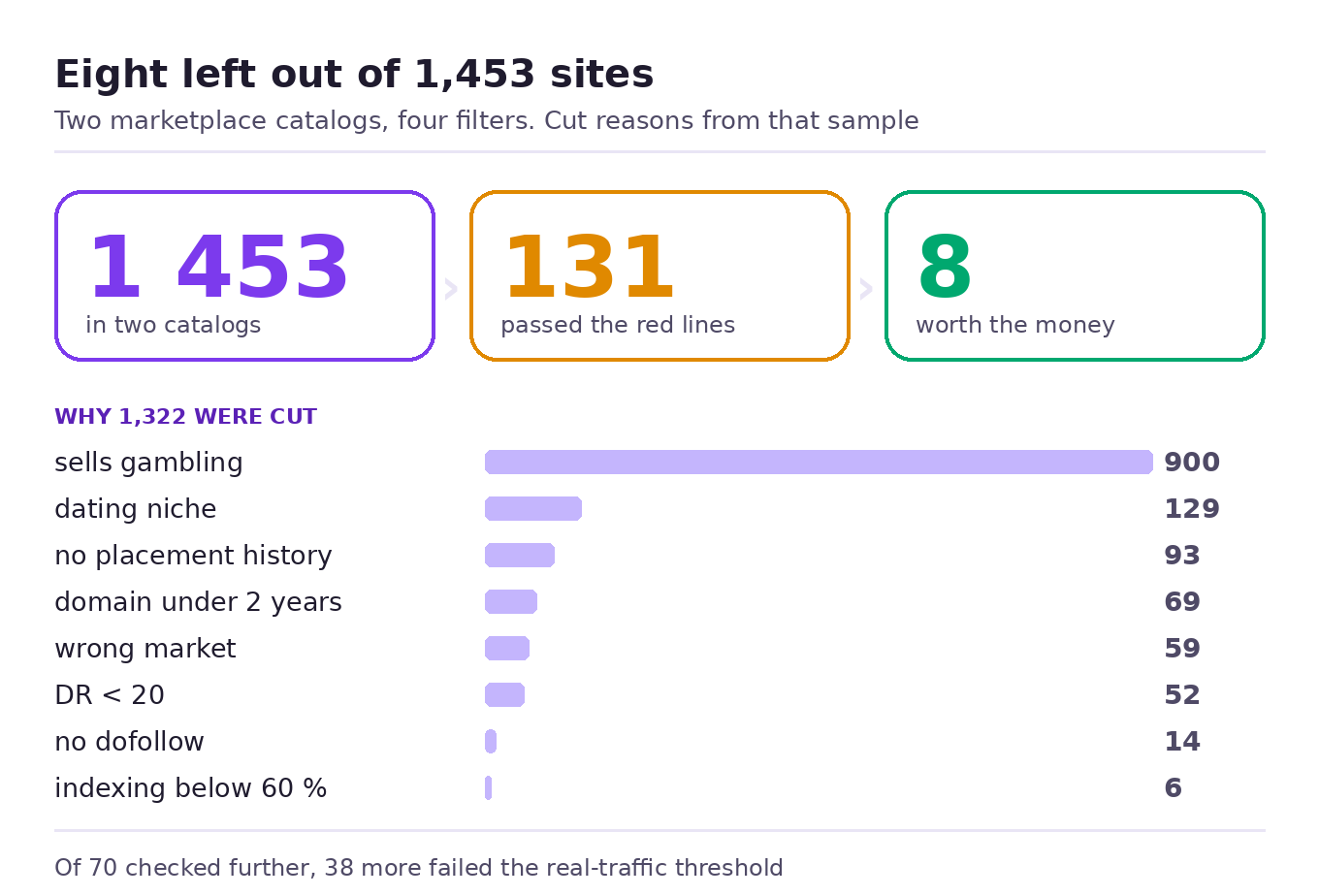
First the red lines. Out went 900 publishers trading in gambling placements, 129 in dating, 93 with no placement history, 69 younger than two years, 59 outside our market, 52 with DR below 20, 14 with no dofollow at all, and 6 with indexation below 60 percent. 131 publishers out of 1,453 made it through.
Then the real traffic and topic check. Of the 70 checked, 38 failed the traffic threshold.
In the end, eight publishers were genuinely worth the money. Three of them are tier A, where the topic matches ours literally: one ranks for “site audit,” another for “website development price.” Five are tier B: business media where our audience is, but with no direct topical overlap.
Eighteen more publishers from the sample are live media with no topical overlap. They work as background, and nothing more.
Here is the honest conclusion that follows. When an agency promises you “20 quality topical publishers a month,” ask what pool they were selected from. If a catalog of fifteen hundred sites leaves eight after a normal filter, then twenty a month means either a different filter or no filter at all.

Check a publisher before you pay for it
The numbers in a marketplace listing are what the publisher wrote about itself. Its real traffic and the queries it ranks for take a minute to see, for free.
Open the donor check — paste the publisher’s domain and see whether it is alive or painted on.
Check a donor site for freeThis is a service from our partners’ marketplace SEOTOOLS.PRO, and the link is an affiliate one. The domain check in it is free and requires no sign-up.
How to vet a publisher by hand: four sieves
The order is exactly this, from cheap to expensive in time.
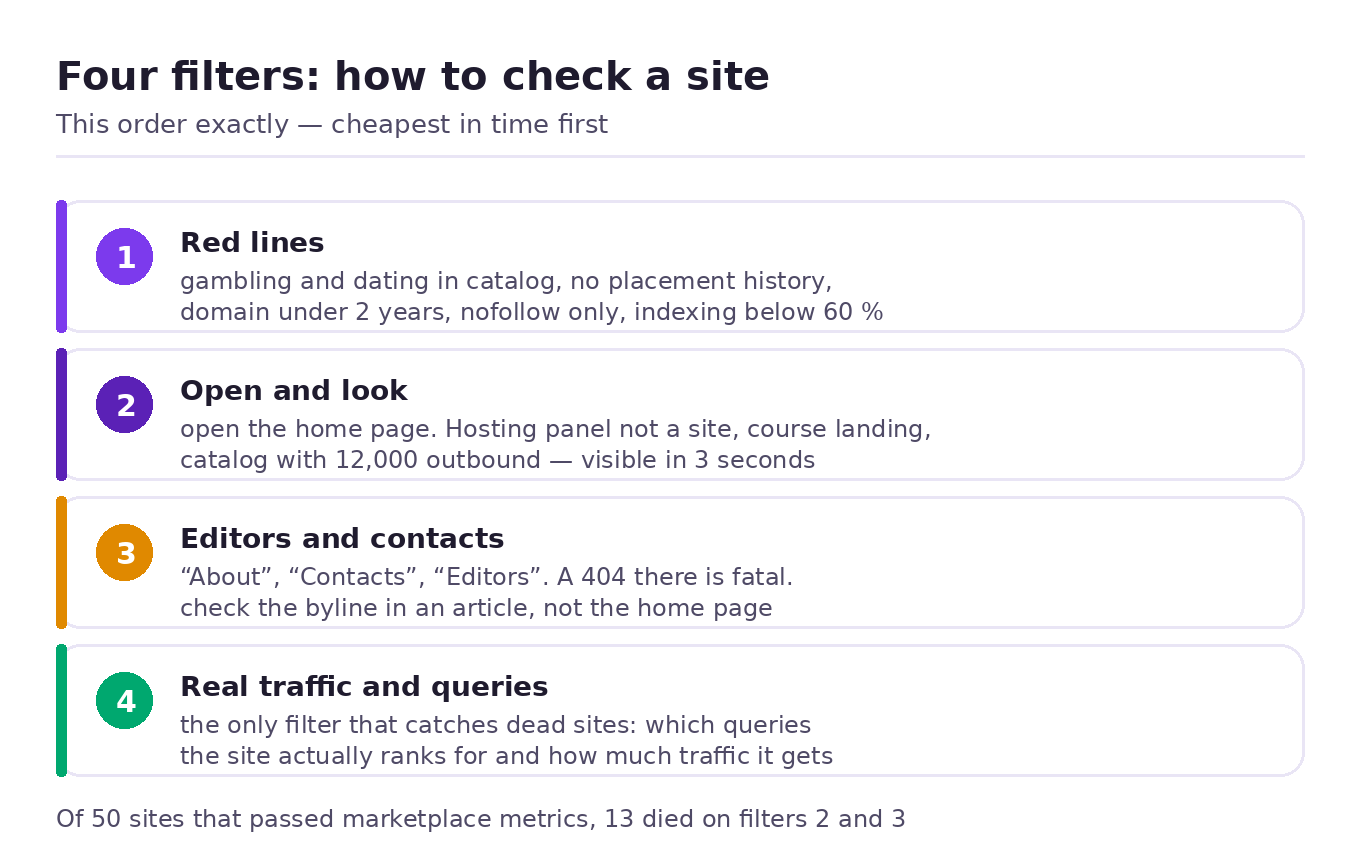
Sieve one — formal red lines. Gambling or dating verticals in the publisher’s catalog, no placement history, a domain younger than two years, nofollow on every outbound link, indexation below 60 percent. That gets cut in seconds and throws out most of the catalog.
Sieve two — look at the site with your own eyes. Open the homepage. This sounds funny until you start doing it. In our sample, this step killed: a domain with a hosting panel instead of a site; a “media outlet” that turned out to be a landing page for accounting software courses; a company directory with twelve thousand outbound links; a site about esoterics; and a lifestyle publication that honestly mentions “special verticals” in its own description.
Sieve three — the editorial and contact pages. Open “About us,” “Contacts,” “Editorial team.” If they return 404, that is a death sentence. If they do not exist at all and no article carries a byline — also a death sentence. At this step eight of fifty publishers dropped out for us, and on one of them “About us” and “Contacts” returned 404 while the metrics were excellent.
Sieve four — real traffic and queries. Covered above. It is the only sieve that catches the empty shells.
Of the fifty publishers that cleared the marketplace metrics, thirteen dropped out after sieves two and three. The budget went up as a result: quality donor sites cost more. That is a fair price to pay, not a reason to go back to the cheap ones.
The formula I use to score a publisher
To stop arguing about “I like it, I do not like it,” I reduced the check to a number. The scale is crude but reproducible.
| Signal | Points |
|---|---|
| Each working “About us,” “Contacts,” “Editorial team” page | +2 |
| Such a page returns 404 or 503 | −3 |
| Page not reachable from the homepage | −1 |
| A byline on a real article | +2 |
| A publication date | +1 |
| Article length above 3,000 characters | +1 |
| Phone, address, company details on the homepage | +1 each |
| Domain age above 8 years | +1 |
| Outbound domains above 6,000 | −3 |
| Outbound domains above 3,000 | −1 |
The threshold: 4 points or below means do not take it, 5–7 is acceptable, 8 and up is good.
Two caveats, without which the formula lies. First: check authorship at the article level, not the homepage — decent publications often have no author markup on the homepage either. Second: a high number of outbound domains at a large news outlet is normal, they link out to sources constantly. It becomes a death sentence when it comes together with no editorial team and no contacts.
What the price is made of: three layers instead of one number
Now to the money. I will show the structure using my own example — not because I sell link building as a standalone service (I do not, more on that below), but because it is the only way to explain what the number in a quote is made of.
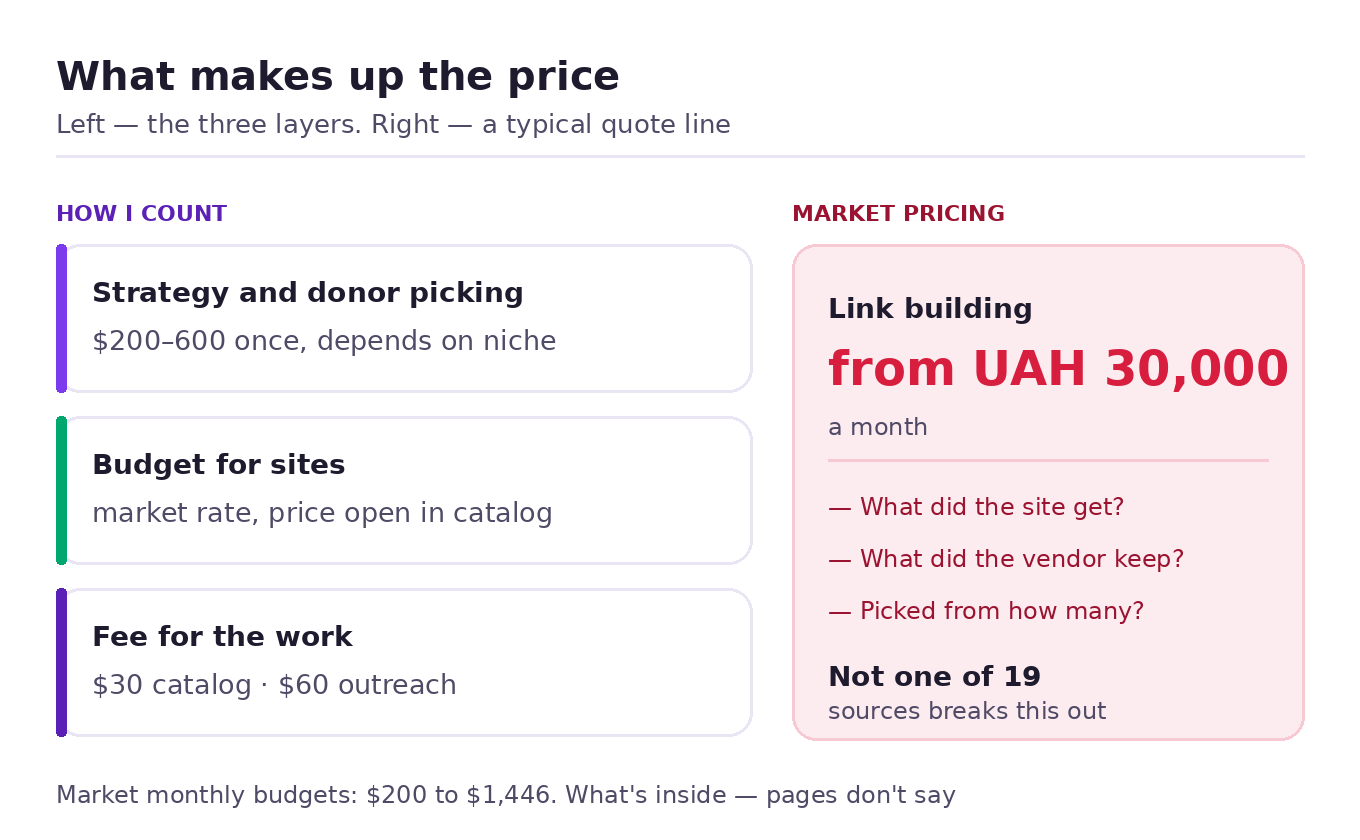
Layer one: strategy and donor selection. This is one-time work — the answer to the question of where this particular site should even appear. For me it runs from $200 to $600 depending on the niche. The narrower the niche and the fewer live relevant publishers in it, the more it costs: the search takes longer.
Layer two: the budget for the placements themselves. Market average, and it is open. The placement price is visible in the marketplace catalog — anyone can check it, you included, without asking me.
Layer three: the fee for the work. $30 for selection and placement through a marketplace, $60 for outreach with payment. Outreach costs more because it involves live correspondence and half the emails go nowhere.
Now compare that with the market: monthly budgets from $200 to $1,446, and not one of the nineteen sources separates the work from the media buy. You pay UAH 30,000 and you do not know how much of it reached the publishers and how much stayed with the vendor. It could be 80/20, it could be the reverse — the page gives you no way to tell.
I am not claiming a blended budget is necessarily deception. I am claiming it takes away your ability to verify. And that splitting it is not hard: I manage somehow.
I will size the link budget for your site
I will show you how many live relevant publishers exist in your niche, what the placements would cost, and whether investing in links makes sense right now — or whether something else comes first.
The review is free, 30 minutes, no slide decks.
Book a reviewWhat we do and what we don’t
Straight answers, point by point, because further down I am going to tell you to ask vendors these questions — and it would be odd not to answer them myself.
We have no standalone link building service. Links are part of the SEO promotion package. That is not a marketing trick, it follows from what I believe: buying links for a site whose technical foundation is unresolved and whose semantics have never been worked out means paying for growth in something that does not grow. First the site has to become something worth linking to.
We do two formats. Guest posts through marketplaces — when the publisher is already in a catalog, with visible metrics and price. And direct outreach — we find the site, find the email, write, and learn the placement terms.
We never buy PBNs. Networks of sites built for the sake of links are a product with a known expiration date. Google does not promise when exactly it will get to them, but it will.
We do not do forum links. We do have a crowd marketing case study on the site, it is honest, but it is years old. Today that instrument is dead and produces no effect. I am leaving the old material as it is — it is part of the history — but I do not take forum links on as work and I do not advise you to buy them as a source of ranking credit.
The pace is 3–5 links a month, and it depends not on the budget but on the niche: how many live relevant publishers it has. In a narrow vertical there is simply nowhere else to go, and pushing the pace means placing where you should not.
If a publisher removes a link or dies on its own — we replace and restore it. With no separate contract and no argument about whose responsibility that is.
What is left for you when we part ways
This is the question five of nineteen on the market answer. Here is my answer.
Every link we place is external, built by outreach or by placement on someone else’s site. They are not rented. That means there is no monthly payment whose end makes the link disappear.
All access is the client’s. We create nothing on our own accounts: no sites, no profiles, no dashboards. There is nothing to take back, because nothing in the project is ours.
If you leave, you leave with everything. The links stay up, the access stays yours, and the reports with the list of placements are in your hands.
I went through in detail what that should look like in a contract in a separate piece about the contract with an SEO agency — it also covers which clauses fall apart in court.
Ten questions for your vendor
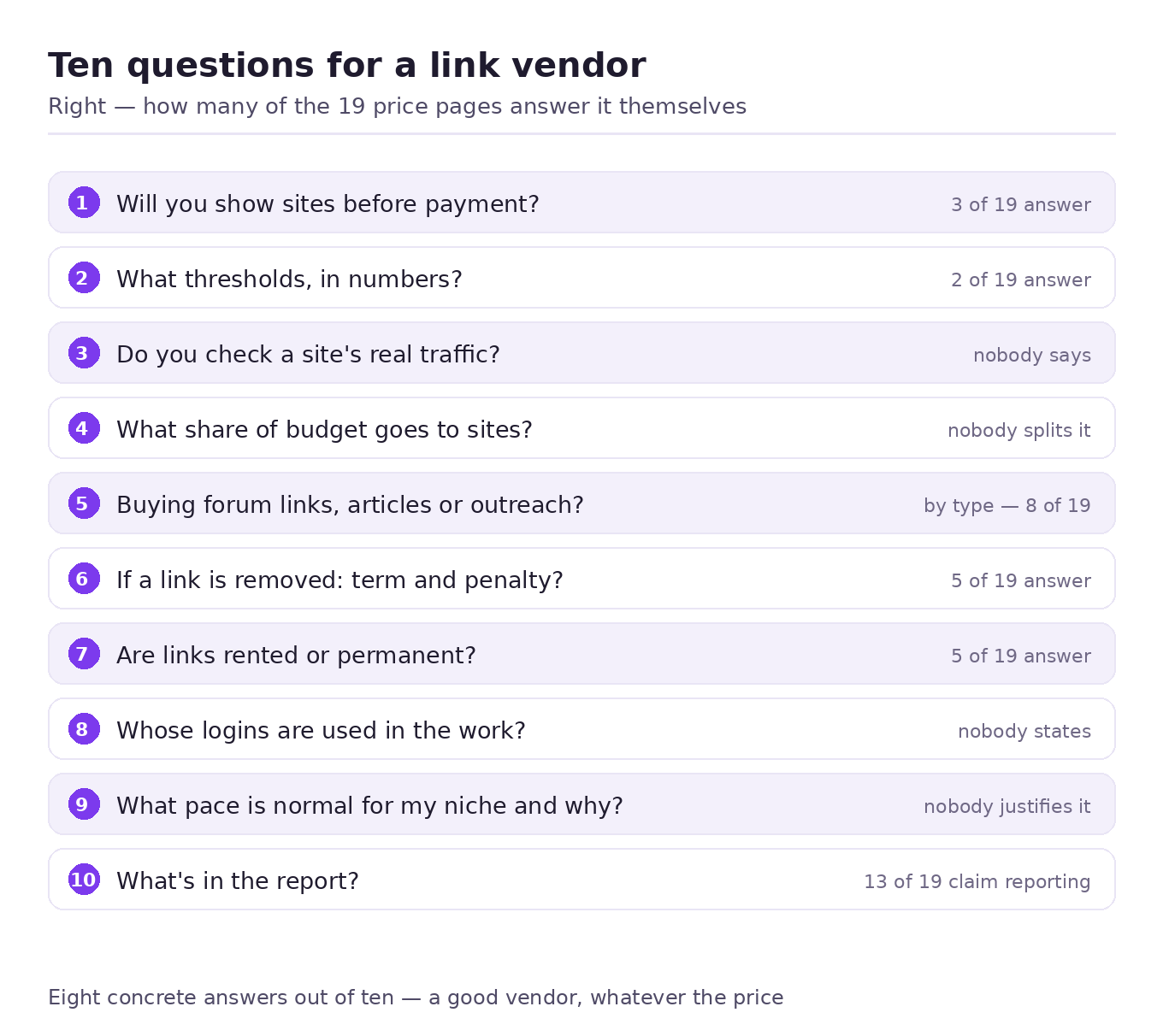
The list is not made up: every question hits something the market does not disclose. If you get specific answers to eight out of ten, that is a good vendor, regardless of price.
1. Will you show me the list of publishers before I pay? Three of nineteen on the market do. “We will show you after placement” is also an answer, just a worse one.
2. What thresholds do you select publishers by — in numbers? Not “authority and topical relevance,” but figures: minimum DR, minimum real traffic, maximum outbound domains.
3. Do you check a publisher’s real traffic, or do you take the number from the marketplace listing? After this article you know why that question is not idle.
4. How much of my budget goes to the publisher and how much to you? The most uncomfortable question on the list.
5. What exactly am I buying: forum links, submissions, guest posts, outreach? And what each type costs separately.
6. What happens if a publisher goes down or the link gets deleted? You need a timeframe and a remedy, not the word “guarantee.”
7. Are the links rented or permanent? And what happens if I stop paying.
8. Whose access is used in the work? If the vendor creates anything on its own accounts, you will lose it.
9. What pace do you consider normal for my niche, and why? The answer “as many as you pay for” is a bad sign.
10. What will be in the report? At minimum, a list of placement URLs you can open and see the link.
How many links you need and when they start working
The two most common questions, and neither has a pretty answer.
How many you need. The right unit of measurement is not a count, it is the gap between you and whoever already ranks for your queries. Look not at “how many links do I need overall,” but at how many referring domains the top five in the search results have and what sources they come from. If they have 40 domains and you have 4, the question is not whether to buy ten or twenty.
When they will work. The honest answer: unknown. A link needs the page to be recrawled, to get into the index, and the signal to be counted. In practice that is weeks, sometimes months, and separating the contribution of links from everything else in SEO is nearly impossible. Anyone who gives you an exact timeframe is making it up.
Which leads to something unpleasant: link building works poorly as a standalone short campaign. It works as background over a long distance, and that is exactly why we keep it inside the promotion package instead of selling a “buy twenty links” cycle.
Toxic links and disavow
A separate section, because this is where the most unnecessary work gets sold.
First, notice a detail: when a Google employee answers a question about “toxic” links, they put the word in quotes. The term belongs not to Google but to the tool vendors who also measure it.
In Google’s help, the conditions for a disavow are written with an AND, not an or: the tool is worth using if you have a considerable number of spammy links AND those links have caused a manual action or are likely to cause one. The same page says plainly: “In most cases, Google can assess which links to trust without additional guidance, so most sites will not need to use this tool.” And a warning: “If used incorrectly, this feature can potentially harm your site’s performance in Google Search results.”
The freshest statement on the subject is John Mueller in March 2026: “The disavow file is a tool, not a religion :-). Most sites don’t need it, but that’s not all sites.” That is a measured position and I share it: a disavow makes sense when you know exactly what you paid for and you cannot get it taken down.
What you definitely should not do is dump everything a tool flagged red into the file. That is not work, it is an imitation of work.
Quick answers to common questions
Do links still work? Yes, but as confirmation, not as a lever. Google itself puts PageRank in the “things we believe you shouldn’t focus on” section and on the same documentation says links from prominent sites are a trust signal. Both statements are true at the same time.
Will I get banned for buying links? For buying — no. For buying links that pass ranking credit without marking — that is a spam policy violation, and it can lead to a manual action. The difference is in the marking, not in the fact of payment.
How much does a link cost? From $0.67 to $114 inside one and the same Ukrainian sample. Until it is stated what exactly is being bought, the number means nothing.
Is it worth buying links on a marketplace yourself? Yes, if you are prepared to vet the publishers. No, if you intend to trust the numbers in the listings — you have seen what is wrong with them.
Do agencies just resell marketplace links? Some do. One question settles it: how much of the budget went to the publisher. If there is no answer, you are paying for resale.
Are guest posts still alive? Alive as a format. But a guest post with an exact-match commercial anchor is named outright in Google’s spam policies — even with no payment. Which is why our anchor text is branded and diluted, with no exact-match commercial anchors at all.
Which is better — many cheap links or a few expensive ones? Neither, on its own. A link from a site Google considers spammy does not give you zero — it simply does not exist for Google. The money for it has already been spent.
What to do next
If you are reading this before ordering link building, here is the order of operations.
First make sure it is even time to buy links: that the technical foundation is in order and there is something on the site worth showing. If you are not sure, a free audit shows it in a couple of minutes.
Then decide whether you do it yourself or with a vendor. If yourself — you now know the four sieves and the scoring formula, and the tools for the checks are free. If with a vendor — ask the ten questions above and count how many got a specific answer.
And either way, insist on the split: what the work costs, what the placements cost. One number for everything is not a price, it is an invitation to take someone’s word for it.
I will go through your backlink profile
I will look at who links to you, what of it works and what is dead weight, and whether your niche has live publishers worth starting for.
Links sit inside our SEO promotion package — we do not sell them as a standalone service, and on the call I will say plainly if what you need right now is something else.
Book a review
Website development cost in 2026 and what drives it
A landing page from $176 to $2,000, an online store from $335 to $6,700 — measured across 17 Ukrainian price lists. What website development cost is made of, why a “from” figure means nothing, what we charge and how long each type of site takes.
Read →
Pagination SEO: how to index list pages without breeding duplicates
Pagination SEO in 2026: canonicals on list pages, noindex, rel=next/prev, infinite scroll, crawl budget. Based on a check of 36,000 traffic-driving URLs across twelve Ukrainian retailers, plus a teardown of pagination at Foxtrot, Epicentr and our own blog.
Read →
SEO Agency Contract: What It Must Include
We checked 22 Ukrainian agencies: only two publish an SEO contract, and neither of them is a Ukrainian legal entity. We break down 21 court cases, nine ways clients get misled and what can actually be guaranteed.
Read →Want to apply this to your site?
We will review the current situation, find the first growth levers, and suggest a practical working format.