Performance Max in 2026: Setup, Feeds, and Control Over Automation
In 2026, Performance Max stopped being a black box you pour budget into and pray. Google added negative keywords, channel-level reporting, and experiments — advertisers finally have levers. Here's how to set the campaign up right and where to take back control over automation.


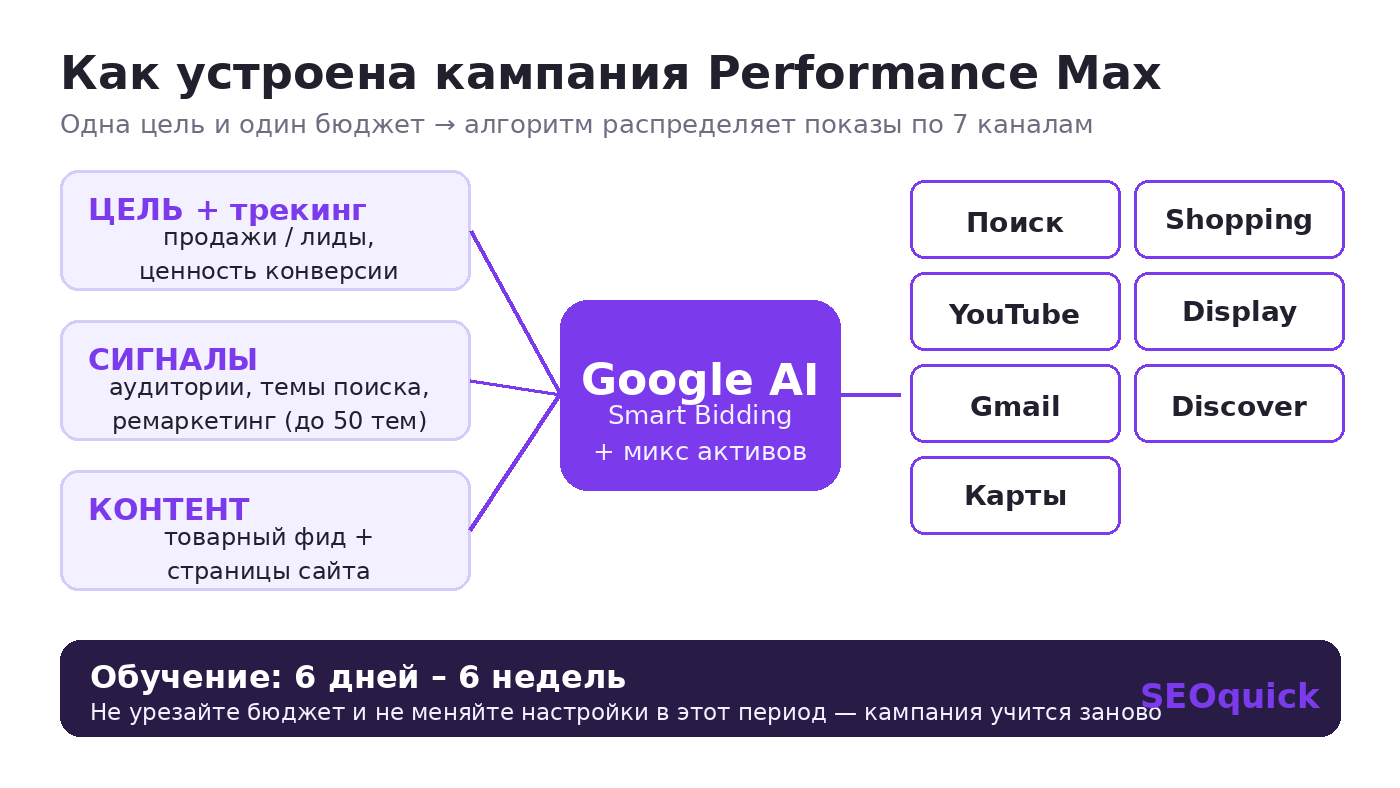
In 2026, Performance Max is configured with signals, not keywords: set a goal and precise conversion tracking, upload as many creatives and high-quality audience signals as possible, prepare a product feed — then give the campaign 6 days to 6 weeks to learn without touching the budget. The big change this year: Google added negative keywords (up to 10,000 per campaign), channel-level reporting, and experiments, so for the first time you have real control over the automation.
Performance Max (PMax) is a goal-based Google Ads campaign that uses one budget and one goal to show ads across Search, Display, YouTube, Gmail, Discover, and Google Maps at once. It sounds like magic, but in practice 80% of failures aren't a "bad algorithm" — they're setup mistakes. Below is how to do it right in 2026, with real numbers and what has changed.

What Performance Max is and who it's for
The core value of PMax is broad reach, minimal manual management, and finding conversions that would slip through regular campaigns. The system raises bids on placements where conversion probability is higher. As our PPC specialist Alena Polyukhovich puts it:
"The foundation of Performance Max isn't keywords — it's AI. You give it audience signals, search themes, and a content type — a product feed or site pages — and from there the algorithm does all the work."
PMax fits when you need to scale conversions across several channels at once and open up demand beyond Search. But it won't fit if you've never run campaigns, have no active conversions, have shaky analytics, and need a quick launch with hard creative testing. In that case, start with regular Search campaigns.
Step 1. Analytics first, launch second
The most expensive mistake is launching PMax without precise conversion tracking. Without correct events, value, and attribution, the algorithm can't learn. So before launch:
- Define a macro goal (sale, lead) and micro goals (add to cart, phone-number click, checkout start).
- Always assign conversion value — without it the system doesn't know what matters most to you.
- Test that conversions register at all, and register correctly.
- Enable enhanced offline conversions if you have a sales cycle.
- Protect against junk leads: double confirmation, CAPTCHA, server-side validation — otherwise fake submissions will skew the learning.
While analytics is being set up, you can run regular Search campaigns on a small budget — they'll generate the first conversion data, which speeds up the learning of your future PMax.
Step 2. Audience signals and search themes
In PMax you don't buy keywords — you give the algorithm hints. Search themes are now expanded to 50 per group. Audience signals (remarketing lists, custom segments, past and active buyers, abandoned carts) are starting hints that speed up reaching the goal. But it's important to understand their nature:
"If you use an audience signal, say remarketing, it speeds up learning but doesn't lock targeting. If the system decides it can go beyond the audience and get a conversion, it will. Your job is to add as many quality elements as possible and replace weak ones based on the reports."
In search themes, don't duplicate your product names — think about the additional words and phrases people use when searching for your service. And don't restrict placements manually: instead of bans, feed it quality signals.
Step 3. The asset group — load it to the max
The asset group in PMax is your "universal ad." Limits: up to 20 images, up to 6 videos, 15 short headlines (30 characters), 5 long headlines (90 characters), 5 descriptions, up to 20 sitelinks plus callouts, structured snippets, phone, and promotions.
The rule is simple: the more quality assets, the better the system mixes them and the wider the reach. You can skip video, but if you add it you unlock YouTube placements and give the algorithm more variations. Videos are needed in three formats: 16:9 (horizontal), 9:16 (Shorts), and 1:1 (square). The built-in AI editor in Google Ads can, for example, remove the background — for SEOquick clients, background-free images often perform better.
Step 4. The feed — fuel for PMax Shopping
If you're setting up PMax Shopping, it's the quality of the product feed that determines the relevance of impressions in Shopping and in free listings. Split products by custom label, separate expensive items from cheap ones, and run different regions and countries as separate campaigns. This makes campaigns easier to manage and optimize. You can also upload a page feed under "Business data" — it helps target specific URLs.
Step 5. The learning period — don't touch the budget
This is where most money gets wasted out of impatience. Remember the numbers:
"Learning can take from 6 days to 6 weeks. In the first two or three weeks the campaign actively collects signals and tests combinations, and stabilization begins around the sixth week. If you make major changes too often, the campaign gets thrown off and relearns from scratch."
Google explicitly asks you not to restrict the campaign for at least 6 weeks. You can't cut the PMax budget hard: without a critical mass of signals, the process drags on. And the main mistake is pulling out too early. The campaign isn't cheap and takes time to learn, but impatience is the #1 cause of failure. Budget swings up and down every two days lead to incorrect operation.
What's new in 2026: control levers
The main complaint about PMax was always the same — "black box." In 2026, Google finally handed advertisers the management tools. Here's what arrived:
Negative keywords — up to 10,000 per campaign
Previously you couldn't set negative keywords in PMax at all. Now, per AdNabu, you can add up to 10,000 negative keywords per campaign (plus at the account level) and cut off irrelevant and brand queries. As Alena notes:
"Now you can calmly set negative keywords on a campaign — something that just a few months ago simply wasn't allowed."
Channel-level reporting
From January 2026, Google introduced channel-level reporting: per the Google Ads Developer Blog, you can now see clicks, conversions, value, and cost broken down by channel — Search, Shopping, Display, YouTube, Discover, Gmail, and Maps. Previously all of this was hidden inside one combined figure. Now you finally see where the budget goes.
Experiments and exclusions
Per Google, PMax gained experiments (test new variants against the current campaign without cloning), asset-group-level reporting, and customer list exclusions — so budget goes toward acquiring new customers rather than those who already bought. Also use brand exclusion at the account or campaign level so you don't cannibalize cheap brand clicks.
PMax and AI Max — where it's all heading
In parallel, Google is rolling out AI Max for Search campaigns. Per Google's blog, the full AI Max feature suite delivers on average 7% more conversions or value at a comparable CPA/ROAS. And Google is upgrading Dynamic Search Ads (DSA) to AI Max: the automatic upgrade of campaigns using automatically created assets and the broad match setting starts in September 2026, while the mass DSA migration begins in February 2027. The takeaway: automation in Google Ads is deepening, and the skill of working with it is becoming mandatory.
Common PMax setup mistakes
Let's boil failures down to the four most common points:
- Too few creatives. Two headlines and no video — the system has nothing to mix, can't learn, and won't deliver results.
- Pulling out too early. Pausing or cutting the budget during learning is the #1 cause of failure.
- Broken goals. Duplicate goals, no conversion value, or no offline data break optimization.
- Junk conversions. Without form protection, fake submissions skew statistics and learning.
If you're just moving to automated campaigns, it's worth checking your setup against our breakdown of Performance Max in Google Ads and the PMax for an online store case study.
Bottom line: automation isn't "set it and forget it"
Performance Max in 2026 is a partnership with the algorithm, not a surrender to it. Your part of the work is precise analytics, quality signals and feed, maximum creatives, and patience during learning. Google's part is budget distribution and finding conversions. And the new levers (negative keywords, channel reporting, experiments) turn the "black box" into a manageable system. Don't set the campaign up once — keep reviewing reports, swapping out weak assets, and testing new features.
Not sure whether PMax fits you, or why your current campaign isn't delivering? Send your ad campaigns for a free SEOquick audit — we'll find the mistakes and tell you how to fix them.
Frequently Asked Questions (FAQ)
How long does Performance Max take to learn?
From 6 days to 6 weeks. In the first 2–3 weeks the campaign collects signals and tests combinations; stabilization comes around the sixth week. Google asks you not to make major changes during this period.
Can you set negative keywords in PMax in 2026?
Yes. Since 2026 you can add up to 10,000 negative keywords per campaign and at the account level — this feature was previously unavailable. It's the main tool against irrelevant and brand queries.
Do you have to add video to the asset group?
Not required, but recommended. Video unlocks YouTube placements and gives the algorithm more variations to mix. You need three formats: 16:9, 9:16, and 1:1.
Why does PMax "eat" a large budget?
The campaign needs a critical mass of signals to learn, so you can't restrict the budget hard. Cutting it during the learning phase is the main mistake. Plan the budget for 6 weeks of learning in advance.
How is PMax different from AI Max?
Performance Max covers all Google channels with one campaign. AI Max is an add-on for Search campaigns (query expansion, text customization, URL expansion). Per Google, the full AI Max suite delivers an average +7% conversions at a comparable CPA. Google is migrating Dynamic Search Ads to AI Max over 2026–2027.
Google AI Max in 2026: Should You Switch From Performance Max
What Google AI Max is, how it differs from Performance Max, and whether you should switch in 2026. Google's real numbers vs independent data, brand and geo controls, DSA migration. A breakdown by SEOquick.
Read →
Duplicate Content: The Silent Traffic Killer — How to Find and Fix It
Google doesn't penalize duplicate content, but it dilutes signals and hurts AI search visibility. The 4 types of duplicates, how to find them via GSC and Screaming Frog, and how to fix them — a breakdown from SEOquick.
Read →
X/Twitter promotion for business: when the channel still makes sense
How to use X/Twitter for B2B, experts, launches, events, and performance: content, ads, targeting, conversion tracking, and SEO signals.
Read →Want to apply this to your site?
We will review the current situation, find the first growth levers, and suggest a practical working format.