Perplexity Optimization in 2026: How to Earn Citations via Reddit, YouTube and Review Sites
Perplexity sends under 1% of search traffic, but those people arrive pre-researched and buy far more often than Google visitors. To land in its answers, ranking in the top 10 isn't enough — you need to be in the sources it cites. Here's what those sources are and how to get in.


I will look at your site and answer your questions on the topic of this article. 30 minutes, no slide decks, no pressure.
Book a consultationPerplexity almost never makes up an answer on its own—it scrapes it from external sources and slaps links right next to them. To get cited, being in the organic TOP-10 isn't enough: you need to be where Perplexity grabs its facts—Reddit, YouTube, and review sites like G2—and serve your content "answer-side out": short direct theses, hard numbers, and comparisons. Traffic will be low, but the client will arrive already warmed up.
Perplexity isn't just another search engine; it's a citation engine. For every query, it runs over 200 billion URLs through its pipeline, picks a few sources, and glues together an answer with footnotes. For business, this shifts the goalpost. You're no longer fighting for the first line in a list, but to get into those footnotes. Let’s break down how it works—and what you can do literally this week.
Why bother with Perplexity if the traffic is low?
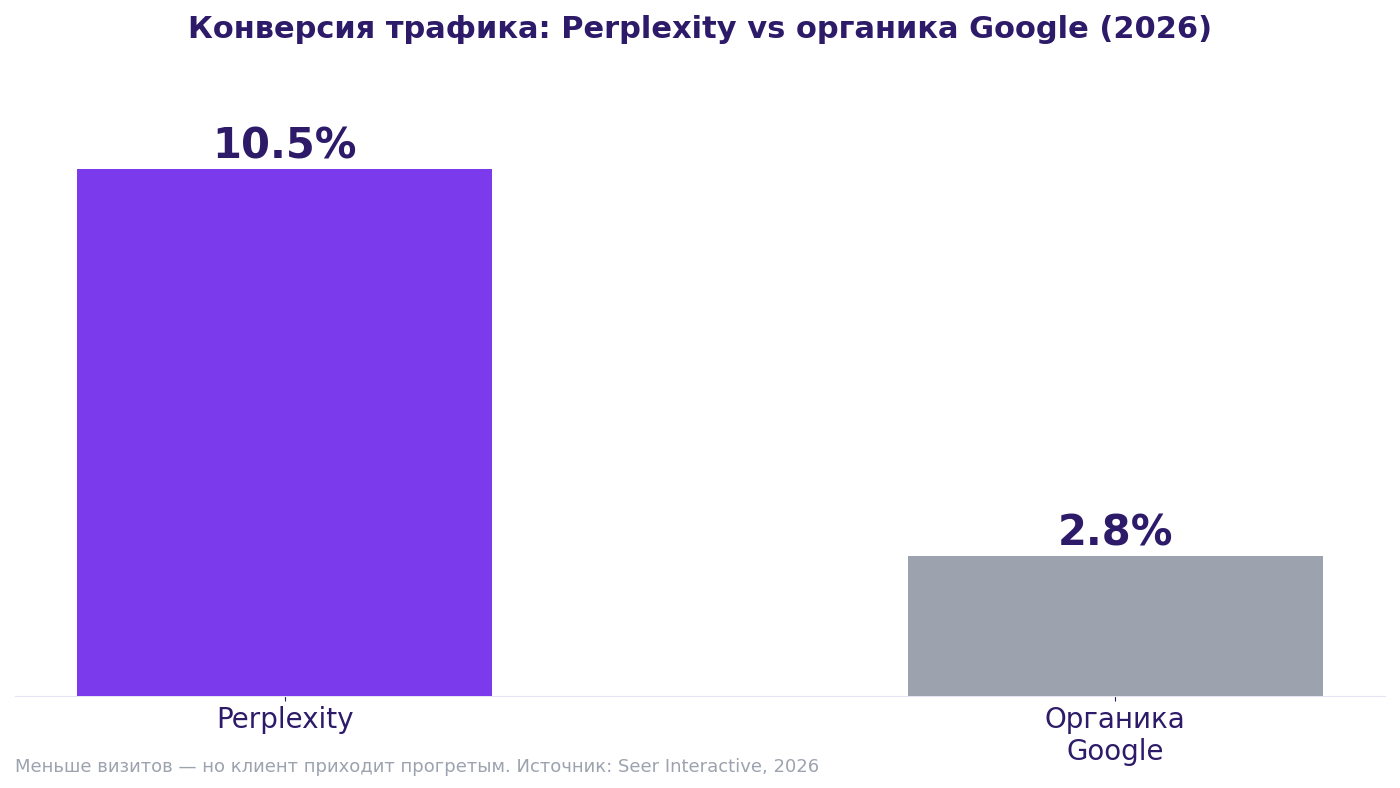
The objection always sounds the same: Perplexity has less than 1% of the market compared to Google's 90%—is it even worth the sweat? Yes, and here’s why. It’s about the quality of those visits. According to 2026 data, 64% of Perplexity's audience are professionals searching for work purposes. They land on your site after already reading a condensed answer and comparing you to competitors.
Conversion rates confirm this bluntly. In the Seer Interactive benchmark, Perplexity sessions yielded a 10.5% conversion rate versus 1.76–2.8% for standard Google organic search. One such visitor is worth several from search. The founder of SEOquick describes this "warmed-up client" effect using AI purchases as an example:
“If your brand makes it into this output, you get a maximally warmed-up client who has already compared you with competitors right in the chat and is ready to buy right now.”

Where Perplexity gets its sources
Under the hood, it’s a RAG scheme: first, the engine finds documents, then re-evaluates them in several layers, and only then writes the answer, embedding links into specific statements. A document must pass checks for relevance, freshness, structure, authority, and engagement. If it fails, it doesn't get cited.
According to a breakdown of ranking factors, the weight is distributed roughly like this: content relevance around 30%, visual placement on the page around 20%, then domain authority and freshness follow closely at 15% each, with source diversity and structured data rounding it out at 10% each. For commercial queries, the weight of trust and review sites grows; for informational ones, pure relevance carries more weight.
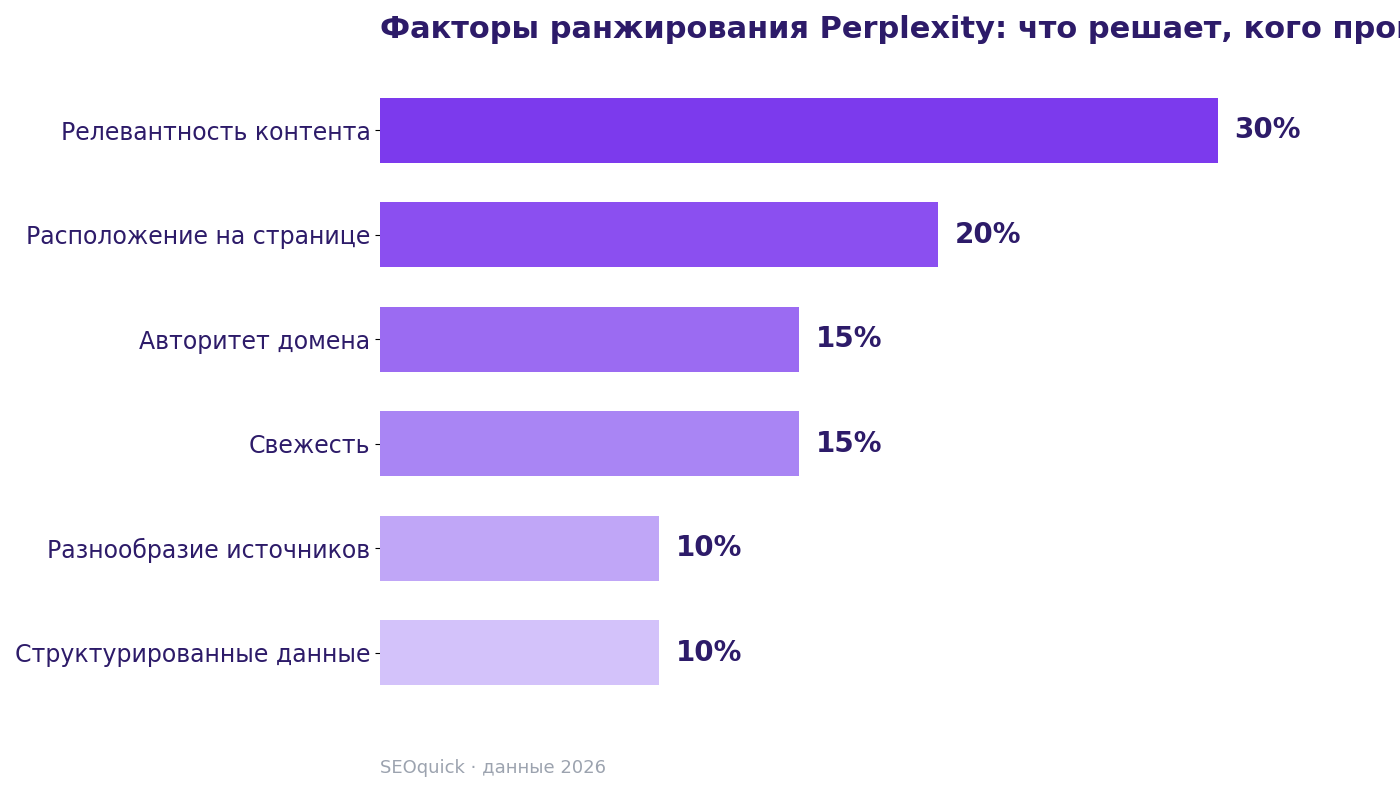
The conclusion is simple: "writing a good article" isn't enough anymore. You need the fact to sit within the first screens, be fresh, backed by a number, and located on a platform Perplexity trusts. This is where Reddit, YouTube, and review sites step forward.
Reddit—Perplexity's #1 citation source
Reddit is the most cited social domain in Perplexity. According to a 2026 report, it accounts for 53.6–62.8% of all social media citations, and in January 2026, about 24% of all Perplexity citations led to Reddit. That’s a drop from the peak of 46.7%, but still more than any other platform.
The reason is simple: on Reddit, real people discuss products in their own words. This is exactly the unpolished experience AI loves to pull into an answer. What should a business owner do? Find subreddits in your niche and become a normal participant—answer questions, bring cases and numbers, not just a link to your landing page. A client's detailed answer in a thread gets cited better than your homepage. And don't try to game it: spam accounts get nuked, and Perplexity values organic, upvoted answers. Reddit doesn't replace your site—it acts as a second voice confirming your expertise from the outside.
YouTube—the second strongest source
YouTube provides about 22.7% of Perplexity's social citations, and Perplexity is the largest driver of YouTube citations among AI tools, at about 38.7%. Together, Reddit and YouTube grab 78.2% of all AI citations from social media. A nuance that saves you money: 94% of these citations lead to long-form videos, not Shorts.
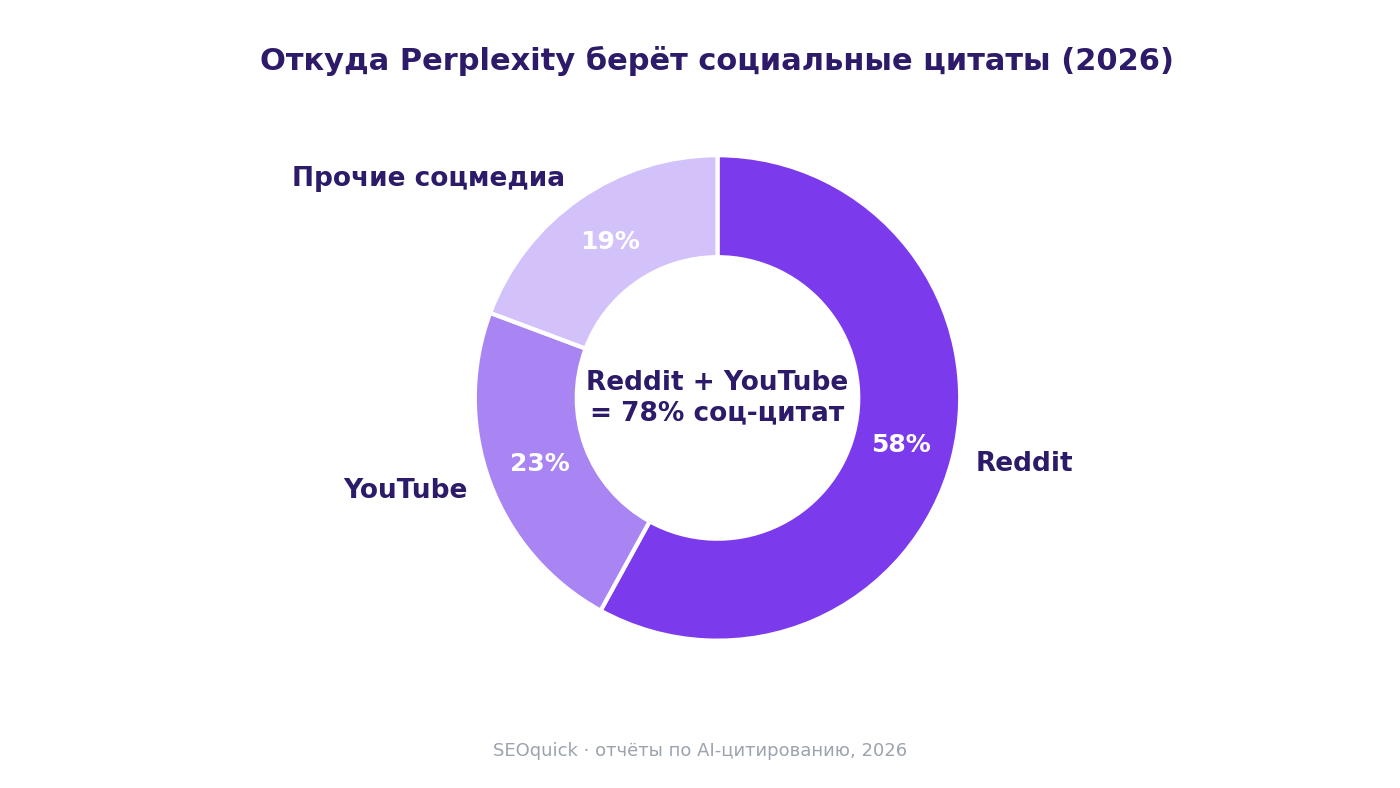
For an owner, the takeaway is this: film long videos where you break down client questions properly—with examples, screen shares, and conclusions. Such a video works as a standalone citable source, not just "social media content." We see this on our own channel: a calm 12-minute breakdown brings more mentions in Perplexity than a dozen viral Shorts. More on video as a search engine in the material about Google AI Mode.
G2 and review sites—the entry to commercial answers
As soon as a query becomes commercial ("best service for...", "X vs Y"), Perplexity leans harder on trust platforms. G2 is the most cited B2B review site here: the engine pulls its ratings and third-party mentions during the final check. And 73% of B2B buyers are already using AI at the research stage.
The practice is simple. Collect fresh reviews on specialized platforms—G2, Capterra, industry directories, Google Business Profile—and consistency matters more here than a one-time wave of fifty reviews in a week. On your own site, create honest "us vs. competitor" comparison pages and reviews: this is an extractable format that AI loves to cite. And watch what people say about you in general: scattered or negative mentions slash the chance of being cited specifically for commercial queries where money is on the line.
How to rewrite content so Perplexity pulls it
Even when you're already on Reddit and YouTube, the site itself must serve facts "answer-side out." Start a section with a direct two-to-three sentence thesis, not a "warm-up"—AI pulls exactly the first 30% of the text. Provide extractable formats: definitions, numbers with sources, comparisons, short step-by-step instructions. Add an update date and actually update the numbers—freshness weighs about 15%, and that’s no small thing. Keep a clear structure: understandable H2 questions, short paragraphs, markup. More on this in the AEO, SEO, and GEO breakdown and the piece on GEO optimization for GPT.
Don't forget about trust: Perplexity makes mistakes too
While working on Perplexity visibility, remember the service isn't perfect. There was a public scandal: users noticed that under the guise of an expensive model, they were being fed a cheap one. The founder of SEOquick commented on this without diplomacy:
“Users caught Perplexity lying... Trust is undermined. Watch out, because sometimes it can lie. Verify the answers.”
The takeaway for business is twofold. First, double-check how exactly the AI describes your brand—it can easily distort facts. Second, the clearer and more unambiguous the phrasing on your site and in reviews, the less reason the model has to hallucinate on your behalf.

Where to start this week
Don't put it off until "there's a strategy." Open Perplexity yourself and run 5–10 queries in your niche: see who it cites and why. Find two or three subreddits and start giving detailed, useful answers there. Record one long video breakdown of a common client question. Pull in fresh reviews on G2, Capterra, and directories. And rewrite the intro paragraphs of key pages into a "direct answer plus numbers" format and add update dates. This set is enough to start appearing in answers in a month or two.
Not sure where exactly you're losing AI visibility? Send your site for a free SEOquick audit—we'll show you which sources you're missing to get into Perplexity and other AI answers.
Frequently Asked Questions
Is it even worth dealing with Perplexity if the traffic is low?
Yes—if you want sales, not just visits. Traffic from Perplexity converts at about 10.5% versus 1.76–2.8% for Google organic, and 64% of its audience are professionals searching for work who arrive ready to talk business.
Why is Reddit so important for citations?
Because it's Perplexity's most cited social domain—up to 62.8% of social citations. People discuss products there in their own words, and AI pulls that live experience more readily than polished marketing copy.
Shorts or long videos?
Long ones, no contest: 94% of AI citations lead to full-length videos. Record detailed breakdowns of client questions, not fifteen-second clips.
Search Everywhere Optimization: Ranking on TikTok, YouTube, Reddit and AI Search
Your customer does not only search on Google: 49% of consumers search on TikTok, Reddit pulls 842M organic clicks a month, and YouTube is the source of roughly one in four AI Overview citations. Here is how a business owner picks 2–3 platforms without burning the budget.
Read →
TikTok SEO in 2026: How to Rank in TikTok Search and Get Into Google
TikTok is now a second search engine: 49% of users search on it, 65% of Gen Z. Here is how TikTok indexes video (ASR, OCR, captions), how to optimize clips for search, and how TikTok content also surfaces in Google — with 2026 data and SEOquick experience.
Read →
E-E-A-T in 2026: How the March Core Update Boosted Author Experience
The March 2026 core update amplified the first E in E-E-A-T — Experience. What changed, why YMYL sites dropped 20–35%, and how to show real author experience — a breakdown from SEOquick.
Read →Want to apply this to your site?
We will review the current situation, find the first growth levers, and suggest a practical working format.