Why AI Cites Your Site But Never Names Your Brand
Your site keeps landing in the sources under an AI answer, yet your company name is never spoken. I pulled 751 AI Overview answers for my own domain and found the factor that decides almost everything. Plus six prompts that let you audit your brand in ten minutes for free.


I will look at your site and answer your questions on the topic of this article. 30 minutes, no slide decks, no pressure.
Book a consultationBecause "citing" and "naming" are two different operations for a machine. It pulls a fact off your page, drops it into the answer and attaches a link. Saying your company's name serves no purpose there: the person asked how to choose a supplier, not who you are. I pulled 751 Google AI Overview answers that list my site as a source and found the one factor that decides almost everything. It isn't the topic and it isn't the schema. It's where your link sits in the source list.
Let me start with something you don't normally brag about.
In July I ran a live stream and put seoquick.com.ua through my own audit tool on air. My site, my tool, in front of an audience. And I scored zero on expertise.
Zero. From someone who has been talking about E-E-A-T for twelve years.
Turned out there were no author pages, the email wasn't clickable, and articles had no author in the markup. Part of that was a bug left over from a migration, part was simply never getting around to it. On camera I said: "I need to build an author page." We fixed it. And while I was at it I dug into the data, and here's what came out.

These are two different questions, and confusing them is expensive
When someone on a call tells me "we're invisible in AI," that sentence hides two separate problems. Split them immediately: different people fix them, on different timelines.
Does AI cite my site? That's engineering. Can the bot fetch the page, read it without executing scripts, extract a ready answer. Developer and copywriter handle this. Timeline in weeks.
Does AI name my brand? That's reputation. Does the model know the company exists, and does it have a reason to recommend it. Marketing and PR handle this. Timeline in months.
You can be a source that gets cited and not be a brand that gets named. That isn't a bug. That's how the system works.
Six prompts I use to check a brand in ten minutes
Before you pay anyone for "GEO services," do this yourself. Free, by hand, in ordinary Google AI. This is exactly how I open every project review.
1. "What do you know about the brand [name]?" The first prompt of all. If there's nothing about you, stop there, you have a problem at the entrance. You'll also spot collisions right away: I was reviewing a coffee brand called Banelli, and there are children's products under the same name. The machine mixes them up. Worth thinking about back when you pick the name.
2. "How well known is the brand [name]?" This shows which shelf you've been put on: mass market, niche, B2B. And here's the rule I repeat on every review: if it can't tell you anything meaningful, your brand is weak. A detailed answer means information about you exists on the web.
3. "Compare the brand [name] with its competitors," followed by "score our brand with a SWOT." Nobody needs to be paid for this. The model lays out strengths and weaknesses itself, and it often lands uncomfortably close (mine came back with "weaker personal brand of the founders in the wider public," and I had nothing to say to that).
4. "Why is the brand [name] not recommended?" My favourite. Very simple prompt, enormous payoff. For that same Banelli it answered: they work with HoReCa, roast for robusta, they don't position for ordinary buyers, so they won't show up in ordinary answers. That's a finished brief for your marketing team.
5. "Evaluate my site against the E-E-A-T methodology" with the domain attached. Google returns a point-by-point breakdown, because it does hold information about your site.
6. "What have I missed in SEO for the brand [name]?" You can ask this in Gemini, but if you have a heavier model, feed it your competitors' keyword set and ask: "find the gaps in my semantics." That's how I surface whole clusters. Usually it turns out there are products and a top-level category, but the intermediate collection pages don't exist at all.
Ten minutes, zero budget. And you already understand more about your brand than half the paid reports will tell you.
What I found in 751 AI Overview answers
Then I wanted to measure this properly rather than by feel.
I exported every August 2026 query from SE Ranking's Ukrainian database where seoquick.com.ua appears in the AI Overview sources. That gave 751 answers, each with the full text Google showed the user plus the ordered list of sources. The check is simple from there: does the word SEOquick appear in the answer itself?
It appeared 536 times. That's 71.4%. In 215 cases (28.6%) the page was used silently.
Not a bad number, the global picture is worse. But things got interesting when I sorted those same answers by where our link sat in the source list.
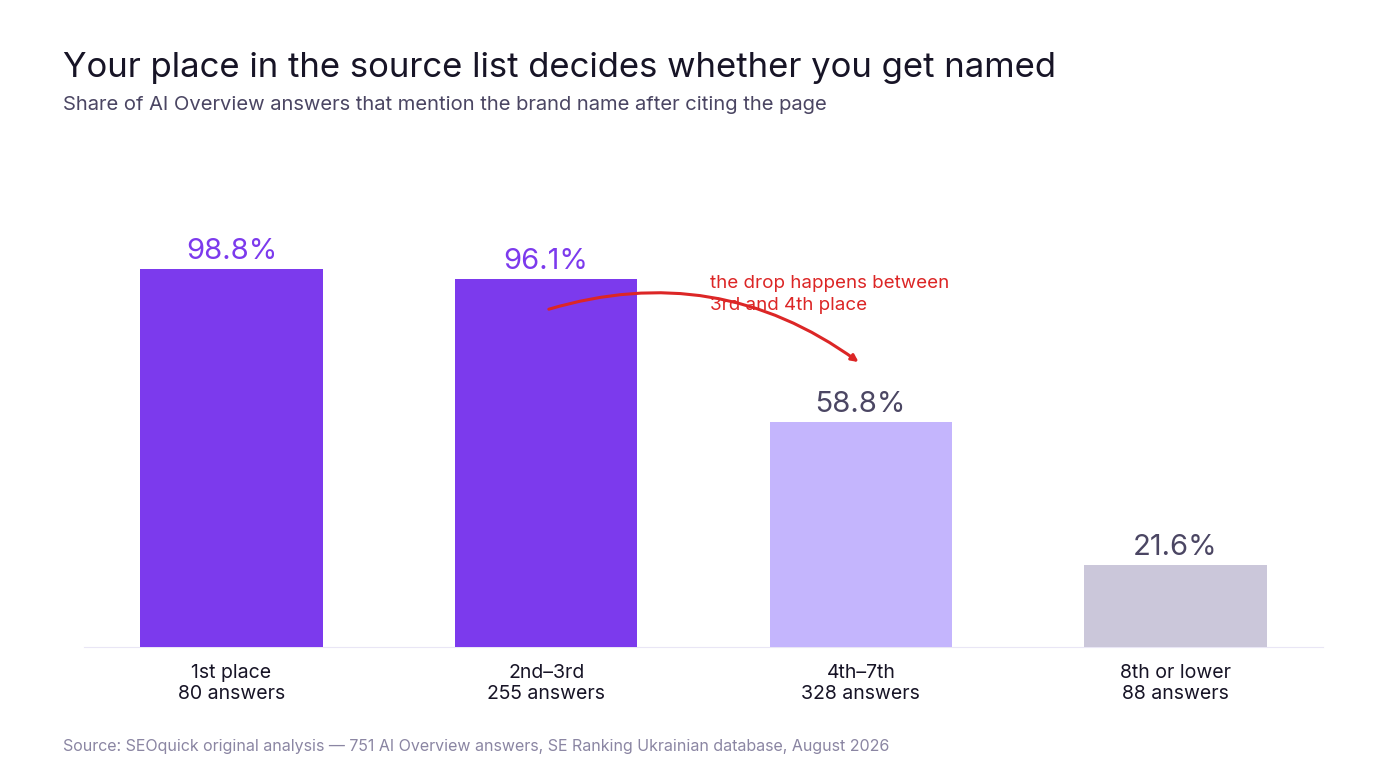
The collapse happens exactly between third and fourth place. In the top three sources the brand is named almost every time. From fourth, only about half the time. From eighth, one in five.
My first thought was: what if this is an artefact? Maybe longer answers simply pull more sources, and I'm measuring answer length rather than position.
So I checked. I took only answers with eight or more sources and looked at position within that group. Top three: 99.1%. Fourth to seventh: 58.1%. Eighth and below: 21.6%. Nothing changed. So it really is position.
And here's what struck me. On that live stream, without any of these numbers, I told viewers out loud that Google doesn't have many slots in an answer, that at best it shows three, four, maybe five brands, not twenty and not thirty. I said it on instinct. The data showed the same cliff after the third row.
The practical conclusion is unpleasant. Getting into the sources is half the work, and it's the easy half. The real fight is for the top three. Everything below the fourth row feeds someone else's answer.
Two side findings from the same export. Our /website-audit/ page was cited 81 times and carried the brand name in 80 of them, which is 99%. The /seo/ section, with 64 citations, produced a mention only 44% of the time. Same domain, same company, twice the difference. And one more: YouTube showed up in the sources 239 times out of 751. A third of the answers that cite us also link to a video.
One market, a hundredfold gap
Then I ran the same ratio across our niche: how often AI Overview cites a domain's pages versus how often it says the name. One database, one month, all local players.
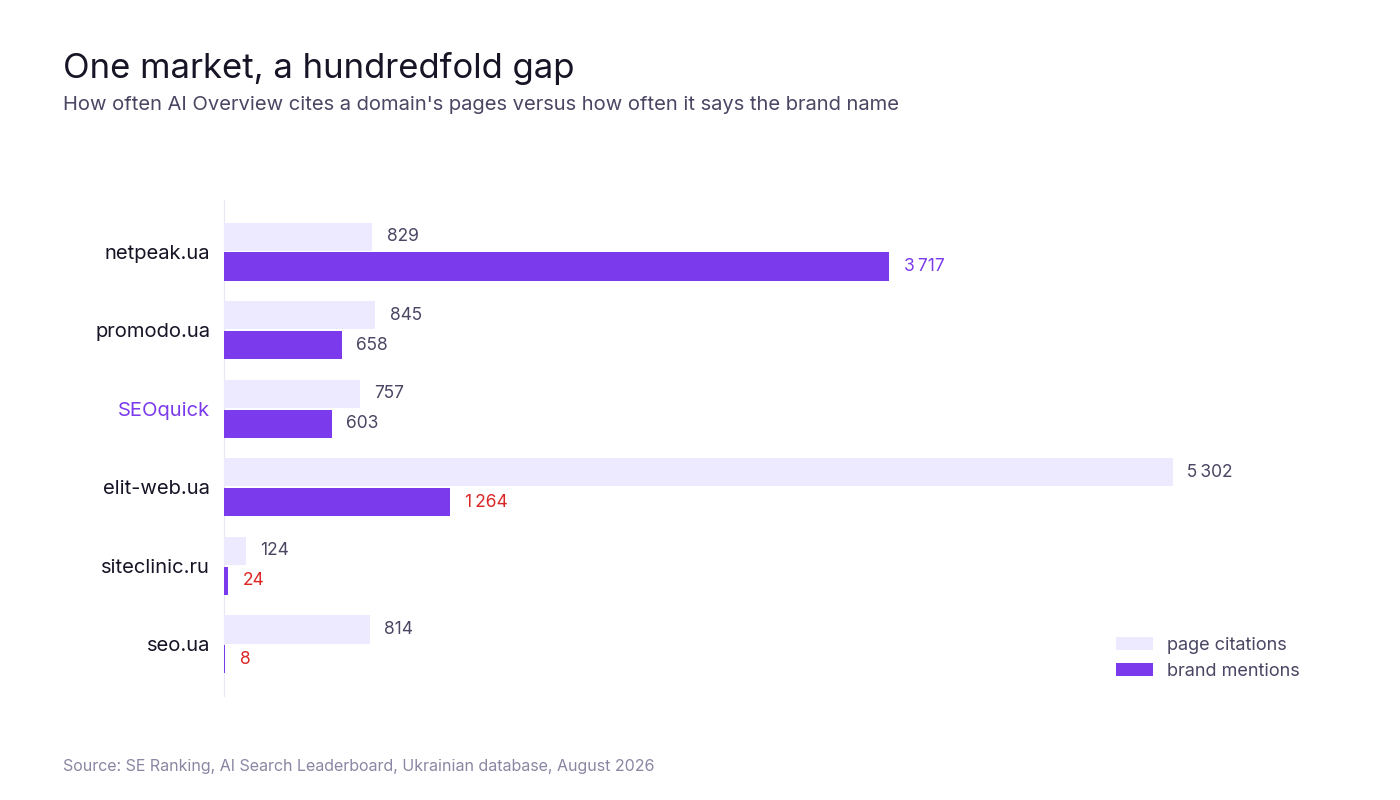
Look at the two extreme rows.
seo.ua has 814 citations and eight brand mentions. Eight. The site dutifully feeds facts into answers, and almost nobody who asked ever learns whose fact it was.
Netpeak is the mirror image: 829 citations (the same as ours) against 3,717 mentions. The model names them four times more often than it opens their pages. Which means it doesn't know them from the site.
We sit in the middle: 757 citations, 603 mentions, third place by share of voice with 21.6% against the leader's 54.4%. No point hiding it. In ChatGPT and Perplexity we're nearly invisible in our own niche, and that's my own unfinished business.
The difference between Netpeak and seo.ua isn't site quality and isn't schema. People talk about one of them on other people's platforms, and don't talk about the other.
The same pattern in global studies
In June 2026 Semrush and Kevin Indig analysed 3,981 domain appearances across 115 prompts in 14 countries. The result: 61.7% were citations without a mention. They called them ghost citations.
The most interesting part is the spread between platforms. It isn't just large, it's a mirror image.
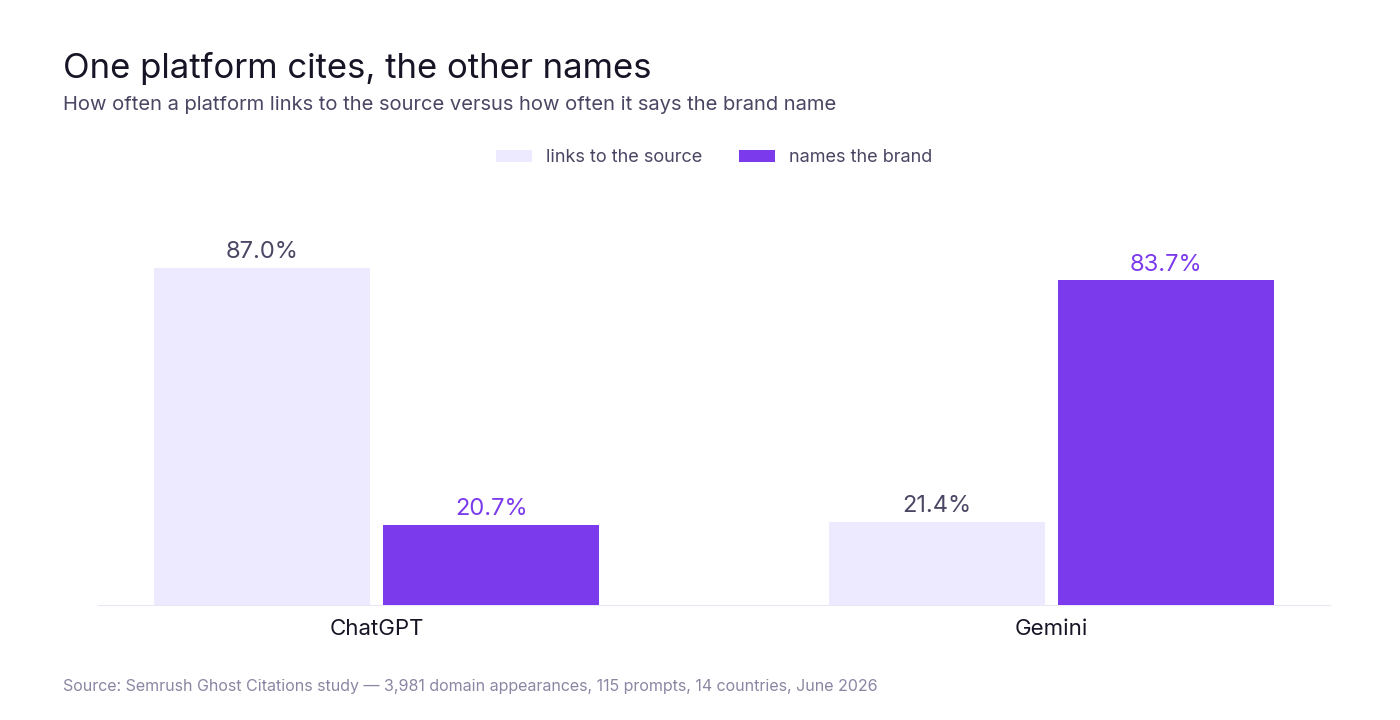
ChatGPT almost always attaches a link and almost never says the name. Gemini does the opposite. Indig puts it this way: "There's almost no overlap between which brands ChatGPT cites and which ones Gemini names for the same prompt."
So "we're visible in AI," without saying which AI, means nothing. And Google itself runs three separate products (AI Overviews, AI Mode, Gemini), where Profound measured a median visibility gap of eight percentage points for the same brand.
Three reasons your name doesn't get spoken
The site is unreadable to a machine
Let me repeat the basic thing I say on every stream: AI sees your site as HTML. It breaks that code into chunks (small blocks) and assembles the answer out of those.
Vercel measured live crawler traffic: GPTBot downloads JavaScript in about 11.5% of requests and doesn't execute it, ClaudeBot in 23.84% and doesn't execute it either.
What disappears because of that? Your phone number, if a widget loads it. Reviews, if a script pulls them. Prices, specs inside tabs, half the description behind a "show more" button.
It takes a minute to check: Ctrl+U on your page, search the code for your own phone number. Not there? Then it doesn't exist for the machine.
From a recent audit of a live store: 48 pages, and 36 of them have no text at all. Plus missing image alts. Just sit with that: AI only sees a picture through its alt.
There's nothing outside your site to back you up
Omniscient Digital analysed 23,387 citations across 240 branded prompts: 48% go to earned mentions off the brand's own site, 30% to commercial content, and only 23% to the brand's site itself. For questions like "what are the reviews" and "who would you recommend," external sources reach 82%.
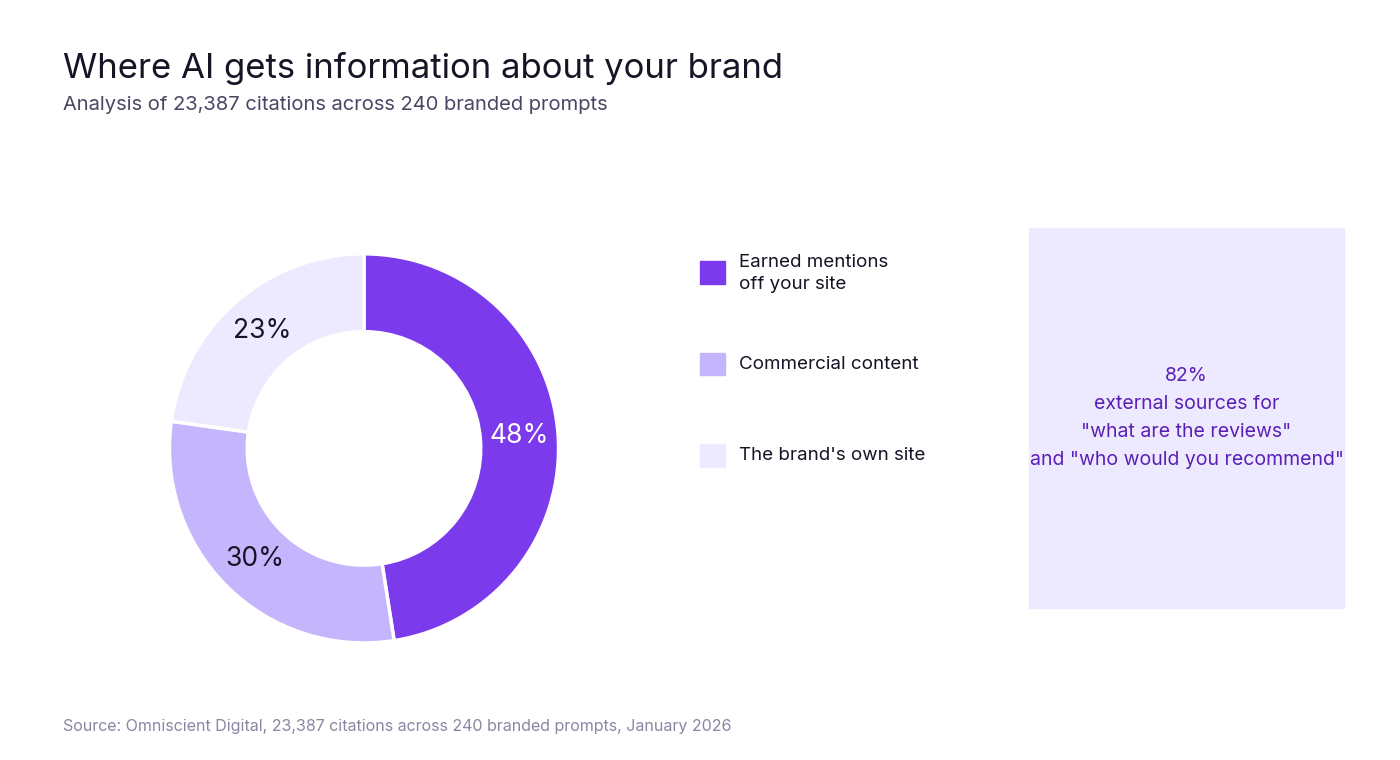
I see this on every review. I open a client's knowledge panel and the data there was pulled not from the site but from a business directory and from their own Instagram. The product range too, incidentally.
So don't be lazy about listing your company in directories. If you're lazy, you'll have problems. It's two boring evenings of work with disproportionate weight behind it.
A word on social profiles. In my checklist this is a scale, not a checkbox: zero when there are no profiles, one point when they exist, ten when you actually run them. Google sees the difference between a live account and a dead one perfectly well. Rare posts, no likes, no comments, all of it counts.
And the most common mess I find. One set of social links on the site, a different set connected in Facebook, a third set in directories. Company name spelled one way in the catalogue, another on the site, a third in Google Business. What is Google supposed to think? It doesn't think, it decides you have no social presence at all. You lose for nothing.
Your name doesn't appear next to your category
Rand Fishkin puts it without metaphors: "The currency of large language models is not links. The currency of large language models is mentions." The model names those whose name it has seen many times in the same paragraph as the words of your niche.
Ahrefs backed that with numbers. Across 75,000 brands they calculated Spearman correlations with AI Overview mentions.
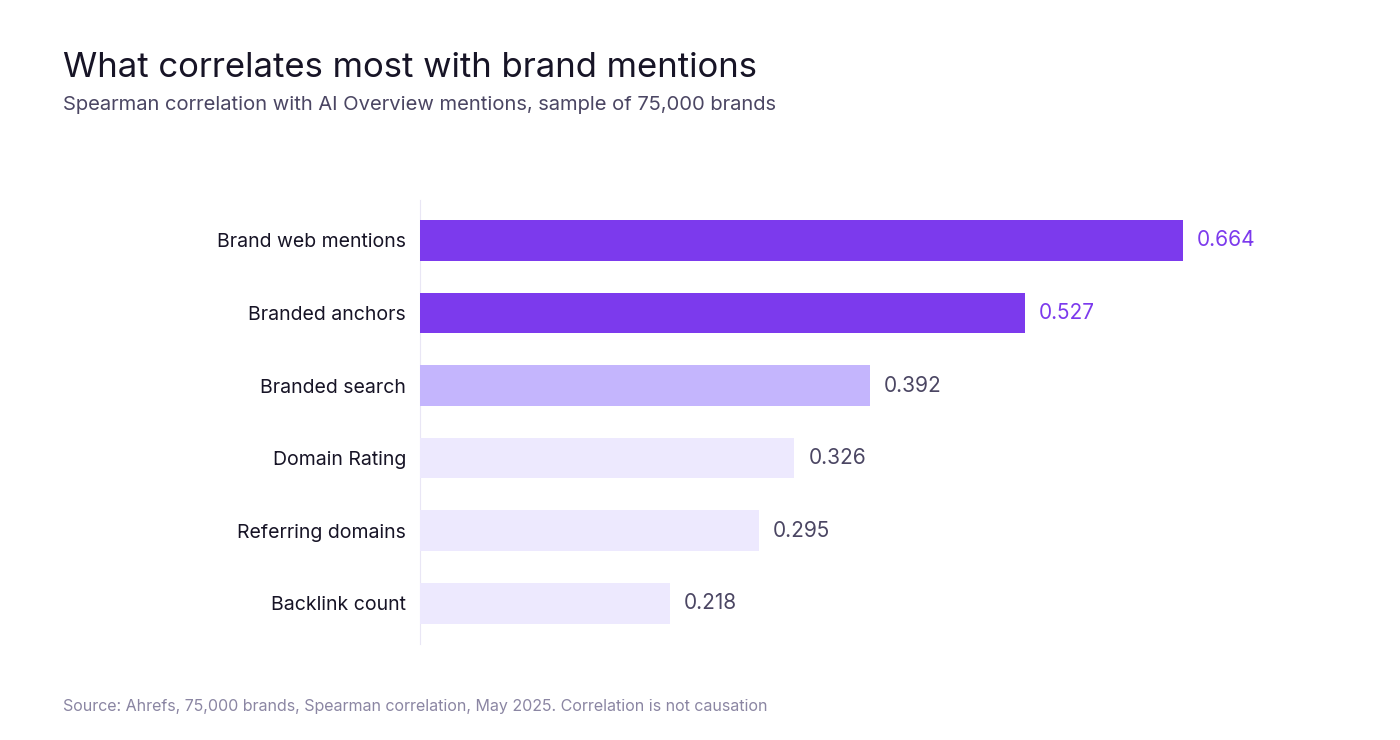
Correlation isn't causation, and that has to be said every time. But when the strongest signal is simply "how often people talk about you" (0.664) while backlink count trails three times lower (0.218), the direction for your budget stops being debatable.
What this looks like on a real site
August audit, an auto parts store. 2,690 pages in the crawl, trust index 46 out of 100. Trust 61, authoritativeness 25, structured data 50, experience zero.
Exactly zero. Not one review on the site, not one marker of first-hand experience.
What's there: contacts, HTTPS, a clickable phone number, a form, legal details, Organization markup with sameAs. What's missing: an about page, a privacy policy, terms, an email address, reviews, a team page, certificates, social profiles, breadcrumbs.
Not a single item on that second list costs link-building money. It's a week of work for a copywriter, a lawyer and a developer.
Now the same site through AI's eyes. Brand mentions: zero. Meanwhile the pages made it into the sources fourteen times. Share of voice 0.02% against the niche leader's 69%.
Readable, yes. Nothing to recommend.
And here's the trap: 2,690 pages and 46 points of trust. Content volume and trust live on different axes.
What doesn't work, even though it's being sold to you
This section matters more than the previous ones, because this is where the money goes.
Schema on its own. Ahrefs did something rare for our industry: a study with a control group. They took 1,885 pages that added JSON-LD and 4,000 matched pages that didn't. In AI Overviews, citations dropped 4.6%, and that result is significant. I still add schema everywhere, but I add it where the page holds the actual data. Schema without data is a risk, not a signal.
The llms.txt file. SE Ranking ran 300,000 domains through the analysis: no relationship with citation frequency, and removing the variable actually improved the model's predictions. It was adding noise.
Piling up reviews for the sake of AI. Two studies disagree here, and it's worth knowing. Seer Interactive, across 804,491 answers, found that simply having a profile on a review platform lifts median citation rate from 1% to 53.5%. But G2 with Profound, across 30,000 citations, calculated that growing review volume beyond that explains under 2% of the variance. The threshold seems to be what matters, and everything above it barely moves the needle. Worth noting separately: G2 published data against their own commercial interest, which adds weight to it.
Buying mentions. Google said it plainly in its own documentation: "seeking inauthentic 'mentions' across the web isn't as helpful as it might seem."
"In 2026 you can hold top positions in classic search and still be completely invisible to AI."
What to do: the first 30 days and the next 60
The first month is mostly your team's time, not an agency budget.
The owner writes an about page without slogans: who we are, how many years, who exactly works here, what backs it up. The lawyer closes off the privacy policy, terms and returns. The developer checks whether the main content is visible in the raw source, and looks at robots.txt and the CDN settings while they're there (Cloudflare can block AI bots with a single toggle, and owners regularly hear about it from me for the first time). Marketing brings the name, address and phone number to a single consistent form everywhere they appear.
The next two months are about what happens off your site. Reviews on independent platforms. Getting into industry roundups. Markers of real experience instead of stock photos. An answer paragraph at the top of key pages, so the machine has something it can lift whole. Author and specialist pages with real names.
Let me say a separate word about authors, since I got burned on this myself. If you have a blog and you have a team, put them on the site. Blog, team, director, doctors, whoever. It has to be personalised. Having that information is mandatory now, and I see this item failed on almost every site I review.
And one more task: fighting for the top three sources, now that we know what it's worth. That means writing the page to answer the question more completely and more directly than competitors do. Not in more detail, more directly. The top three goes to material that closes the query by itself.
Agree on timelines up front. Readability is fixed in weeks, trust pages in days, brand mentions in months. Seer ran a lovely experiment during the 2026 Olympics: 231,347 answers over 52 days. Norway won the medal table, and AI kept mentioning the US more than twice as often the entire time. Three weeks after the event, one in five factually correct answers was still retelling the old narrative.
"There's an enormous psychological difference between you shouting 'I'm an expert' and being recommended by something impersonal and impartial, like an artificial intelligence."
How to measure it
Where do you see your own AI queries? Search Console doesn't show them, and that's the core pain. I use Serpstat: domain, Keywords section, the "Your domain in AIO" tab. It shows immediately which queries you actually surface for. A small site will have 60–70 keywords there, and the job is to push it not to 70 but to 700.
First, though, learn the unpleasant part. SparkToro with Gumshoe ran 2,961 measurements and found this: the odds that a hundred runs of ChatGPT or Google AI return an identical list of brands are under one in a hundred. Identical ordering is roughly one in a thousand.
I see this by hand constantly. Yesterday the brand was in the answer, today it isn't. Open it in incognito, still not there. An hour later it's back. Which makes "position in the AI answer" a meaningless metric, while share of presence across many repetitions is a meaningful one.
Third, about analytics. Profound measured the effect of a mention on a user panel: a mention lifts visits to one and a half to two and a half times the forecast baseline, but over 97% of those visits arrive with no identifying markers. In your GA4 they sit under "direct." Which means you're underestimating AI's contribution, and badly.
What to keep in the report: trust index monthly, share of voice in AI answers monthly, the makeup of who cites you quarterly. And only compare a measurement to another measurement taken on the same set of pages, or your "improvement" turns out to be a change in crawl depth. We stepped on that one ourselves.
Frequently asked questions
Should I block AI bots from my site?
It's a deliberate decision with a price: block them and you're guaranteed to vanish from answers. If you run a paywalled publication, that's a different conversation. For a business that wants to sell, the answer is usually no. Curiously, Amazon blocks around fifty AI crawlers and still remains the top e-commerce domain in citations. But Amazon has a name the model knows without crawling the site. You almost certainly don't have that cushion.
Can I just publish a lot of articles?
See the case above: 2,690 pages and 46 points of trust out of a hundred. Volume and trust are different axes. My own data says the same thing from the other side: what matters isn't how many of your pages got cited, but where they landed in the source list.
What does this cost?
The first thirty days are almost entirely your team's time. The expensive part starts at stage two, where it's PR and mentions, and the horizon there is months rather than weeks. Anyone selling you an "E-E-A-T boost" by the end of the month for a fixed fee is selling something that doesn't exist.
In short
AI doesn't search. It retells. It retells only what it managed to read, and only about those it has reason to trust.
Citation gets you the first, a mention gets you the second, and there's no automatic bridge between them. My 751 answers say the bridge does exist, it's just narrow: land in the top three sources and you'll be named almost every time. Stay below the fourth row and your page will be working on someone else's answer.
Start with the six prompts from the top of this article. Ten minutes and no money. And if you want to see your site scored against the whole checklist at once, run it through our free website audit — it shows trust, experience, expertise and exactly what to fix. For the other half of the problem, getting into the answer block itself, I have a separate breakdown of AI Overviews citation factors.
What ecommerce SEO costs in 2026 and what you pay for
Why the same question gets answered with $300 and $3,000, what actually drives the price, what agencies publish on their own sites, the five costs that are never in the quote, and how to work out whether it pays back on your catalogue.
Read →
Broken Links and Redirect Chains: Clearing 3XX, 4XX and 5XX Without Bleeding Link Equity
Broken links and extra redirects quietly steal traffic, crawl budget and link equity — and they push your pages out of AI answers. Here's what actually goes wrong and how to get your hops down to zero.
Read →
Search Everywhere Optimization: Ranking on TikTok, YouTube, Reddit and AI Search
Your customer does not only search on Google: 49% of consumers search on TikTok, Reddit pulls 842M organic clicks a month, and YouTube is the source of roughly one in four AI Overview citations. Here is how a business owner picks 2–3 platforms without burning the budget.
Read →Want to apply this to your site?
We will review the current situation, find the first growth levers, and suggest a practical working format.