BeCoin.net Case Study: How SEOquick Built a Multilingual Forecasting Platform for Traders
How SEOquick built BeCoin.net: UX, live market tables, forecast pages, a multilingual SEO structure, analytics, GSC control, and safe blue/green deployment.


BeCoin.net is not a landing page and not a classic corporate site. It’s a product platform for traders and investors: with forecasts for different markets, live asset tables, pages for individual instruments, a multilingual structure, and technical requirements where an error on the first screen immediately hits trust.
SEOquick’s task was broader than “making a beautiful website.” We needed to develop a system that simultaneously works as a product, as an SEO platform, and as a stable foundation for growth.
A Brief Overview of the Project
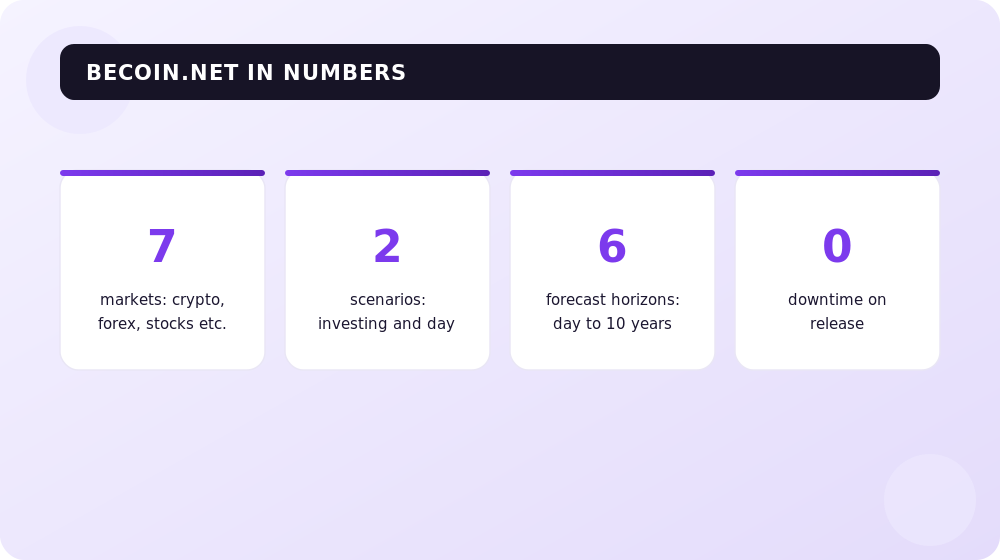
| Parameter | What We Did |
|---|---|
| Project | BeCoin.net |
| Niche | trading, investing, asset forecasts |
| Format | a multilingual product site with dynamic data |
| Markets | crypto, forex, stocks, commodities, indices, ETF, bonds |
| Focus | development, UX, SEO-ready architecture, analytics, a stable release |
The Task the Project Came With
The platform needed a site that can display forecasts and market data in a way that lets the user immediately understand the value of the product. For such a niche, static pages aren’t enough: fresh data, clear filters, fast access to assets, and careful handling of different languages all matter.
The main requirements:
- show real data already on the first screen, without the feeling of an “empty template”;
- separate the investing and day trading scenarios;
- give the user search, filters, categories, and pagination without overload;
- prepare the forecast pages for indexing;
- make the structure scalable for different languages;
- connect analytics and Search Console control;
- release changes safely, without the risk of breaking production.
What We Developed
1. The Product Structure of the Site
We designed BeCoin as a product system rather than as a set of separate pages. The structure now includes:
- a homepage with market signals;
- a forecast catalog;
- individual asset pages;
- sections by market categories;
- blocks for investing and day trading scenarios;
- support for multilingual URLs and a localized interface.
This approach helps both the user and the search engines: the pages have a clear role, internal connections, and predictable navigation.
2. Live Market Tables
A key element of BeCoin is the tables with assets and forecasts. We implemented an interface where the user can work with different markets:
- Crypto;
- Forex;
- Stocks;
- Commodities;
- Indices;
- ETF;
- Bonds.
For the tables, not only the data but also the behavior mattered: search, filtering, switching categories, pagination, stable rendering on the first visit, and correct loading after a refresh.
Separately, we worked through the first-screen problem: instead of a temporary fake table or an endless loading state, the user should see real data on the first loading attempt.
3. UX for Two Scenarios: Investing and Day Trading
BeCoin has two different usage logics:
- Investing — the user looks at forecasts for different horizons: tomorrow, 7 days, a month, a year, 5 years, 10 years.
- Day Trading — the user works with short-term signals, signal strength, volatility, RSI zones, and timeframes.
We separated these scenarios in the interface so that the user doesn’t mix a long-term forecast with short-term signals. For day trading, we added separate filters and asset search, so that the table works as a tool rather than as a decorative block.
4. Multilingualism and Localization
BeCoin is intended for an international audience, so multilingualism was part of the architecture, not the last layer of translation.
We worked with localized:
- navigation;
- market categories;
- search placeholders;
- table headings;
- warnings and risk notices;
- homepage blocks;
- cards, CTAs, and utility states.
A separate focus was on making sure that no “islands” of English interface remained in the non-English versions: for example, Search assets, Crypto, Stocks, 3 min read, or other strings that often slip through in dynamic components.
5. An SEO-Ready Technical Base
For a project with a large number of forecast pages, it’s important to control indexing in advance. We prepared the technical foundation:
- sitemap;
- canonical;
- hreflang;
- schema.org;
- robots.txt;
- internal links;
- correct page statuses;
- redirect control;
- preparing old or invalid URLs for closure via 410 where needed.
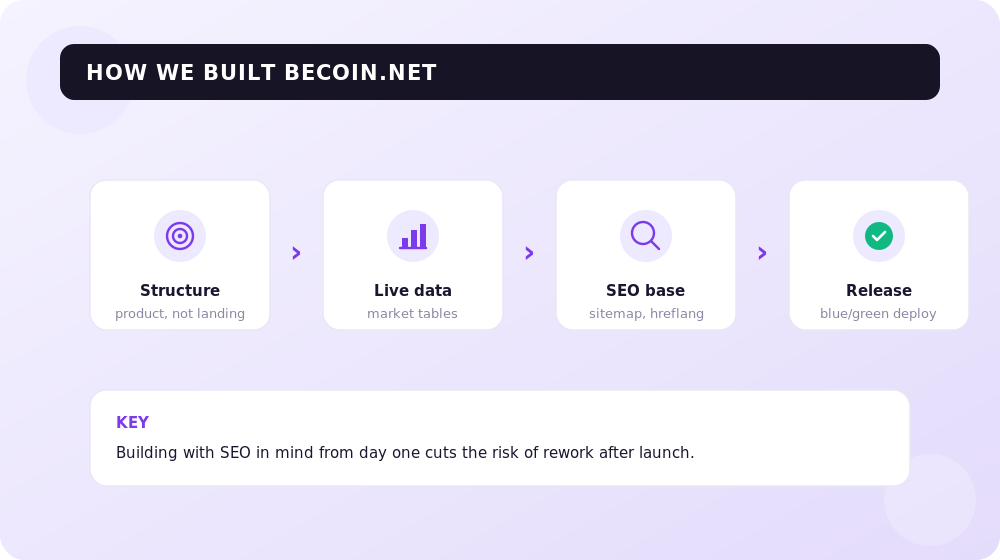
This is not “SEO after development,” but development with SEO in mind from day one. This approach reduces the risk that, after launch, you’ll have to redo templates, URLs, markup, and internal linking.
6. Analytics and Search Console Control
The project needed not only publishing but also observability. That’s why we connected and verified:
- Google Search Console;
- event analytics;
- API behavior;
- indexing signals;
- the status of important pages;
- errors in the sitemap and internal links.
For BeCoin, this is especially important: dynamic data, different languages, and a large number of pages create more risk points than an ordinary services site.
7. A Safe Release Process
For production, we used a safe blue/green deployment. The logic is simple: the new version is first built and checked separately, then switched over only after runtime checks.
The process included:
- fixes in a clean local version;
- type-check;
- a staging release;
- copying only the needed files;
- a remote build;
- switching staging;
- browser checks and API checks;
- a production release only after confirmation;
- a blue/green cutover with the rollback version preserved.
Such a process is especially important for a site where the homepage, the API, and localization must all work stably at the same time.
Why This Was Difficult
The main difficulty of BeCoin is the intersection of several tasks in a single interface:
- product logic;
- financial data;
- SEO;
- multilingualism;
- dynamic APIs;
- the speed of the first render;
- stability after release.
The usual approach of “first we’ll build the layout, then connect the data, then think about SEO” wouldn’t have worked here. We had to keep the user, Googlebot, and the developer who will maintain the system after launch all in mind from the start.
What We Achieved
As a result, BeCoin got a platform where:
- the homepage shows real market data;
- investing and day trading are separated as different user scenarios;
- the tables have categories, search, filters, and pagination;
- the forecast pages are ready for SEO scaling;
- the multilingual interface doesn’t break on dynamic blocks;
- production releases go through staging and a blue/green switch;
- the team can safely continue to develop the product.
What Matters for Similar Projects
If you’re developing a site with dynamic data, multilingualism, and SEO tasks, don’t put off the technical architecture “for later.”
First, you need to answer the questions:
- which pages should be indexed;
- which URLs should be closed or removed;
- which data the user sees on the first screen;
- how the fallback works if the API responds slowly;
- how dynamic strings are localized;
- how to verify a release before production;
- how to quickly roll back if something goes wrong.
This is precisely what distinguishes a site that just looks ready from a product that can be scaled.
Need a site with an SEO base, multilingualism, and a safe launch? Take a look at SEOquick's website development service or book a short project review.

H1 vs Title: how many H1 tags you need and how they differ
H1 in SEO 2026: how many H1 headings are acceptable, optimal length, how it differs from title, empty H1 and H1 as an image. Based on a measurement of 77 pages from the Ukrainian top and data on how often Google replaces your title with the H1.
Read →
Pagination SEO: how to index list pages without breeding duplicates
Pagination SEO in 2026: canonicals on list pages, noindex, rel=next/prev, infinite scroll, crawl budget. Based on a check of 36,000 traffic-driving URLs across twelve Ukrainian retailers, plus a teardown of pagination at Foxtrot, Epicentr and our own blog.
Read →
URL Structure: The Full Guide to Addresses You Can't Change After Launch
How to get URLs right: transliteration or Cyrillic, slug length, duplicates from case and filters, pagination, UTM tags, redirect maps. A breakdown of Rozetka, Comfy, Prom and Makeup URLs plus 2026 research data.
Read →Want to apply this to your site?
We will review the current situation, find the first growth levers, and suggest a practical working format.