SEO Agency Contract: What to Check
I went through 22 Ukrainian agencies and 21 court cases on SEO contracts. Only two publish a services agreement, and neither of them does it through a Ukrainian legal entity. And nobody answers the question of what you keep after you leave.


Short answer: a contract needs six things — a measurable subject matter with a list of works, a payment obligation covering only the period immediately ahead, the right to walk away without a penalty, an answer to the question “what do I keep after I leave”, reporting on a stated schedule and a working communication channel. A position guarantee does not belong in the contract: any number written into it works in court against whoever wrote it. I checked 22 Ukrainian agencies — only two publish a contract for SEO services, and neither of them has a Ukrainian legal entity.
People read this article the day before they sign. So it is built not as a reflection on what an ideal contract should look like, but as a list of what to open in the document you have been sent — and what will most likely not be in there.
About the conflict of interest up front. We sell SEO and we hand clients our own contract to sign. So I am not going to write “pick the one with better terms” and leave you guessing who I mean. At the end there is a separate section where I ran my own contract through this same checklist and named the two places in it that fail the check.
What I checked and how
Three sources, all captured by hand on 3 October 2026.
Twenty-two Ukrainian agencies. I opened every site and looked for: a public contract or offer, the wording on guarantees, KPIs, timelines, payment terms, termination conditions, what happens to accesses and links, reporting. I took only what is actually written on their pages, with a link and a date.
Twenty-one court cases from the Unified State Register of Court Decisions — disputes between clients and contractors over website promotion agreements, from 2010 to 2026. Four reached cassation. This is the most useful part: in court you can see exactly which wordings break and which hold.
The legal framework — from the text of the laws themselves, not from someone else's retelling. That matters more than it sounds: so much has changed over the past year that half of the articles about SEO contracts on the Ukrainian internet are simply wrong today.
There are almost no public contracts on the market
A public contract for SEO services turned up at two agencies out of twenty-two. Neither is a Ukrainian legal entity: at one of them the party to the contract is an Estonian company with disputes governed by Estonian law; at the second the Ukrainian domain has long redirected to an international one, and the terms are written in English.
Six more have documents that look like a contract but are not one: terms of use for the website, SLAs, offers for training courses. A separate case is an agency whose page «Публічна оферта» (Public offer) exists in all three language versions and contains exactly two lines: the heading and the subheading «Текст публічної оферти» (Text of the public offer). The text itself is not there. An SEO agency built an SEO-optimised contract page and did not put a contract in it.
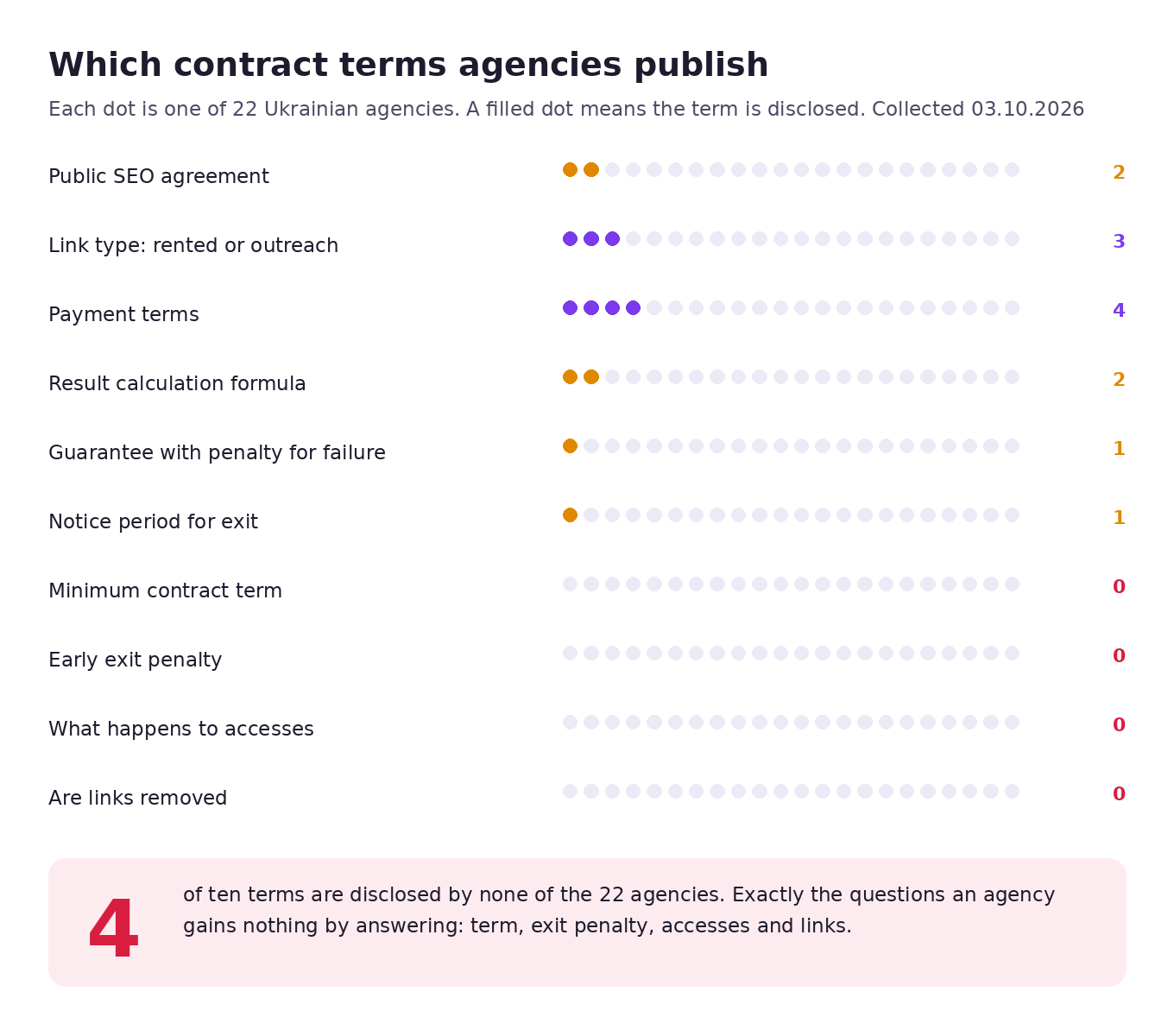
But something else is more interesting — not what is missing in whole, but what is missing at every single one of them.
| What a client wants to know before signing | How many of the 22 publish it |
|---|---|
| Minimum contract term | 0 |
| Termination notice period | 1 |
| Penalty for leaving early | 0 |
| What happens to accesses after termination | 0 |
| Whether purchased links are taken down | 0 |
| Payment terms: prepayment or payment in arrears | 4 |
| The formula for calculating the billable result | 2 |
| A guarantee with a described sanction for non-performance | 1 |
The four zeros in this table are neither an accident nor laziness. These are exactly the points where the answer is inconvenient for the contractor. As long as they are unnamed, the agency keeps its room to manoeuvre and the client keeps hoping it will all be handled decently.
The landing page promises one thing, the document says another
The most telling observation of the whole audit: at many agencies the sales page and the legal document read as if they had been drafted by two departments at war with each other.
The agency with the Estonian legal entity says on its landing page: entrust your SEO promotion to professionals to get a guaranteed result. In its own public offer, liability is removed entirely — the contractor is not liable for any losses, including loss of commercial benefit, business interruption and loss of data, even if the client was not warned that such losses were possible. The compensation cap is the amount for a single billing period.
Another agency placed the heading “Guaranteed promotion of your site into the top” on one page, and a paragraph below it its own text saying that any competent SEO will tell you there is no such thing as a guarantee in SEO, and that an honest optimiser will not undertake to bring a site into the top 3 by a specific date for an agreed sum. Both statements live on the same URL.
The practical conclusion: read the document, not the landing page. If there is no document, assume there are no promises either, because you cannot hold anyone to a landing page.
Subject matter: why “a package of works” means nothing
The most common way contractors describe the subject matter is “a package of works on website promotion”. It looks solid and means nothing: it makes it impossible to establish what exactly the contractor was supposed to do, and therefore impossible to prove that he did not do it.
A properly described subject matter contains three things: the specific website address, a list of works with volumes, and the period for which that list has been agreed. Here is how we do it: the contract states the site's URL, one contract covers one site, and the list of works and the amount live in a monthly annex. If the client launches a second site in a related niche, that is agreed separately — otherwise his own two sites start competing with each other in the results.
Let me point out separately what has disappeared from the law. Until 28 August 2025 the Commercial Code was in force, and it contained an article requiring the subject matter of a commercial contract to be itemised. That Code has been repealed. Itemising the subject matter is now entirely your own problem, and no legal provision will demand it on your behalf. If you are reading an article about contracts that cites articles 180 or 231 of the Commercial Code, it is out of date.
Any position number in a contract works against whoever wrote it in
This is the main lesson from case law, and it is counterintuitive. Clients insist on writing positions in, believing that this protects them. In reality they are creating a tool — but it does not always work the way they intended.
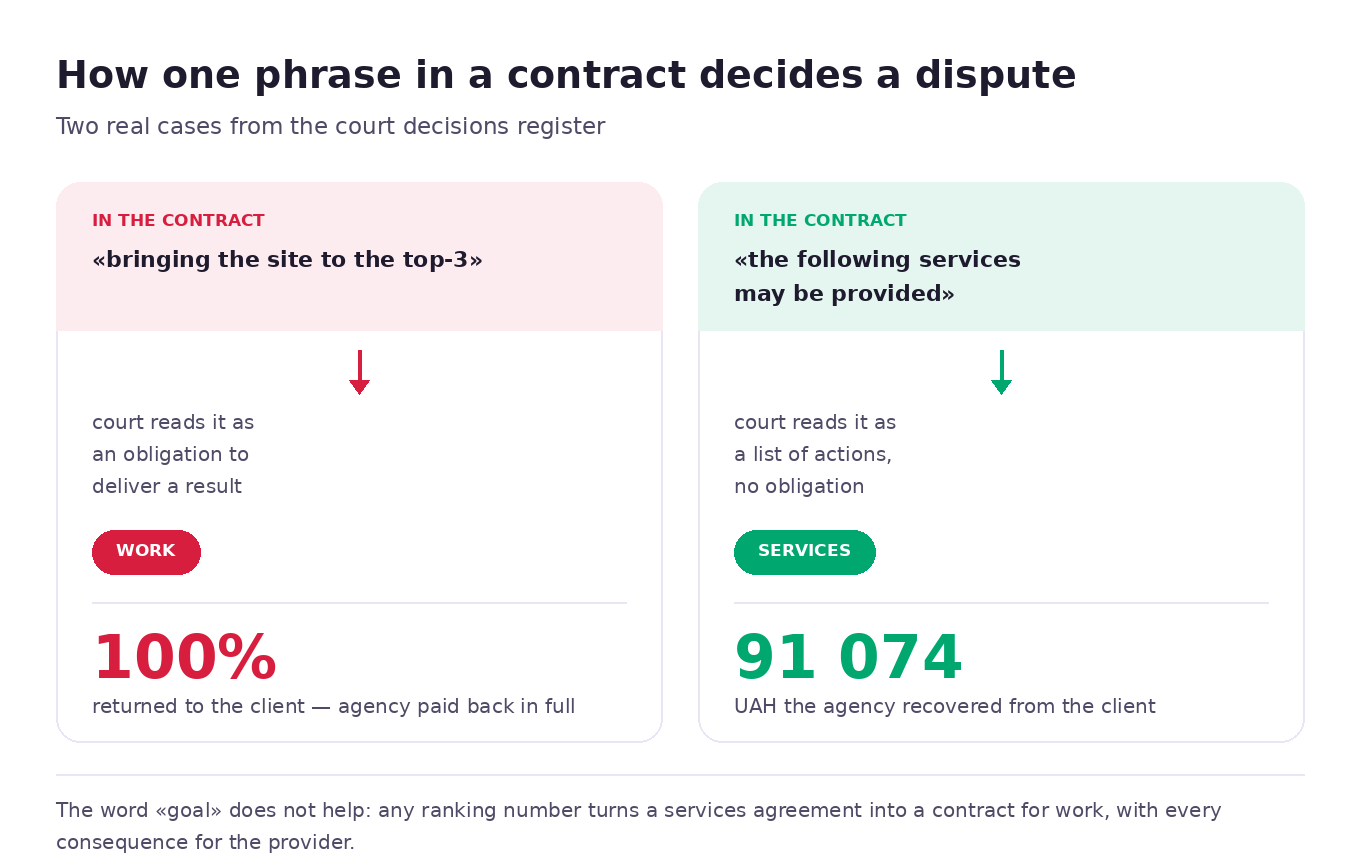
In one case the contract stated that the main goal of the cooperation was bringing the site into Google's top 3. The word “goal” did not save it: the court read this as an obligation to achieve a result, held the contract to be mixed — services plus work — and applied the rules on contracts for work. The agency refunded the client the full amount.
In another case the contract was drafted differently: services “may be provided”, recommendations were to be implemented by the client, and the goal was formulated as attracting users, with no numbers. The court wrote it out plainly: the terms of the contract do not establish clear obligations such as bringing the site into the top 10, and no guarantees of any kind are provided for. The agency recovered UAH 91,074 of debt from the client.
And in a third case the court measured the result from the agency's own reports. The contract contained an obligation to secure promotion onto Google's first page for the queries listed in the annex. The agency dutifully sent its reports, and those reports showed: first 1 query out of 31, then 3 out of 31, then 0 out of 31. Its own reporting became the evidence against it.
Two conclusions follow, and they differ depending on which side of the table you are on. For the client: a number in the contract gives you a chance of getting your money back, but only if it is worded as an obligation rather than as a “goal” or a “forecast”. For the contractor: once you write a number in, you take on work-and-materials liability instead of a services obligation — with everything that follows.
We do not write position numbers in, and we say so openly. Not because we are afraid of liability, but because you can only promise what you control. None of us controls Google's algorithm.
Guarantees: what can actually be promised
Of the 22 agencies, 19 use the word “guarantee” in one form or another. But look at what stands behind it and the picture splits into three groups.
Ten agencies deny any guarantee of results. The wordings vary in bluntness: “we do not promise the impossible”, “no agency can guarantee first positions in Google”, “there are no guarantees in SEO”. One of them adds what the rest keep quiet about: guarantees in such cases are usually built into the price tag. In other words, you simply pay extra for the “guarantee”.
Four promise a result using the word “guarantee” — up to and including a guarantee of sales. None of them has any description alongside it of what happens if the result does not come.
And one out of twenty-two publishes a sanction. The only one on the entire market. Its terms say: a certain level of organic traffic is guaranteed, and if it is not reached, the package price is reduced by 35% or the shortfall in traffic is bought through Google Ads. It kicks in from the third month. You can argue about how well buying paid traffic substitutes for organic, but it is the only public mechanism on the market — at everyone else, the guarantee carries no consequences.
Separately, there are guarantees on links, the only material obligation that shows up at all: one agency promises six months of free restoration of publications if links are removed, another twelve.
My position is simple. You can guarantee what is within your power. Positions are not within our power, traffic is partly, but the scope of work, the deadlines, the methods, the reporting and what the client keeps after leaving are entirely. There is more on this in the piece on guarantees in SEO promotion; here we are talking about the document.
KPIs: a metric without a formula is worth nothing
Eleven agencies out of 22 name a specific metric. But only two give the formula for calculating it. The difference is fundamental, because disputes arise not over the metric but over how to count it.
The best formula I found on the market looks like this: the billable number of visits equals total traffic minus baseline traffic minus branded traffic. Baseline is the average monthly traffic over the year before the work started, taken as the median and locked in at the moment the contract is signed. Branded traffic is filtered out with a regular expression in analytics.
Note what has been done right here. The baseline is locked in — otherwise the contractor gets credit for growth that would have happened without him. Brand is excluded — otherwise the KPI picks up people who were searching for the company by name anyway. The data source is named — otherwise each side counts in its own system.
If your contract just says “30% traffic growth”, ask three questions: from what baseline, over what period, and do we count branded queries. Without those answers it is not a KPI, it is a wish.
How much you are obliged to pay up front
This is the most underrated clause in the contract, and it is the one that determines whether you are free or not.
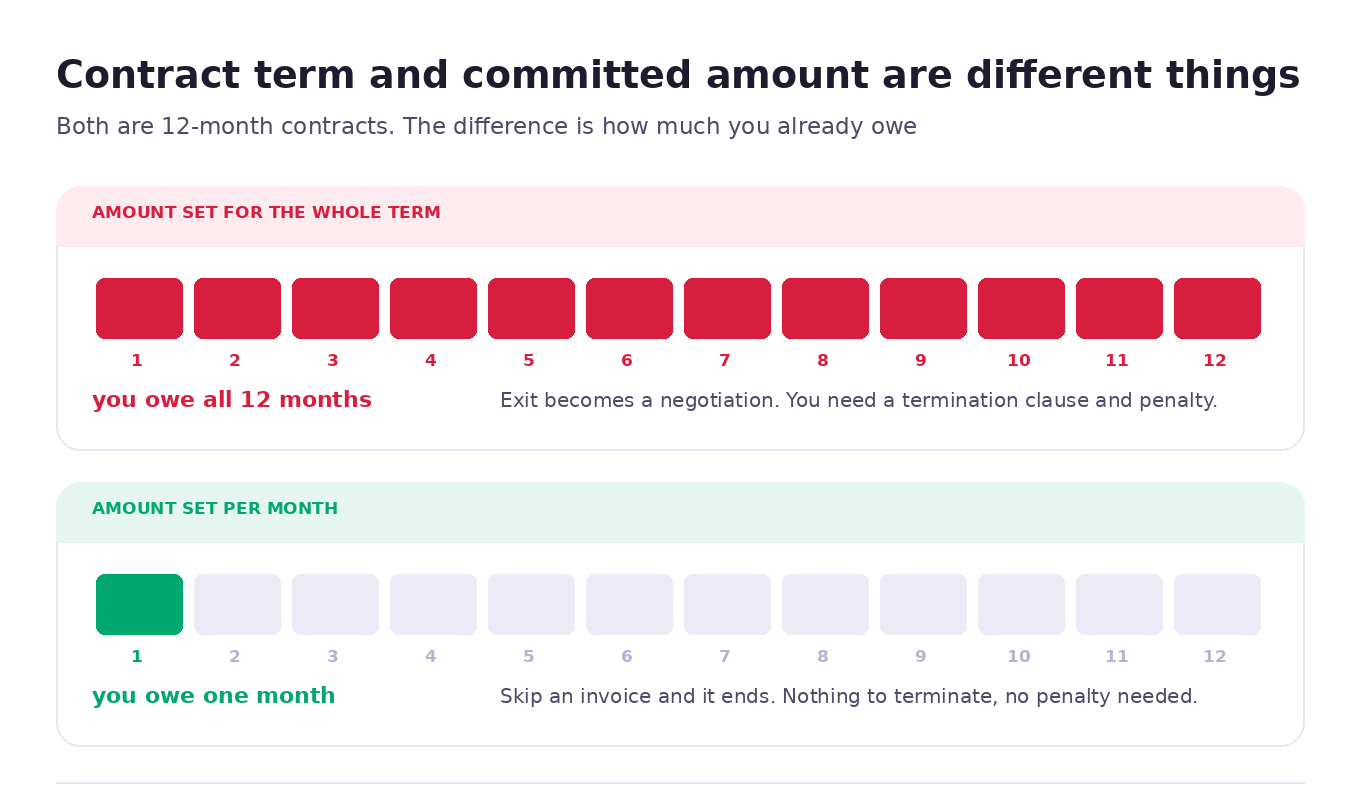
The term of the contract and the amount you are committed to are different things, and they get confused constantly. The contract can be concluded for a year, but the question is a different one: what amount did you sign up for. If the document states a total amount for twelve months, you owe all of it, and what follows is haggling over how much they withhold if you leave early. If the contract states the amount for the coming period and then separate invoices and annexes follow, you owe nothing beyond the current month.
We work on the second design, and I consider it the only honest one. The contract states a monthly amount. Then each month gets its own invoice and its own supplementary agreement with the scope of work. The one-year term of the contract itself serves exactly one purpose: so that the client can press pause and come back without redoing the paperwork. A seasonal business stops for two months and returns under the same contract.
The side effect of this design is the most important part. There is nothing to exit from in such a contract. No obligation to pay up front means nothing to be released from. You do not pay the next invoice, and the engagement is over. That is why we need neither exit penalties nor complicated termination procedures: there is nothing to terminate.
At everyone else, the clauses on termination, notices and sanctions exist precisely because their contracts create an obligation stretching forward. Check yours: if there is a penalty for leaving early, then somewhere above it there is an amount you already owe.
Exiting the contract: the article everyone cites does not work
Here I have to say something that goes against the common belief. It is widely assumed that a client of services can withdraw from the contract at any time — the usual citation is article 907 of the Civil Code of Ukraine. That article grants no such right. It refers you back to the contract itself, to the Code, or to another law. An unconditional right to walk away at any moment exists only in contracts for work.
The practical conclusion: if your services agreement does not say you can exit, you cannot. The law will not write that clause in for you.
In court this plays out harshly. In one case the contract allowed the client to withdraw only in the event of a breach by the contractor and only after written warning. The client did not follow the procedure, left on his own and lost the entire prepayment, UAH 33,440. In another case the court held the services to be “an inseparably connected package”, which made it impossible to calculate arithmetically the value of partially completed work: the client who left on his own initiative paid in full.
And the reverse case: where the list of works was generic and not broken into stages, the court split the prepayment in half, taking the contractor's unilateral acceptance act as its reference point.
What this means for you: look for the clause on your right to exit. If it is not there, insist on it. The minimum wording: the client is entitled to withdraw from the contract by notifying the contractor in writing and paying for the services actually rendered in the current period. And separately, on unearned prepayment: by default it is not refunded, which follows directly from the Code, so the refund clause has to be written in by your own hand.
What you keep after you leave
Not one of the 22 agencies answers this question in its public materials. Not about accesses, not about links. Meanwhile one of them advises, on its own blog, asking the contractor whether the backlinks built during the engagement are subject to removal. So the market knows about this problem and still does not put it in writing.
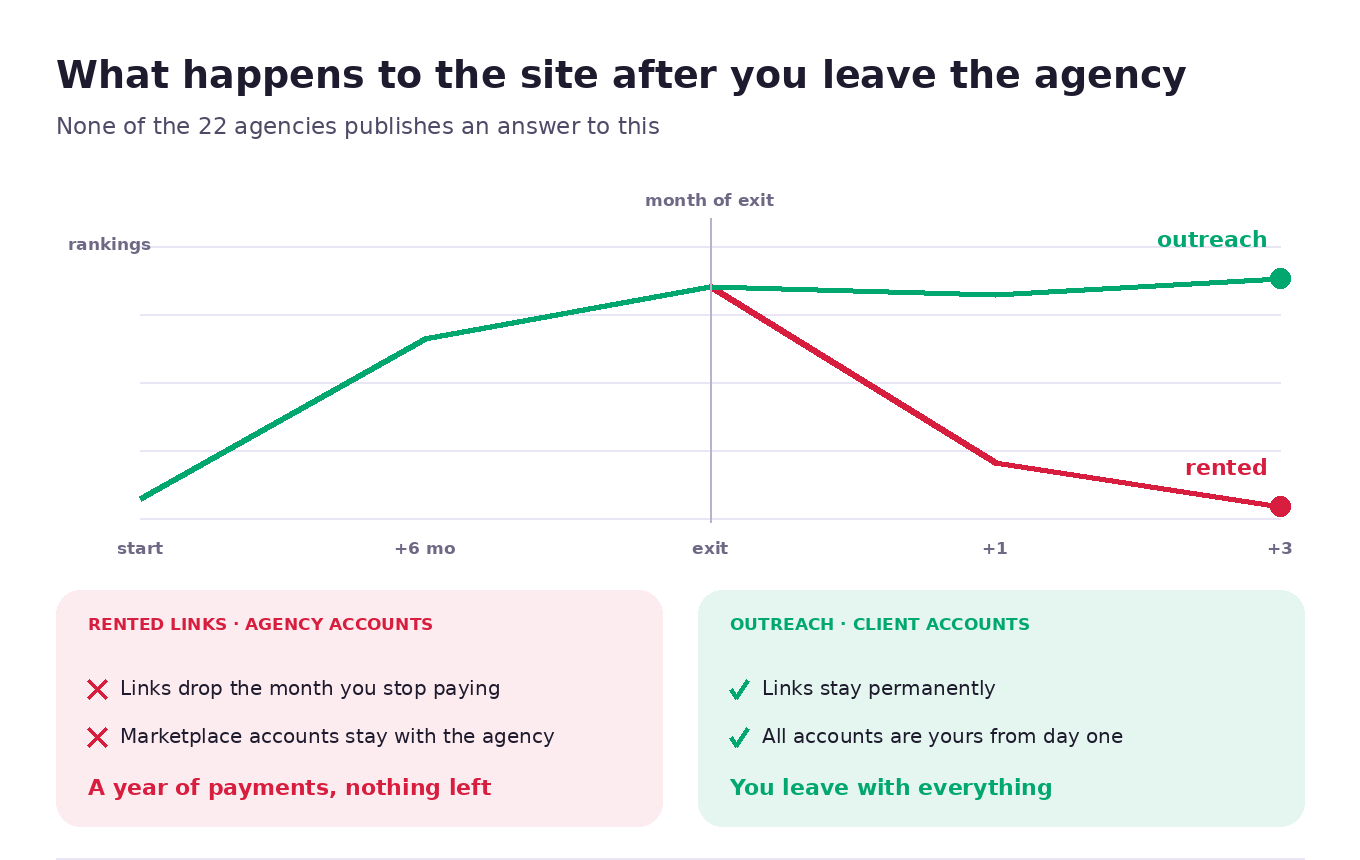
Let us look at the mechanics. Links come in two kinds: rented and permanent. A rented link sits on someone else's site exactly as long as the monthly fee is paid for it. Stop paying and the link comes down. If your contractor promoted you with rented links, then in the month you leave it is not only the work that collapses but the entire accumulated link profile: you lose the positions you paid for all year.
A permanent link obtained through outreach is a publication on someone else's site that stays there whether or not you keep working with the contractor. It cannot be taken down, because it was never rented.
Three agencies out of twenty-two state the type of links outright. One of them, incidentally, honestly lists “temporary links” in its packages — and that is decent in its own way, because at least the client can see what he is paying for.
The second half of the question is accounts. If marketplace accounts, directory profiles and services are registered to the agency, you are left without them when you leave. Three out of twenty-two publish a substantive provision on this.
Now an important observation about the contract itself. A document's silence about accesses can be read two ways. Either the agency never thought about it — and then you are at risk. Or it has nothing to hand over, because everything was registered in your name from the start — and then the clause is simply unnecessary. In the text of the contract these two cases look identical.
One question to the contractor tells them apart: whose name are the accounts registered in, and what links do you buy — rented or permanent? The answer says more about the contract than ten pages of text.
We do not have this clause in our contract and we do not need it: we create nothing on our own accounts, we use strictly the client's, and we get links through outreach. There is nothing to hand over when a client leaves — everything is already his. Even if we wanted to, there is nothing we could switch off.
Rights to texts, design and code
The good news: by law, the rights to what a contractor created on your order pass to you in full from the moment of creation. That is written directly into the copyright law as amended in 2022. You do not need a separate clause in the contract for this — you only need one for the opposite.
The bad news: the opposite is exactly what often gets written in. Three traps worth checking.
Design. As a work of visual art it stays with its author, and the general rule applies to it differently. If someone drew mockups for you, the rights have to be addressed explicitly.
A “licence” instead of a “transfer of rights”. If the contract says the client is granted a licence to use the materials, that is not a transfer of rights. By default such a licence is non-exclusive, valid within Ukraine and for no more than five years. The difference between “the rights pass to the client” and “the client is granted a licence” is the difference between “mine” and “borrowed”.
AI-generated content. The newest point and the most underrated. By law, an object generated by artificial intelligence is not a work at all — it has a separate legal regime. The wording “rights to works created under the contract pass to the client” simply does not cover it. And today almost everyone writes texts with AI. If this matters to you, it is handled by a separate agreement — in our case, for example, it is not pulled into the main contract, because the vast majority of clients do not raise that requirement, but it is drawn up on request.
Reporting and acceptance acts: what changed in 2026
Thirteen agencies out of 22 publish reporting on a stated schedule, but only one does it in a legal document with deadlines. The difference is substantial: a promise in the “how we work” section commits you to nothing, an obligation in the contract commits you.
We have reporting written in as an obligation: at the end of each reporting month — a position report with rank checks no less often than once every ten days, recommendations on filling the site, and an acceptance act (statement of work completion). Nobody on the market states the frequency of rank checks in the contract. It looks like a trifle — but it is exactly what separates live monitoring from a single measurement at the end of the month taken on a good day.
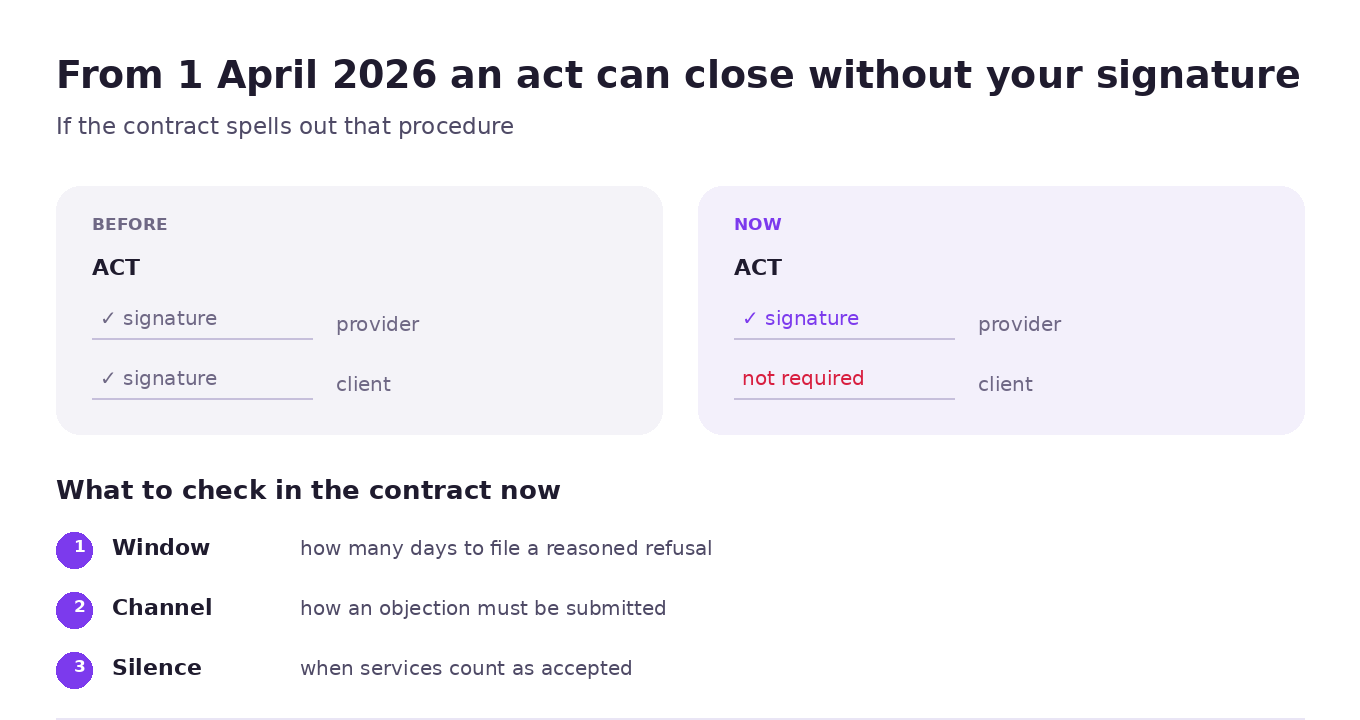
And here is what everyone signing a contract in 2026 needs to know. From 1 April 2026 the contractor may close out acceptance acts without your signature, provided the procedure for doing so is set out in a written contract. The provision is new, introduced into the accounting law.
This is not a trap in itself — a unilateral act is convenient for both sides when the client simply forgets to sign. But now there are two things to check: how many days you are given to raise substantiated objections and by what means those objections are to be submitted. If the deadline is three days and the means is registered mail, you have effectively been deprived of the ability to object.
Case law on acceptance acts, incidentally, settled long ago and cuts both ways. The wording “the act plus N days for a substantiated written refusal; absent a refusal, the services are deemed accepted” won cases for five agencies. And the wording “proper evidence of the provision of services is an act signed by both parties”, with no right of unilateral signature, sank two: no signed act means you lose, however much work was done.
The communication channel — the clause everyone treats as a formality
The most unexpected case in the whole set. The contract stated that the parties exchange documents exclusively by email. All the actual work, meanwhile, was done in a Telegram group that the agency itself had created. When it came to a dispute, the court refused to accept the client's screenshots of the Telegram and Viber conversations — because the contract named a different channel.
In another case, substantiated refusals of acceptance acts were sent as comments in an electronic document management service. They were not counted, for the same reason: the contract named postal addresses.
A conclusion that takes a minute to act on: open the “additional terms” section and check whether the communication channel recorded there matches how you actually talk to your contractor. If the contract says email and the work happens in a messenger, either write the messenger in or copy anything important to email. It is the cheapest clause on the list and one of the most expensive in its consequences.
If the contractor is abroad
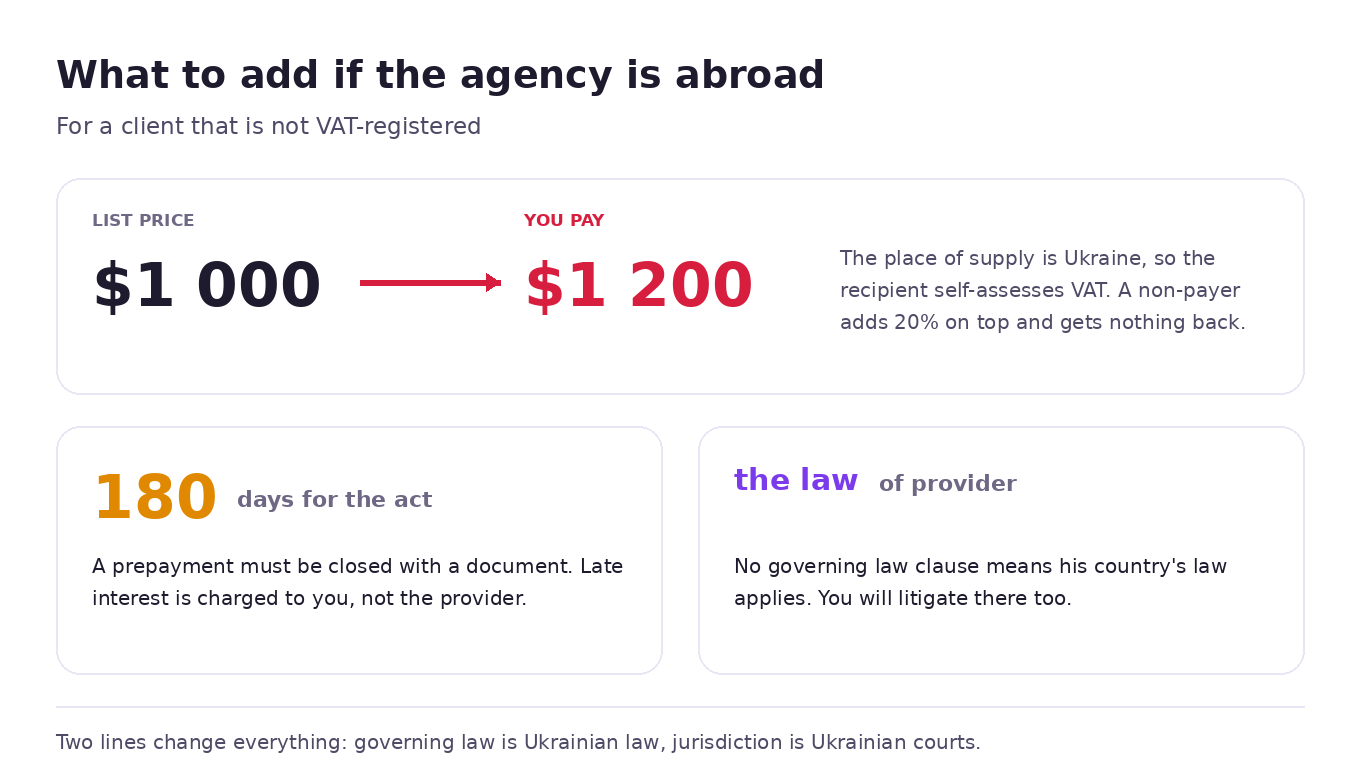
The price is 20% above the price list. The place of supply of advertising and marketing services is Ukraine, which means the recipient charges and pays the VAT himself. If you are a VAT payer, this is neutral: you charge it and claim the credit. If you are not — and most sole proprietors and companies on the simplified system are not — you pay 20% on top and get nothing back. A foreign contractor charging $1,000 costs you $1,200.
Deadlines and currency supervision. With prepayment, you have 180 days to close the operation. If the document is not closed in time, the penalty is charged to you, not to the contractor — for operations from UAH 400,000 upwards.
Governing law. Unless the contract provides otherwise, a services agreement is governed by the law of the contractor's country. No clause, and the Estonian company litigates under Estonian law, the American one under American law. Two lines change the whole picture: governing law — the law of Ukraine, jurisdiction — the courts of Ukraine. If the counterparty will not agree to that, at least you know what you are signing up for.
Let me be honest about my own side too: in our foreign edition of the contract the governing law is American, because the party to it is an American company. The logic is exactly the one I pick apart above when discussing Estonian jurisdiction, only from the other side of the table. For a Ukrainian client we have a Ukrainian edition and a Ukrainian legal entity; the foreign edition exists for foreign clients, and for them jurisdiction at the contractor's location is as natural as the Ukrainian one is for you.
What we actually guarantee
The principle is simple: we guarantee everything that is within our power and promise nothing that is not. The list of what is within our power turns out to be longer than anyone else's on the market — simply because the rest spend their guarantees on positions they do not control.
| What we fix in the contract | How many of the 22 agencies publish it |
|---|---|
| A written undertaking not to use prohibited methods, with the list in an annex | 0 |
| Rank check frequency — no less than once every 10 days | 0 |
| Re-optimisation of a dropped page at no extra charge if it has not returned within 30 days | 0 |
| Reporting as a contractual obligation: report, recommendations, acceptance act | 1 |
| Links stay with the client, accounts are the client's | 0 |
| An explicit disclaimer of any top-position guarantee plus the client's right to decide every month | 0 |
Here is what that list contains, point by point.
We do not use prohibited methods. This is not a “we only work white hat” slogan but an annex to the contract with a list: automatically generated text, copy-paste with no changes, hidden and barely visible text, cloaking, doorways and redirect pages, link farms. We undertake in writing not to use them. The client gets protection from exactly what gets a site penalised — and can hold us to that undertaking.
A report every month with positions, recommendations and an acceptance act, with rank checks no less often than once every ten days.
A dropped page. If a page has left the results and has not come back on its own within 30 days, we re-optimise it for the search engine's current policy at no separate charge.
You leave with everything that is yours. Links are external and obtained through outreach, not rented. Accesses and accounts are the client's. Nothing is created in our name.
You pay a month ahead and no more. You can leave at any time, with no penalty and no procedure. The year in the contract is a framework for pauses.
Link building from the second month. The first goes on on-site work. Selling links from day one is easier and more profitable, but pointless on a site that is not ready.
Confidentiality is written into the body of the contract, not into a separate piece of paper “on request”. Plus a tax clause for foreign clients, so that the tax on imported services does not turn up as a surprise after signing.
And force majeure written for reality: war and military action, prolonged outages of electricity and internet access. For the Ukrainian market that is not a formality.
We send the contract itself to the client for signing — it takes into account the specifics of the country we are working with. The Ukrainian and the foreign editions are two different documents, not a translation of one.
We ran ourselves through this checklist
It would be dishonest to publish a list of requirements for other people's contracts and not apply it to my own. I applied it. Two points fail the check.
We do not have a public contract — exactly like twenty out of the twenty-two. We send it out for signing, but it is not posted on the site. Reproaching the market for being closed, I have to admit that I am on that same list.
The wording on non-refundability. The contract says the amount paid is non-refundable, and by default the law works the same way. In practice we do not behave like that: if a client stops the engagement and part of the work has not been delivered, we return the difference for what was not done — every time. In substance that is stronger than the public refund promises of the three agencies on the market, because theirs come with conditions attached: one refunds only for the first month and only if you are unhappy with the result, another only on its top tier. But none of this is in the text of our contract, and it should be: a clause on returning unearned payment is worth exactly the two lines it takes.
There is a third one too, but I do not count it as a shortcoming, even though it is formally on the checklist: we have no clause on handing over accesses. It is not needed — we create nothing on our own accounts, there is nothing to hand over. But a client reading the contract before signing sees the same silence as everywhere else. One factual line — that all accounts and links are registered to the client — is worth adding: it is not an undertaking to hand anything over, it is a statement of how things are set up.
How you can be misled: nine mechanisms
What follows are the tactics I saw in the audit. There are no agency names here on purpose: the point is not to point a finger at a particular company but for you to recognise the mechanism in any document you are sent. All the quotes below are public texts from websites, captured on 3 October 2026; anyone can open them and check.
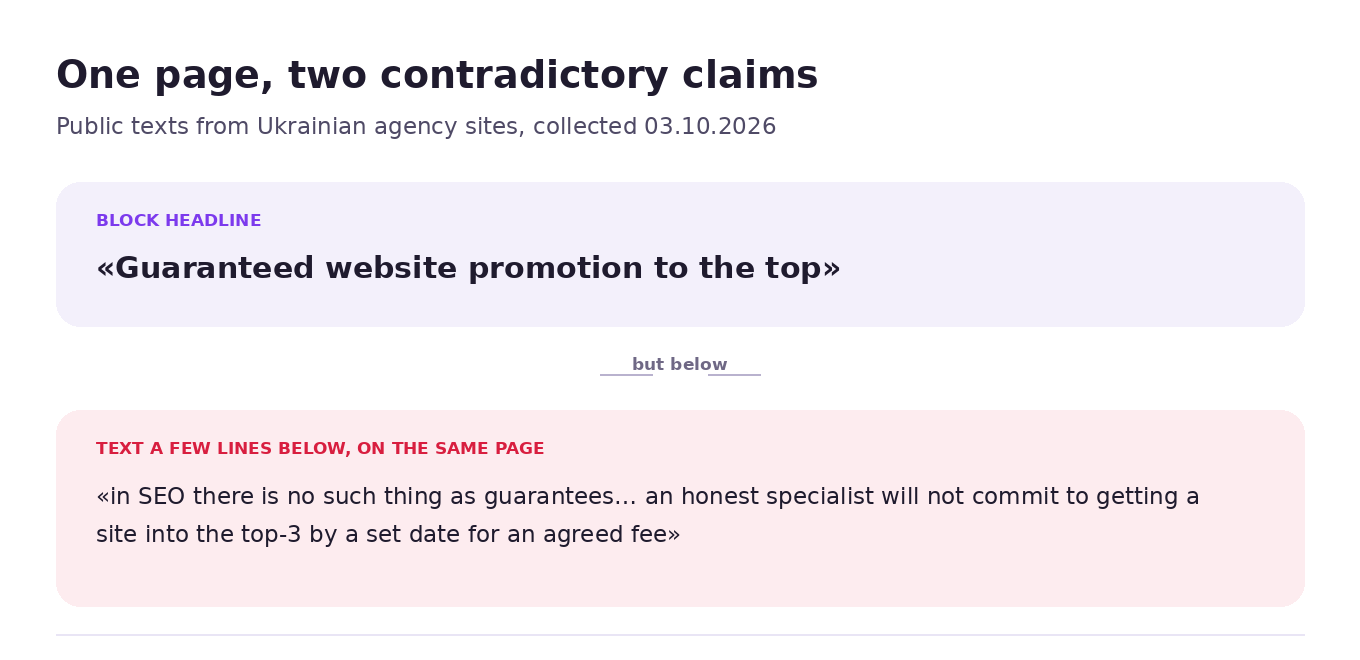
1. A top guarantee with a number. It looks like client protection and works like a price tag: one of the agencies says outright that guarantees in such cases are usually built into the cost. In other words, you pay extra for a word. And if it comes to a dispute, the court, as we have seen, measures the result from the contractor's own reports.
2. Rented links. The most expensive tactic in its consequences. While you pay, the positions are there; stop and the link profile crumbles. Checked with one question: are the links permanent or rented.
3. Accounts in the agency's name. Marketplace dashboards, profiles and services registered to the contractor. Formally you can leave; in practice you leave with nothing.
4. Traffic inflation. One agency warns about this in its own service description: dishonest SEOs inflate traffic, distorting the figures in analytics. And in the same place it allows that the source of the counted traffic may be Google Ads, “if this source is agreed and approved with the client”. Which means you pay for organic and get paid traffic bought with your own budget.
5. One label, different money. “Payment for positions” at one agency means “usually up to 30 keywords in the campaign”, at another “from 500 search queries” — and payment for top positions only starts from the sixth month. The difference in volume is more than fifteenfold, and the service has the same name.
6. Reporting on what grew by itself. From a client review: in the reports they only draw attention to metrics that grew naturally, instead of the results of their own work. The antidote is the locked-in baseline in the contract discussed above.
7. Dead metrics in the report. Alexa Rank, Google PageRank, Yandex SQI and FID. The first service shut down in 2022, the second has not been updated since 2013, the third is a Yandex metric, the fourth was removed from Core Web Vitals in 2024. See any of them and the report was assembled from a decade-old template.
8. Ratings and reviews as proof. I found no independent ratings of Ukrainian SEO agencies. The largest local one sells points directly: verification for UAH 1,000 adds 500 points, a paid account another 500 in each section. International directories sort sponsors first or state outright that some of the places are paid for. Reviews are similar: on one platform the three largest agencies do not have a single review below 4.5, and at another agency 54 of 55 five-star reviews were published within the same six months.
9. A document that does not exist. A page titled «Публічна оферта» (Public offer) containing two lines and no text. A contract handed out “on request, give us a call”. A landing page with a guaranteed result and an offer that removes liability entirely. In all three cases you are being sold the feeling of a document instead of a document.
What 21 court cases teach
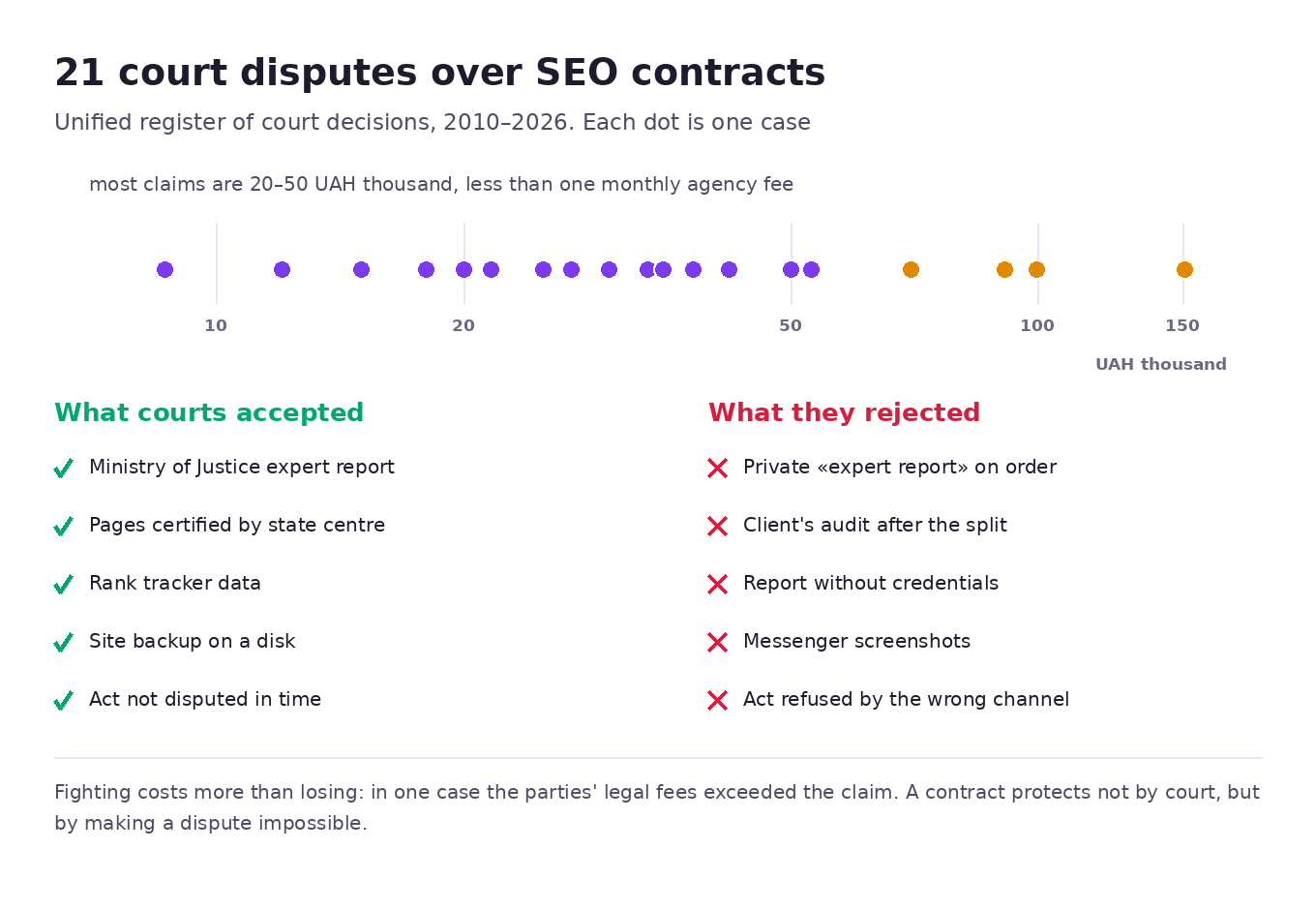
The first thing that stands out is the amounts. From UAH 8,600 to UAH 151,000, most of them in the UAH 20,000–50,000 range. That is less than a monthly invoice at an average agency. In one case both sides' legal costs came to UAH 22,000 in a dispute worth UAH 21,500.
Hence the main conclusion, and it is uncomfortable for everyone: this market barely litigates. Arguing costs more than losing. Which means a contract protects you not through the prospect of court but by making the dispute impossible — by answering in advance the questions the dispute grows out of.
Second: evidence. The courts accepted state expert opinions, web page capture by a specialised centre, data from a rank tracking service, a backup of the site on a disk. And they rejected: a private “expert opinion” commissioned by one of the parties, an audit report from a specialist with no auditor's qualification, a late audit done by the client after the split. In one case the court even refused to order an expert examination, pointing out that the acceptance procedure is established by the contract and can be examined without specialist knowledge.
Third: how the claim is framed. In one case the client called his prepayment “damages” and lost — the court pointed out that these funds do not fall within the definition of damages but are property acquired on a ground that has since fallen away. The money was there, the ground was there, and the claim was lost over a word.
What should not be in the contract
A short list. See any of these clauses and ask your questions before signing, not after.
| Red flag | What it means for you |
|---|---|
| A total amount for the whole contract term | You owe all of it, and leaving turns into haggling |
| A penalty for early termination | A sign that there is a forward obligation somewhere above |
| No clause on your right to exit | The law will not write it in for you |
| A position guarantee with a specific number | The contractor takes on work-and-materials liability and will raise the price; or the number turns out to be unreachable |
| Subject matter described as “a package of promotion works” | Nothing to hold them to: you cannot prove what was not done |
| A communication channel other than the one the work happens in | Your correspondence will not be accepted as evidence |
| No deadline for objections to acceptance acts | Since 2026 acts can be closed without your signature |
| Silence about links and accounts | Either they never thought about it or there is nothing to hand over — only a question will tell |
| No governing law clause with a foreign contractor | You will be litigating under the law of his country |
Checklist: what to open in the contract before signing
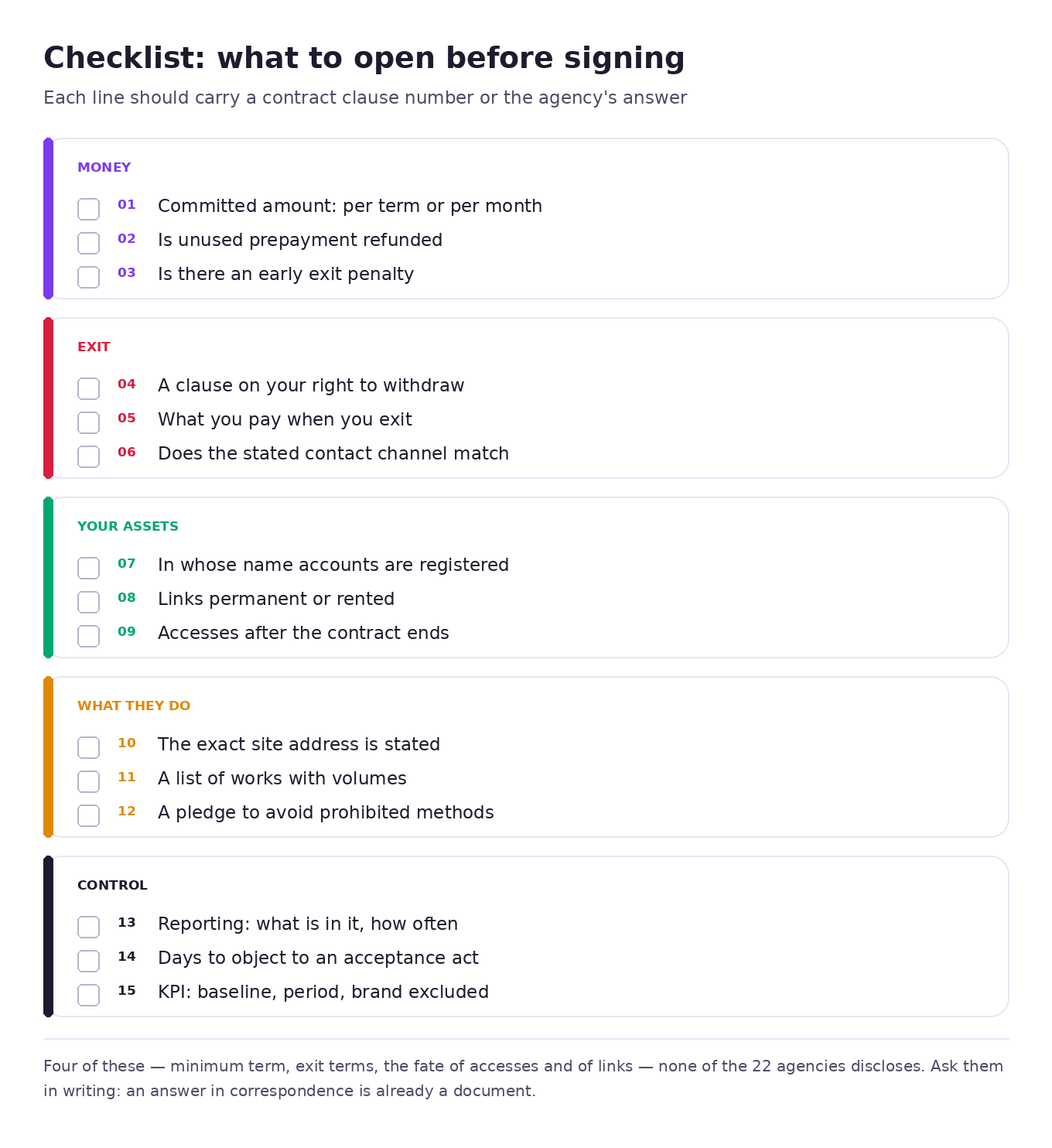
Go through them in order. Next to each point there should be either a contract clause number or an answer from the contractor.
- Whether a specific website address is stated, rather than “the client's site”.
- Whether there is a list of works with volumes — in the contract or in an annex.
- Which amount constitutes your obligation: for the whole term or for the coming period.
- Whether there is a clause on your right to withdraw from the contract and what you pay if you do.
- Whether unearned prepayment is refunded.
- Whether there is a penalty for leaving early.
- Whose name accounts and services are registered in.
- Which links are bought: permanent or rented.
- What happens to accesses once the work ends.
- Whether reporting is specified: what it includes and how often.
- How many days you have to object to an acceptance act and by what means objections are submitted.
- Whether the stated communication channel matches the real one.
- Whether there is an undertaking not to use prohibited methods and whether their list is attached.
- How the KPIs are worded: whether the baseline, the period and the exclusion of branded queries are stated.
- For a foreign contractor: governing law, jurisdiction and who pays the tax on imported services.
Frequently asked questions
Can an SEO agency guarantee top positions?
Technically you can write anything into a contract. In practice such an entry moves the contract from services to work-and-materials, with all the consequences for the contractor, so it is either not offered or priced in. Of the 22 agencies, one publishes a sanction for failing to meet its guarantee.
Can I leave my contractor at any time?
Only if the contract says so. The widespread belief that article 907 of the Civil Code gives a client of services that right is wrong: it refers you back to the contract itself. An unconditional right to leave exists in contracts for work, not in services.
Will I get unearned prepayment back?
By default no — that follows directly from the Code, which is precisely why a separate refund clause is needed. We always return the difference for work not delivered, even where no such clause exists in the contract. But in your place I would not rely on a contractor's decency and would ask for it to be written down.
Who owns the texts the agency wrote?
You do, from the moment of creation, unless the contract says otherwise. Check whether the transfer of rights has been replaced by a licence, and whether design and AI-generated content are addressed separately.
Will the links come down if I leave?
It depends which links they are. Rented ones come down when payment stops, permanent ones stay. Not one of the 22 agencies checked answers this question in its public materials — ask directly.
Do I need a contract if the amount is small?
Yes. The register contains a case where funds paid simply “against an invoice” with no contract were recovered back as unjustly acquired — along with interest and inflation adjustment. It works the other way too: without a contract the contractor has nothing to hold you to either.
What should I do if the agency will not give me the contract in advance?
Treat that as the answer. A document shown only after you agree to work is not a document, it is paperwork for the accountants.
What to do about all this
If you have no time to read all of it, remember three things.
First: you do not need a guarantee, you need the right to leave. But a real right is made up of three conditions at once — no obligation to pay up front, no penalty for leaving, and you leave with everything that is yours. Without the third, the first two are worth nothing: formally you are free, in practice you are tied down by links and accesses.
Second: check the document, not the sales page. A gap between the two is not a rarity but the market norm, and it always favours whoever wrote the contract.
Third: four questions nobody among the 22 answers — the minimum term, the exit conditions, the fate of the accesses and the fate of the links. Ask them in writing before signing. An answer by email is already a document, even if those clauses are missing from the contract.
And if you are choosing a contractor right now, we have a piece on how to choose an SEO agency and a breakdown of what guarantees in SEO actually exist. And to see what shape your site is in going into that conversation, use our free audit — half an hour and zero UAH.

How to choose an SEO agency in 2026: a verification procedure
Not another ranking. Ten criteria with a specific check for each, how to tell a number you can trust from one you can't, what the market actually charges with links to the agencies' own price pages, what belongs in the contract, and when you don't need an agency at all.
Read →
What ecommerce SEO costs in 2026 and what you pay for
Why the same question gets answered with $300 and $3,000, what actually drives the price, what agencies publish on their own sites, the five costs that are never in the quote, and how to work out whether it pays back on your catalogue.
Read →
Website chatbots in 2026: what you are actually buying and how to vet the vendor
Three different products are sold under the word chatbot at roughly the same price. What separates a callback service from an AI widget from a system, a nine-point checklist with live demo tests, seven questions for the vendor, total cost of ownership and rollout times.
Read →Want to apply this to your site?
We will review the current situation, find the first growth levers, and suggest a practical working format.