Medical Website SEO in 2026: SEOquick Research
Healthcare is the most heavily regulated niche in search: Google scrutinizes author expertise, AI Overviews siphon off clicks, and the law restricts advertising. This research is about how a clinic can keep growing in organic search in 2026.


Medical website SEO is a set of activities aimed at improving the visibility of a clinic, doctor, or healthcare service website in Google: technical optimization, content backed by verified expertise, local SEO, and reputation management. There is one difference from other niches, but it is fundamental: in healthcare, Google evaluates not just how relevant a page is, but who wrote it and on what authority.
We published the first version of this research back in 2020. Since then, search has changed more than in the previous ten years: E-E-A-T gained an extra “E” (Experience), Helpful Content arrived, spam policies now target scaled AI content, and AI Overviews and AI Mode reshaped the results page. Old tricks like “add review stars to your snippet and emoji to your description” no longer move the needle. So we rewrote the piece from scratch — as a research-driven guide to medical SEO in 2026.
Over 18 years, dozens of medical projects have come through SEOquick: dental practices, multi-specialty clinics, medical e-commerce stores, aggregators. Everything below is distilled from that practice, cross-checked against current research from BrightEdge, Seer Interactive, Ahrefs, Gallup, and YC.Market, a Ukrainian market analytics service.
How do you promote a medical website in 2026? First, meet the YMYL requirements: every medical text needs a physician author, their license, and a review date. Next comes local SEO: an optimized Google Business Profile brings a clinic its first-touch inquiries from the Local Pack, where AI Overviews barely interfere. Only then scale your content — with structured, direct answers, so you get cited in AI Overviews, which already cover about 88% of healthcare queries.
Timeline: How Google Tightened the Screws on Healthcare (2018–2026)
To understand Google’s logic in 2026, just look at eight years of its updates. The medical niche has been the main testing ground all along: almost every major update hit (or restored) health websites harder than anyone else.
| Period | Update | What changed for medical websites |
|---|---|---|
| August 2018 | Medic Update | The first update to deliberately target YMYL sites. Medical resources without verified expertise lost 40–50% of their traffic overnight. |
| 2019 | March / June / September Core, BERT | Quality sites partially recovered. BERT taught Google to understand the natural language of symptom-related queries. |
| 2020 | January / May / December Core | May 2020 noticeably reshuffled health rankings: sites with physician authorship and links to research came out ahead. |
| 2021 | June/July Core + Page Experience | Core Web Vitals became a ranking factor — page speed and layout stability started affecting service page positions. |
| August 2022 | Helpful Content Update | A site-wide “helpfulness” classifier: SEO copy written “for the robot” started dragging down even decent clinic pages. |
| September 2023 | Helpful Content Update | The classifier got stronger; medical blogs that wrote about everything under the sun for traffic took the hit. |
| March 2024 | Core + new spam policies | The biggest update since Medic. The term scaled content abuse was introduced — mass-produced content with no added value (including AI generation) was officially declared spam. |
| August 2024 | Core Update | Google said it had taken small-site feedback into account; some niche medical resources recovered. |
| January 2025 | Quality Rater Guidelines update | The rater handbook added definitions of generative AI and expanded the sections on scaled content abuse and site reputation abuse. |
| 2025 | March / June Core, AI Overviews worldwide | AI Overviews rolled out across most countries, including Ukraine. CTR for informational medical queries keeps falling. |
| 2025–2026 | AI Mode | A full chat-style search mode: Google synthesizes the answer from sources itself. Expanding to new markets throughout 2026. |
The takeaway from this table is simple: every 6–12 months, Google raises the cost of entry into medical search results. The “write 100 articles about symptoms” strategy died back in 2022; the “generate 1,000 articles with a neural network” strategy was officially buried in March 2024.
YMYL in 2026: What Exactly Google Checks
YMYL (Your Money or Your Life) is a category of topics that can significantly affect a person’s health, financial stability, or safety. Healthcare is the textbook YMYL case: Google applies the highest quality standards from its Quality Rater Guidelines to pages about symptoms, treatments, medications, and procedures.
In January 2025, Google updated the Quality Rater Guidelines, and for medical websites there are three pivotal points:
- Generative AI got an official definition. Raters are trained to recognize AI content and assign the Lowest rating to pages where it is mass-generated without editing or added value. AI itself is not banned — what’s banned is AI content with no human expertise layered on top.
- Scaled content abuse is now its own spam type. Mass-producing pages “to match queries” (symptom + city, drug + dosage) without unique information is now classified as abuse, regardless of whether a human or a neural network wrote the text.
- The “who is speaking” bar for YMYL was raised. Under the guidelines, a treatment page written by an anonymous author cannot receive a high quality rating — even if the text is factually correct. You need an identifiable author with relevant credentials.
In practice, for a clinic this means: every blog post and every service page must answer a rater’s three questions. Who wrote this? Why can this person be trusted on medical matters? When was the information last reviewed?
A distinct nuance of 2025–2026: Google increasingly checks content against the “consensus” of authoritative sources. Pages contradicting the positions of the WHO, the FDA, or official treatment protocols systematically lose ground on informational queries. For “alternative medicine” and homeopathy websites, this has effectively shut down the organic channel for treatment-related queries.
E-E-A-T for Clinics: How to Prove Expertise Technically
E-E-A-T stands for Experience, Expertise, Authoritativeness, Trust. It is not a direct ranking factor with a “weight,” but a framework through which Google evaluates a site’s quality signals. In healthcare, E-E-A-T decides more than links and copy combined.
Physician Authorship Is the Non-Negotiable Minimum
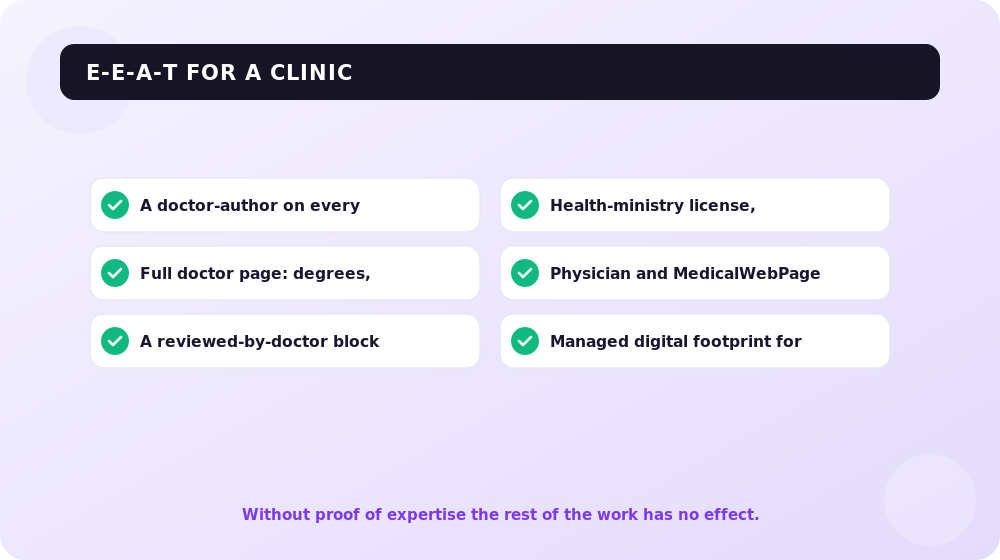
Every medical article and service page must have a physician author, or at the very least a medical reviewer. What to implement:
- An author card below the article: photo, full name, specialty, years of experience, license/diploma number, link to the doctor’s full profile page.
- A doctor profile page on the website: education, certifications, specialty, experience, list of publications and speaking engagements, links to registry profiles.
- A “Medically reviewed” block with a revision date: “Reviewed by endocrinologist Dr. A. Ivanova, last reviewed March 2026.” This is simultaneously an E-E-A-T signal and a freshness signal.
- Schema.org markup:
Physician/Personfor doctors withmedicalSpecialty,alumniOf,memberOffields;MedicalWebPagewithlastReviewedandreviewedByfor articles.
The Doctor’s Digital Footprint Beyond Your Website
Google verifies authors by more than the card on your site. The algorithm connects a doctor’s name with mentions across the entire web. That’s why your clinic’s key physicians need a managed digital footprint:
- profiles in clinic and doctor directories (in Ukraine these are Doc.ua, Helsi, and similar platforms; in other markets — Healthgrades, Zocdoc, and local equivalents);
- publications in industry media and expert commentary;
- up-to-date social media pages listing their place of work;
- consistent spelling of the name and specialty everywhere (otherwise Google won’t “merge” the entity);
sameAsmarkup on the doctor’s page linking to all of their profiles.
SEOquick case in point. For a multi-specialty clinic in Kyiv, we built E-E-A-T from scratch: doctor pages, blog authorship, structured data, a cleaned-up site structure. The result: a 17x increase in organic traffic within a year. Details are in our case study on promoting a clinic website in Kyiv.
Licenses and Clinic-Level Trust Signals
At the site-wide level, Google (and the patient) looks for proof of legitimacy:
- a medical practice license from the Ministry of Health — number and scanned copy, on a dedicated page and in the footer (in Ukraine, that’s the MOH license; in other markets, the local regulator’s equivalent);
- complete legal details, a physical address, phone numbers;
- an “About the clinic” page with history, team, and real photos (not stock images);
- a privacy policy — medical data is sensitive, and Google factors this into its Trust assessment;
- HTTPS, no aggressive ads or popups covering the content.
Structured Data: The Cheap Way to Speak Google’s Language
The must-have set for a medical website: MedicalOrganization or Dentist/MedicalClinic for the organization, Physician for doctors, MedicalWebPage + Article for content, FAQPage for Q&A blocks, and LocalBusiness fields (address, hours, geo coordinates) for branch locations. You can audit what’s already marked up and what’s broken for free — we showed exactly how in a dedicated video.

Clinic Website Structure: The Skeleton Nothing Else Works Without
This section is the only thing that has barely changed since 2020. The basic skeleton of a medical website:
- Homepage — positioning, key specialties, doctors, license, one-click appointment booking.
- Service pages — one per service (not a “dumping ground” of specialties): indications, contraindications, procedure stages, prices, doctors, FAQ. These are the pages that capture commercial traffic.
- Doctor pages — full-fledged E-E-A-T hubs, not a list of last names.
- Prices — an open price list or ranges. Hidden prices kill conversion and user behavior signals.
- Branch location pages — one per location, with unique content and LocalBusiness markup.
- Blog — only topics relevant to the clinic’s services, with authorship and a review date.
Each service page must fully satisfy one search intent. A common mistake is cramming 30 services onto a single “General Medicine” page: such a page ranks for none of the 30 queries.
Local SEO: The Main Patient Channel in 2026
Patients look for a doctor near them: “dentist kyiv pozniaky,” “ultrasound pechersk,” “gynecologist lviv.” For these queries, Google shows the Local Pack — a map block with three businesses — above classic organic results. And here is the key fact of 2026: according to BrightEdge research, AI Overviews appear in 0% of local medical queries. Local results are the last zone where AI isn’t eating the clicks. That’s why a clinic’s Google Business Profile matters more than its blog today.
The Google Business Profile Checklist for a Clinic
- Categories. The primary one should be as precise as possible (“Dental clinic,” not “Medical center”); secondary categories should match the services you actually provide.
- Separate profiles for each branch and, optionally, for key physicians (Google allows practitioner profiles).
- NAP consistency: the name, address, and phone number must match on the website, in the profile, and across all directories down to the character.
- Services and descriptions. Fill in the “Services” section with prices or price ranges — it affects both impressions and conversion.
- Photos. Real photos of the facade, reception, treatment rooms, equipment, and team. Profiles with 100+ photos get noticeably more clicks.
- Reviews — systematically. Ask for a review after each visit (a QR code at reception, an SMS with a link). Respond to all reviews, including negative ones — without disclosing the patient’s medical details.
- Posts and Q&A. Publish news and promotions; pre-fill the Q&A block with typical questions yourself (parking, insurance, pediatric appointments).
- Accessibility attributes, business hours (including holidays), a link to online booking.
- Local pages on the website. Each branch gets its own page with unique content, a map, that branch’s doctors, and
LocalBusinessmarkup. - Local citations: medical directories, map services (Bing Places too), city listings.
SEOquick case in point. We ran a dental clinic on the “local SEO + content + scholarship link building” combo (three campaigns earning links from .edu and .gov domains). Traffic grew roughly 7x and stabilized at 75,966 visits per month. Case study: promoting a dental clinic.
Reviews and Reputation as a Ranking Factor
Rating and review count are a confirmed local ranking factor and, at the same time, the main driver of patient choice. The working benchmark for competitive niches (dentistry, cosmetology) in a major city is 200+ reviews with a 4.6+ rating and a steady inflow of fresh ones. Faking reviews in healthcare is the fastest route to a suspended profile: in 2024–2025, Google purged fake reviews most aggressively in healthcare categories.
AI Overviews and AI Mode: What’s Happening to Medical Search Results
The most serious change since the Medic Update isn’t an algorithm update — it’s a change of the results interface. AI Overviews (the AI summary above the results) and AI Mode (a full chat experience) have rebuilt how patients get medical information.
The numbers worth looking at soberly:
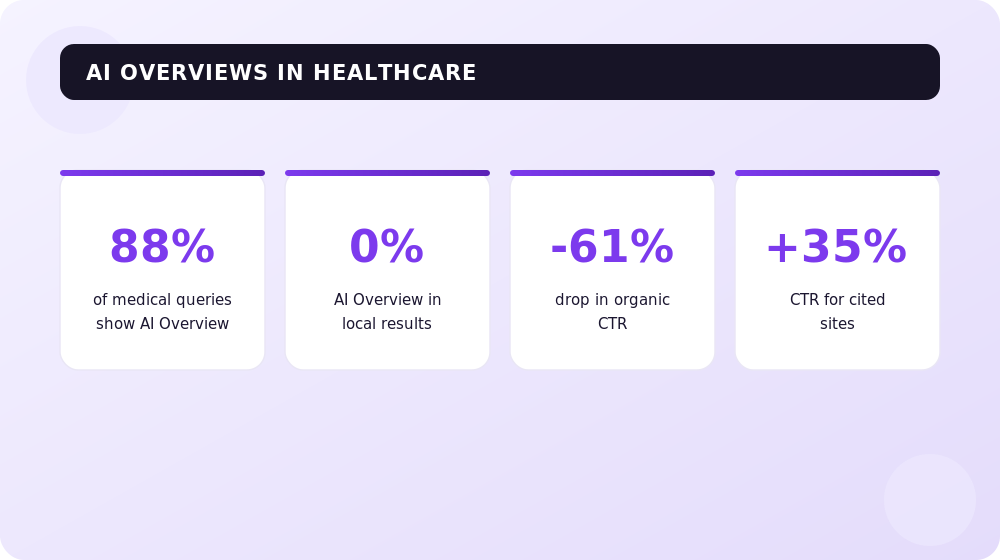
- 88% of healthcare queries already trigger an AI Overview — the highest rate of any niche (BrightEdge research, 2025).
- For queries with “treatment” intent, coverage reaches 100%, while for local medical queries it’s 0% (BrightEdge).
- When an AI Overview is present, organic CTR drops by an average of 61% (Seer Interactive, 2025).
- But sites that are cited inside the AI Overview get 35% higher CTR than uncited sites at the same position (Seer Interactive).
- According to Ahrefs (2025), the first organic position loses about a third of its clicks when an AI Overview is shown, compared to results without one.
- Meanwhile, trust in AI answers about health is low: a Gallup survey (October–December 2025, 5,500+ respondents) found that 25% of Americans already use AI for health questions, but only a third of users trust those answers, and just 4% trust them “completely.”
What this means strategically: informational medical traffic (“what is,” “symptoms,” “why does it hurt”) will keep falling — Google itself now answers those queries. But commercial and local traffic (booking, prices, “near me”) stays with clinic websites and profiles. And getting cited in AI Overviews becomes a distinct SEO goal.

How to Get Cited in AI Overviews
- A direct answer in the first paragraph. Every article starts with a self-contained, 40–60-word answer to the main question — these are the fragments AI extracts most often.
- A question-and-answer structure. Subheadings phrased as patient questions, followed by a concrete answer, then the details.
- Definitions in the “X is…” format — the most-cited pattern.
- Tables and numbered lists for dosages, procedure stages, and method comparisons.
- Freshness with proof: a physician review date, updated data. AI Overviews show a clear preference for recently updated content.
- E-E-A-T signals (author, reviewer, sources) — for YMYL, Google filters AI answer sources more strictly than regular results.
SEOquick case in point. A medical website we promote using this methodology reached TOP-2 for “dentistry Kyiv” and is cited in Google’s AI answers for 26,714 queries — living proof that getting into AI Overviews scales. Case study: promoting a medical website.
AI Mode is the next step: no longer a block above the results, but a dialogue in which Google assembles the answer from several sources itself and provides links. The optimization logic is the same, but the demands on content structure and machine readability are even higher. We covered it in detail in a recent video.

Healthcare Advertising Restrictions: Ukrainian Law and Google Ads Policies
Healthcare marketing is regulated from two sides: national legislation and ad platform policies. Breaking the former risks fines; breaking the latter risks a Google Ads account suspension — which often hurts a clinic more.
Ukraine’s “On Advertising” Law: What’s Off Limits
Since this research focuses on Ukraine’s private healthcare market, here is the national legal framework. Article 21 of Ukraine’s “On Advertising” law sets the boundaries for all healthcare communication, including landing pages and ad creatives (the principles closely mirror healthcare advertising rules in the EU and elsewhere):
- advertising of prescription drugs is prohibited;
- only methods of prevention, diagnostics, treatment, and rehabilitation approved by the Ministry of Health may be advertised;
- images of doctors and medical workers (or actors playing them) may not be used in drug advertising;
- references to specific recovery cases and patient testimonials as proof of effectiveness are prohibited;
- you may not guarantee a therapeutic effect or claim that health will deteriorate without the product;
- targeting drug ads at children or using their images is prohibited;
- a mandatory warning about the dangers of self-treatment is required.
Important: these rules apply to advertising, but a sensible clinic applies them to website content too — “we guarantee a cure in 3 visits” on a service page looks equally bad to a lawyer and to a Google quality rater.
Google Ads Healthcare Policies (2025 Edition)
- Certification is mandatory for advertising pharmacies, prescription drugs, and telemedicine — without it, ads are rejected at the category level.
- Speculative and experimental treatments are banned: cell therapies without regulatory approval, “proprietary rejuvenation methods,” biohacking procedures.
- Health-based personalization is prohibited: you can’t build remarketing audiences based on diagnoses, symptoms, or interest in treatment. This cuts off the standard retargeting playbook for clinics.
- In 2025, Google tightened requirements for telemedicine and online prescriptions: local licenses and advertiser verification are required.
- Some categories (reproductive medicine, addiction treatment) carry additional regional restrictions and format bans.
The practical conclusion: paid search works in healthcare, but everything tied to diagnoses and treatment runs into restrictions. For a clinic, SEO and local search are not an “add-on to advertising” — they are the primary channel that nothing can block.
Ukraine’s Private Healthcare Market: Why Competition Will Keep Growing
A few numbers about the market where all of this is playing out. Ukraine has a large and fast-growing private healthcare sector that operates alongside state medicine — and it is where most of the SEO competition happens. According to YC.Market, a Ukrainian analytics service, 7,768 private clinics operate in Ukraine, and the private healthcare market has reached UAH 64.7 billion (roughly $1.5 billion), growing +26% year over year. Private healthcare is one of the fastest-growing segments of the Ukrainian economy even in wartime.
For SEO, this means three things:
- Competition in search results will only intensify. A growing market keeps bringing new clinics with marketing budgets into search.
- Cost per click in the medical space is rising faster than the market average — making organic search and the Local Pack more economically attractive every year.
- The winners are those who invest in long-term assets: physician E-E-A-T profiles, reviews, medically reviewed content — none of which a competitor can copy in a month.
Key Takeaways
- Medical SEO in 2026 is, first and foremost, proof of expertise: a physician author, licenses, a “medically reviewed” block, structured data. Without these, everything else falls flat.
- Google has raised the bar for YMYL eight years in a row — from the 2018 Medic Update to spam policies against scaled AI content and the updated 2025 Quality Rater Guidelines. Generating medical content with AI and no physician review is a straight path to a penalty.
- AI Overviews cover ~88% of healthcare queries and cut organic CTR by ~61%, but cited sources gain +35% CTR. Optimizing for citation is the new mandatory part of the strategy.
- Local results are an AI Overviews-free zone (0% coverage). Google Business Profile, reviews, and branch pages bring a clinic its warmest patients.
- Advertising restrictions (advertising law, Google Ads policies) make organic search the primary scalable channel for healthcare.
- Ukraine’s private healthcare market is growing 26% a year — the window when positions in this niche can still be claimed relatively cheaply is closing.
FAQ
How long does medical website SEO take?
The first sustainable results come in 4–6 months; reaching target performance takes 9–12 months. Timelines in healthcare are longer than in regular niches: Google is slower to “trust” new YMYL sites, and E-E-A-T signals (authorship, reviews, citations) accumulate over months. A promise of TOP rankings within a month in this niche is a marker of an incompetent contractor.
Can medical articles be written with AI?
Yes as a draft, no as the final product. Google’s spam policies (March 2024) and the 2025 Quality Rater Guidelines explicitly call scaled AI content without added value abuse. The working scheme: AI draft → editing and fact-checking by a physician → a reviewer card with the review date on the page.
What matters more for a clinic: a blog or a Google Business Profile?
Google Business Profile. Local queries bring patients ready to book, and AI Overviews don’t appear in local medical results at all (0% per BrightEdge). A blog is needed, but as a second-stage tool — for capturing informational queries, building E-E-A-T, and earning citations in AI answers.
How do you get into AI Overviews for medical queries?
Give Google an extractable answer: make the article’s first paragraph a self-contained, 40–60-word answer to the main question, use question-style subheadings, “X is…” definitions, tables, and lists. Add strong E-E-A-T signals: a physician author, a review date, links to research. For YMYL, Google selects AI answer sources more strictly than regular results.
Traffic dropped after a Google core update. What now?
Diagnosis first: which pages and queries declined (Search Console), and whether the drop coincided with the update date. Then an E-E-A-T audit: authorship, expertise, content quality, absence of scaled “empty” pages. Recovery usually happens at the next core update — 3–6 months after fixes are made; there are no quick rollbacks.
What structured data does a medical website need?
The minimum set: MedicalOrganization (or MedicalClinic/Dentist) for the organization, Physician for doctor pages, MedicalWebPage with reviewedBy and lastReviewed fields for articles, FAQPage for Q&A blocks, and LocalBusiness data (address, hours, coordinates) for branches. Markup doesn’t guarantee rich snippets, but it helps Google and AI systems correctly understand the site’s entities.

H1 vs Title: how many H1 tags you need and how they differ
H1 in SEO 2026: how many H1 headings are acceptable, optimal length, how it differs from title, empty H1 and H1 as an image. Based on a measurement of 77 pages from the Ukrainian top and data on how often Google replaces your title with the H1.
Read →
Pagination SEO: how to index list pages without breeding duplicates
Pagination SEO in 2026: canonicals on list pages, noindex, rel=next/prev, infinite scroll, crawl budget. Based on a check of 36,000 traffic-driving URLs across twelve Ukrainian retailers, plus a teardown of pagination at Foxtrot, Epicentr and our own blog.
Read →
URL Structure: The Full Guide to Addresses You Can't Change After Launch
How to get URLs right: transliteration or Cyrillic, slug length, duplicates from case and filters, pagination, UTM tags, redirect maps. A breakdown of Rozetka, Comfy, Prom and Makeup URLs plus 2026 research data.
Read →Want to apply this to your site?
We will review the current situation, find the first growth levers, and suggest a practical working format.