TikTok SEO in 2026: How to Rank in
Almost half of all users already search for products and answers on TikTok, and for Gen Z it has become the norm. Here is how search inside TikTok actually works, how to optimize video for it, and how a single clip earns visibility in two systems at once — TikTok and Google.


I will look at your site and answer your questions on the topic of this article. 30 minutes, no slide decks, no pressure.
Book a consultationTikTok SEO is all about optimizing videos for TikTok's built-in search: a keyword in the first 3 seconds of voiceover, in the on-screen text, and in the first 80 characters of the caption. The clip gets indexed three ways—the system recognizes speech, reads on-screen text, and parses the caption. In 2026, 49% of users and 65% of Gen Z search this way, and the videos themselves even land in Google video carousels. It's a separate traffic channel that most businesses simply ignore.
Every month on the SEOquick channel, we watch where search is drifting. And one of the most underrated shifts is this: people have stopped opening Google to find "best running shoes" or "cafes nearby." They open TikTok. Let’s break down how internal search works, how to optimize for it, and how to squeeze visibility in two search engines out of a single video.

Has TikTok really become the second search engine?
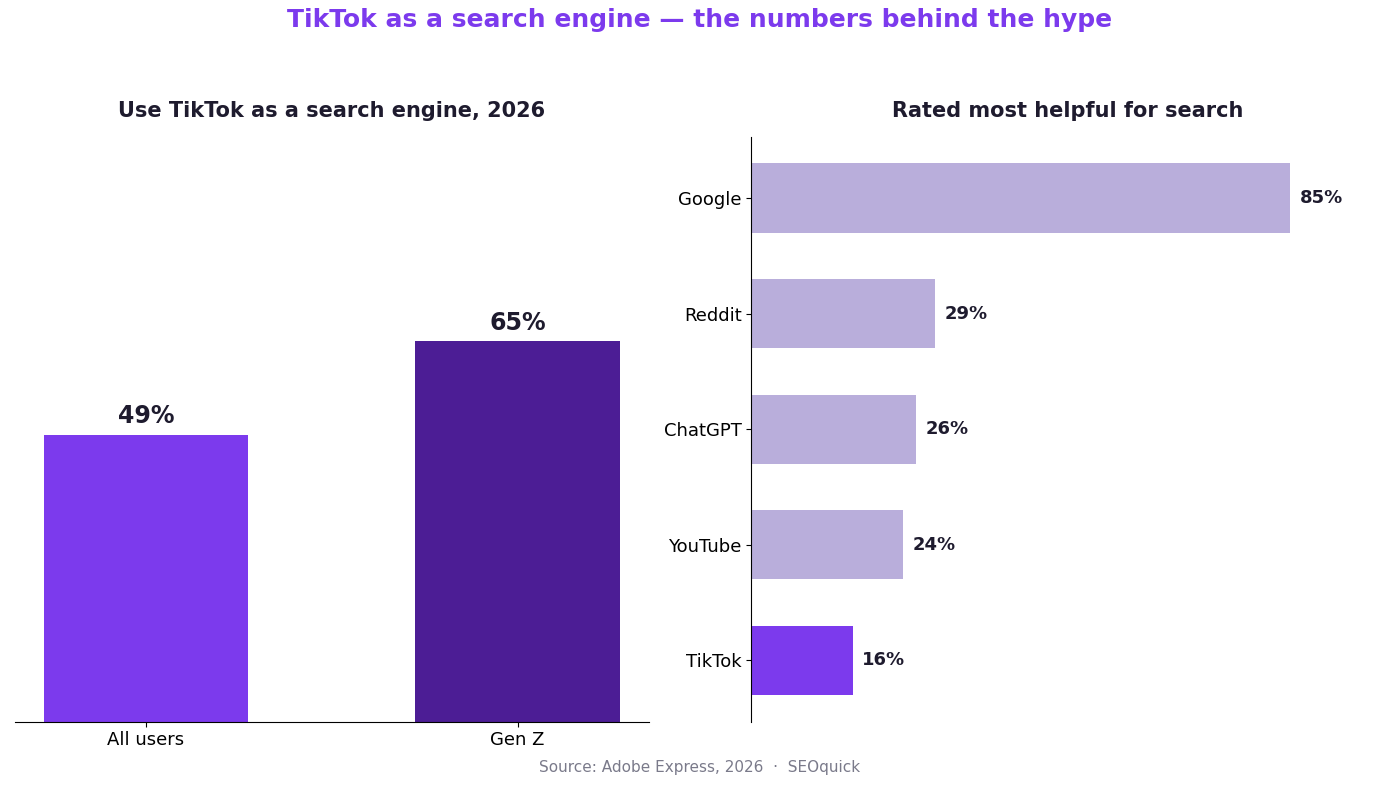
Yes, but with a caveat. According to an Adobe Express study (January 2026, 807 consumers and 200 small business owners in the US surveyed), 49% of users have already searched for something via TikTok—up from 41% in 2024. For Gen Z, that figure hits 65%.
Don't bury Google just yet, though. In that same sample, 85% still call Google the most useful for search, followed by Reddit (29%), ChatGPT (26%), YouTube (24%), and only then TikTok (16%). What’s more: the share of Gen Z who prefer TikTok over Google itself hasn't grown in two years; it actually dropped—from 8% in 2024 to 4% in 2026. So TikTok didn't kill Google; it became a second layer of search—visual, for specific scenarios: products, lifestyle, reviews, "how it looks in real life." Ignoring it means being invisible to half the audience right when they’re deciding what to buy.
How TikTok indexes and ranks videos
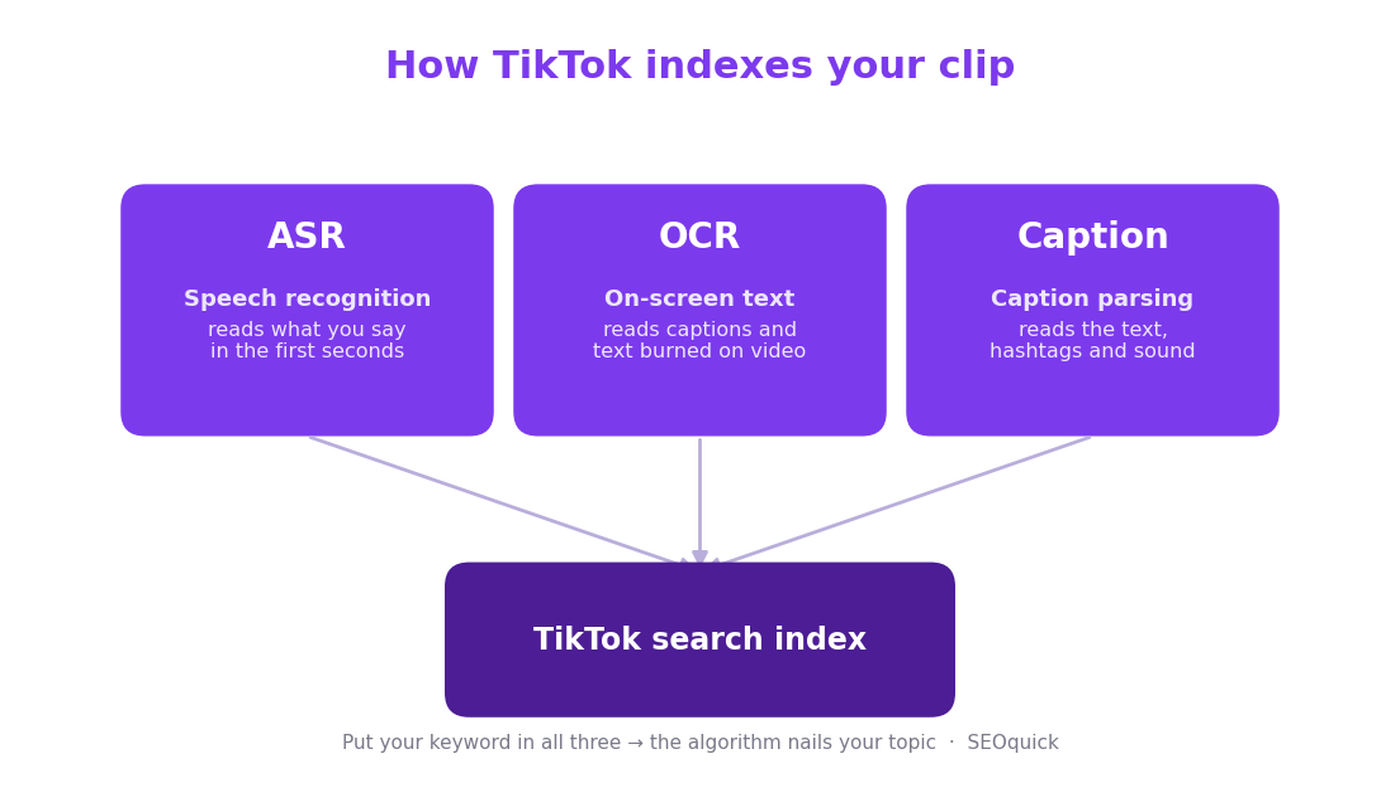
The main thing to wrap your head around: TikTok doesn't see your video as just a picture, but as a set of text signals. It pulls them from three layers simultaneously. It recognizes speech—transcribing what you say out loud, so the phrase "best moisturizer for dry skin" in the first few seconds goes straight into the index. It reads on-screen text via OCR—captions and subtitles directly on the video. And it parses the caption under the video along with hashtags and audio. Hit all three layers with one keyword, and the algorithm understands the topic, no questions asked.
Then ranking kicks in. According to 2026 algorithm breakdowns, the strongest signal is retention: for a video to go viral, you need a completion rate around 70% (in 2024, 50% was enough). Comments weigh more than likes, and direct message shares are the strongest of all. And here's a stat that changes how you view captions: 84% of TikTok searches happen during the research phase. Meaning people are actually searching, not just scrolling, and a keyword-optimized caption with on-screen text decides whether they find you or not.
How to optimize video for TikTok search
The logic is familiar from classic SEO, except the "page" is a 30-second clip. First, find the query: type your topic into the TikTok search bar and watch the auto-suggestions—those are live audience queries. Under competitors' videos, check the "Others searched for" block. Next, drop the keyword in the first three seconds of the voiceover—not "hi, today I'll tell you," but straight to "three mistakes when choosing running shoes": ASR will transcribe it, the viewer won't scroll past, and you've nailed the retention requirement. Duplicate that same keyword with on-screen text—OCR reads the caption, and it's an extra hook for the viewer. In the caption, lead with your focus query in the first 80 characters, not emojis: the caption is the most powerful SEO lever here. And add a few relevant hashtags, a mix of niche and thematic, without spamming generic #fyp and #viral tags.
How one TikTok video lands in Google
The most underrated bonus of TikTok SEO is visibility outside of TikTok itself. Google has been indexing videos for a long time, showing them in video carousels and on results pages. For queries with clear visual intent—recipes, reviews, tutorials, unboxings—a short video often ranks higher than classic pages.
It turns out one properly optimized video works for two search engines at once: it racks up views inside TikTok and pulls the brand up in Google results. For niches where showing the product's face is vital, it's a cheap way to grab a spot in the SERP where a text article would struggle to break through. I broke down similar multi-channel logic in my piece on GEO-optimization for GPT.
TikTok Search Ads: The paid accelerator
Organic is a long game, but TikTok Search Ads give you traffic here and now. For visual niches—clothing, jewelry, cosmetics—the economics are often better than Google. In the video above, I say it straight:
"If you're selling something beautiful and still pouring money into Google Ads, you're likely losing half your cash. A click on TikTok costs 30% less than on Google, and the conversion is higher. People get sucked into TikTok, and when they search for something, they see relevant content and come to you. Properly visualized ads work better than generic search ads, where the cost per click has become unjustifiably expensive."
The point is simple: don't drag Google's banner logic into TikTok. Native vertical video that doesn't look like an ad wins here. Same keyword, same hook in the first seconds—just with a promo budget on top.
Is TikTok SEO worth the investment for business?
Short answer—yes, but keep your eyes open. The entry barrier is rising: according to a 2026 Metricool study, average video views dropped by 31% due to content saturation, and virality is no longer guaranteed—niche content relevant to its community wins, not random hits. Meanwhile, the market is already voting with its budgets: per Adobe Express, 58% of surveyed business owners used TikTok for promotion and allocate an average of 16% of their marketing and 15% of their SEO budget specifically to it. Educational formats perform best in search—61% of users prefer video tutorials, 45% product reviews, and 41% personal stories.
For a practitioner, the takeaway is this: TikTok SEO isn't about "filming one viral clip," it's systematic work with queries and formats, just like a regular blog. It’s worth doing if you sell something visual or can educate your audience—then the channel pays off both inside TikTok and through Google.
FAQ
How does TikTok SEO differ from regular SEO?
The principle is the same—get into search for a relevant query—but the "page" is a video, and ranking is more heavily tied to retention and completion rate. That's why you need to provide the keyword in three places: voiceover, on-screen text, and the caption.
Is it true Gen Z only searches on TikTok?
No. 65% of Gen Z use TikTok as search, but only 4% prefer it over Google—and that share actually decreased. TikTok complements Google; it doesn't replace it.
Do TikTok videos really show up in Google?
Yes—Google shows them in video carousels and regular results, especially for visual queries and those where "how it looks" matters.
Summary
In 2026, TikTok isn't a "dancing social network," it's a second search layer where half the audience and two-thirds of Gen Z are looking for you. The optimization idea is simple: one keyword in three spots (speech, on-screen text, caption), a strong hook in the first three seconds, and a bet on retention. The reward is twofold—views inside TikTok and visibility in Google. And if the niche is visual, TikTok Search Ads will add paid traffic cheaper than overheated Google. Start with 5–10 videos targeting real audience queries and track the share of search traffic in your analytics.
Content Refresh in 2026: How to Revive Old Posts and Win Traffic Back
Updating old articles is more profitable than writing new ones. How to pick pages in Search Console, rewrite the content and win traffic back — the SEOquick method with data and quotes.
Read →
Ecommerce SEO in 2026: A Checklist for AI Search and Zero-Click
An ecommerce SEO checklist for 2026: a product feed tuned for AI Mode, Product schema, AI-citable product content, technical SEO for checkout and cart. A hands-on breakdown with real numbers from SEOquick.
Read →
SEO for Service Websites: A Real SEOquick Case Study and the 2026 Strategy
How to promote a service website in 2026: keyword structure, thin content, links, the Local Pack, and AI search. A real SEOquick case with a 10x organic traffic increase.
Read →Want to apply this to your site?
We will review the current situation, find the first growth levers, and suggest a practical working format.