A website audit: what it actually costs
I captured 31 prices from 13 Ukrainian pages: the same word sells for anything between $33 and $2,035. Here is how a thousand-hryvnia report differs from an audit, which free tools are still alive — and where the addresses of the dead ones lead today.


Short answer: in Ukraine a website audit costs between $33 and $2,035. That is the real spread across 31 prices from 13 Ukrainian pages, captured on 2 October 2026. The median is $335. We charge from $250 for a small site, $500 for a corporate site and from $700 for an online store, and the audit comes with a 75% discount when you order SEO from us. The gap between the bottom and the top is not greed — it is different products: $33 buys an automated report, $500 buys a human-verified breakdown with a developer spec at the end.
The main thing I want to explain here is that a report and an audit are different things, and confusing them is expensive. A report is generated in a minute. Our audit takes several days to a week, and the longest part of it is not finding errors — it is verifying that the error we found is real.
About the conflict of interest, upfront. We sell audits, and we have our own free tool you can crawl your site with without us. So there will be no ranking of "the best audit services" here: I would build any such list to win, and you would feel it. Instead: a measurement of other people's prices with the sources named, a live check of the tools showing where they lead today, and our own numbers quoted first.
A 62x spread: 31 prices from 13 pages
I took the search results for "аудит сайта цена" and "аудит сайту ціна", kept the pages that actually name figures, and captured everything on 2 October 2026. Hryvnia and euro are converted at the National Bank rate for that day: $1 = UAH 44.83, EUR 1 = UAH 50.70.
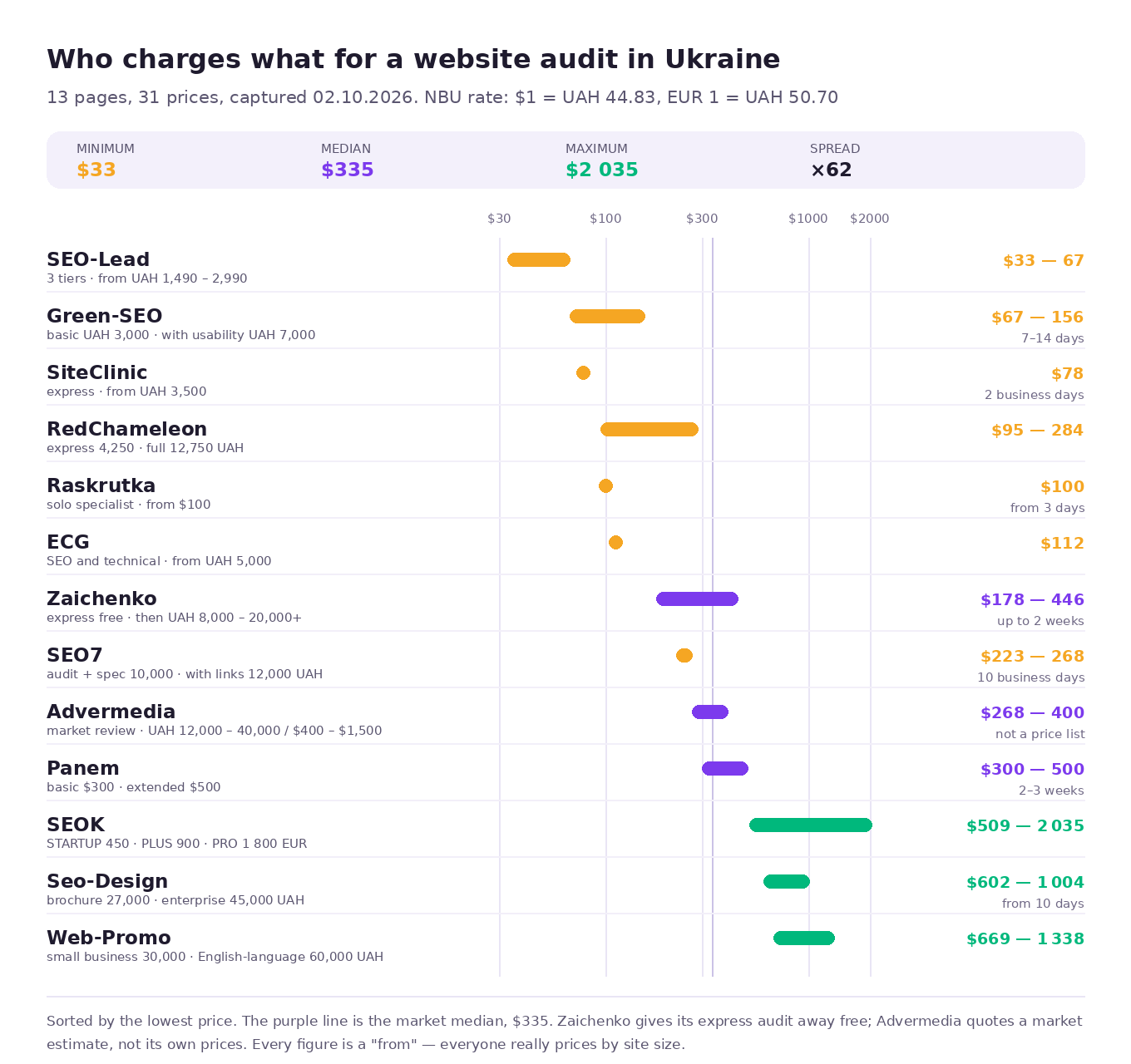
Now by name. I am not hiding the sources behind "according to market data" — here is who charges what. Every figure is public, sits on a service page, and can be checked in five minutes.
| Who | What is on the price list | As published | In dollars |
|---|---|---|---|
| SEO-Lead | basic / mid / extended | from UAH 1,490 / 2,700 / 2,990 | $33 — 67 |
| Green-SEO | basic / with usability | UAH 3,000 / 7,000 | $67 — 156 |
| SiteClinic | express, 2 business days | from UAH 3,500 | $78 |
| RedChameleon | express technical / full package | from UAH 4,250 / 12,750 | $95 — 284 |
| Raskrutka | solo specialist, from 3 days | from $100 | $100 |
| ECG | SEO and technical | from UAH 5,000 | $112 |
| Zaichenko | express / technical + spec / full / store with 1000+ pages | free / 8,000—15,000 / 15,000—25,000 / from 20,000 UAH | $0 — 446 |
| SEO7 | audit + spec / with link analysis, 10 business days | UAH 10,000 / 12,000 | $223 — 268 |
| Advermedia | not a price list — their market review | UAH 12,000—40,000, and $400—1,500 in the same article | $268 — 400 |
| Panem | basic 10—100 pages / extended | $300 / $500 | $300 — 500 |
| SEOK | STARTUP / PLUS / PRO | EUR 450 / 900 / 1,800 | $509 — 2,035 |
| Seo-Design | brochure site up to 10 pages / store up to 1000 / over 1000 / enterprise | from UAH 27,000 / 32,500 / 36,000 / 45,000 | $602 — 1,004 |
| Web-Promo | small and mid business / publishers / e-commerce / English-language | from UAH 30,000 / 35,000 / 40,000 / 60,000 | $669 — 1,338 |
Let us walk through what this table does not show at first glance.
The bottom floor — SEO-Lead, Green-SEO, SiteClinic. From UAH 1,490 to 3,500, which is $33—78. SiteClinic states the turnaround honestly: two business days. In two days a human physically cannot verify what the crawler found, so this is a crawler export dressed up as a document. I am not saying it is useless — I am saying you get exactly the same thing for free by crawling the site yourself.
The middle — RedChameleon, ECG, SEO7, Zaichenko. Here it is $95—446, and here something worth paying for appears for the first time: SEO7 explicitly says "audit + spec" and ten business days, Zaichenko separates formats by turnaround from 1—2 days to two weeks and prices stores over 1000 pages on their own line. That is the sign of a provider who understands where their time goes.
The top — Seo-Design, Web-Promo, SEOK. $500—2,035. What matters is not the figure but the logic of the grid. Seo-Design prices by site size: a brochure site up to 10 pages is UAH 27,000, a store up to 1000 pages 32,500, over 1000 pages 36,000, enterprise 45,000. Web-Promo prices by project type and charges most for English-language projects: UAH 60,000 against 30,000 for small business. Both grids are built correctly — the base rate is simply different.
Two special cases. Zaichenko gives the express audit away free and explains why: nobody charges for half an hour of their own time, clients pay for the full breakdown. That is the most honest position in the whole sample. Advermedia does not publish a price list at all — they publish a market review with a UAH 12,000—40,000 band, and in the same article they quote $400—1,500. I logged those figures as a separate line because it is an estimate of the market from the inside, not a quote.
And one thing you only see when the prices sit side by side. Almost everyone writes "from". That is not a trick — it is an admission that the real number comes from site size anyway. We do the same, we just say it out loud: $250 for a small site, $500 for a corporate one, from $700 for a store.
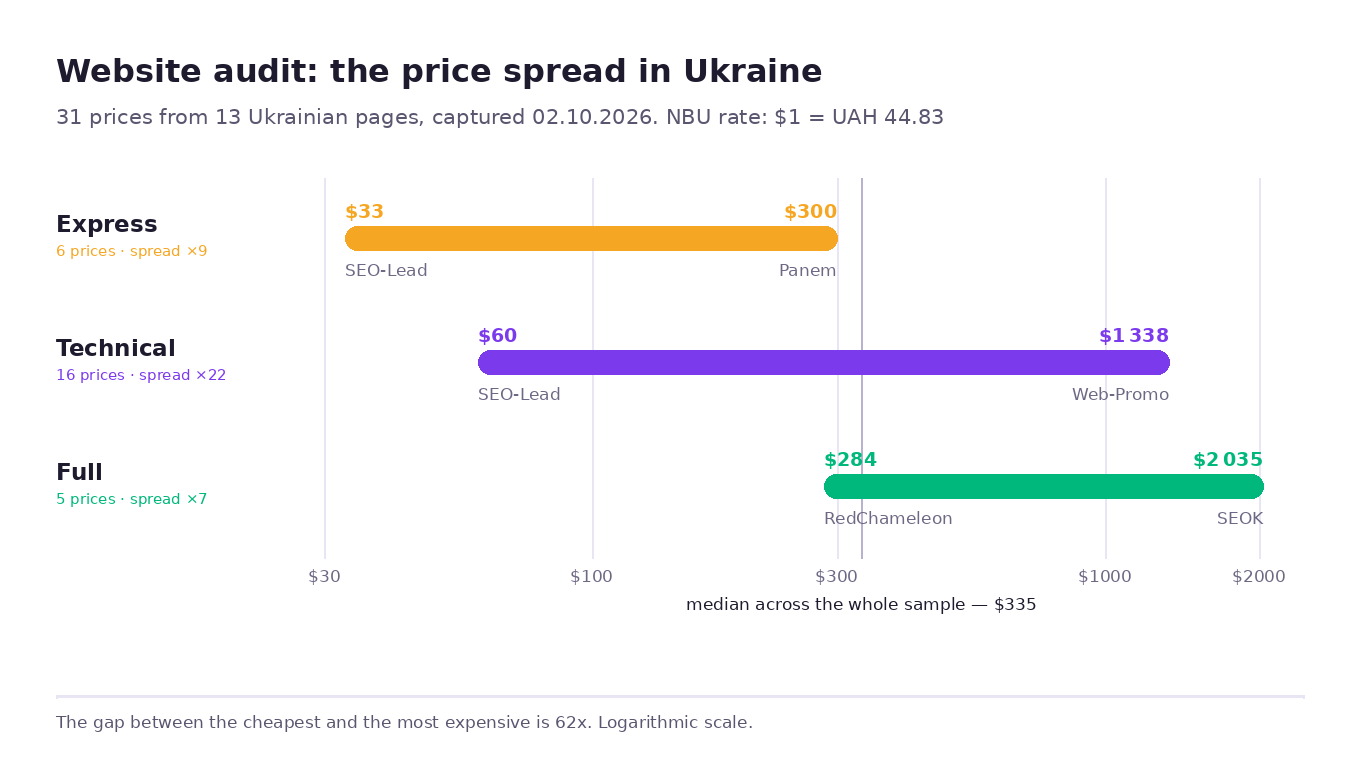
| Audit type | Prices in sample | Lowest | Highest | Spread |
|---|---|---|---|---|
| Express, basic | 6 | $33 — UAH 1,490, SEO-Lead | $300, Panem | 9x |
| Technical | 16 | $60 — UAH 2,700, SEO-Lead | $1,338 — UAH 60,000, Web-Promo | 22x |
| Full | 5 | $284 — UAH 12,750, RedChameleon | $2,035 — EUR 1,800, SEOK | 7x |
One specialist in the sample gives the express audit away for free — and that is probably the most honest position on the market: he states plainly that he does not charge for half an hour of his own work, and the client pays for the full breakdown.
Now look at the extremes. $33 and $2,035 is not "a cheap provider versus an expensive one". Physically different work is done for that money. Until you know what exactly, comparing two quotes is pointless.
Three different products sold under one word
I counted three formats in the sample, and they differ not in depth but in who does the work — a program or a person.
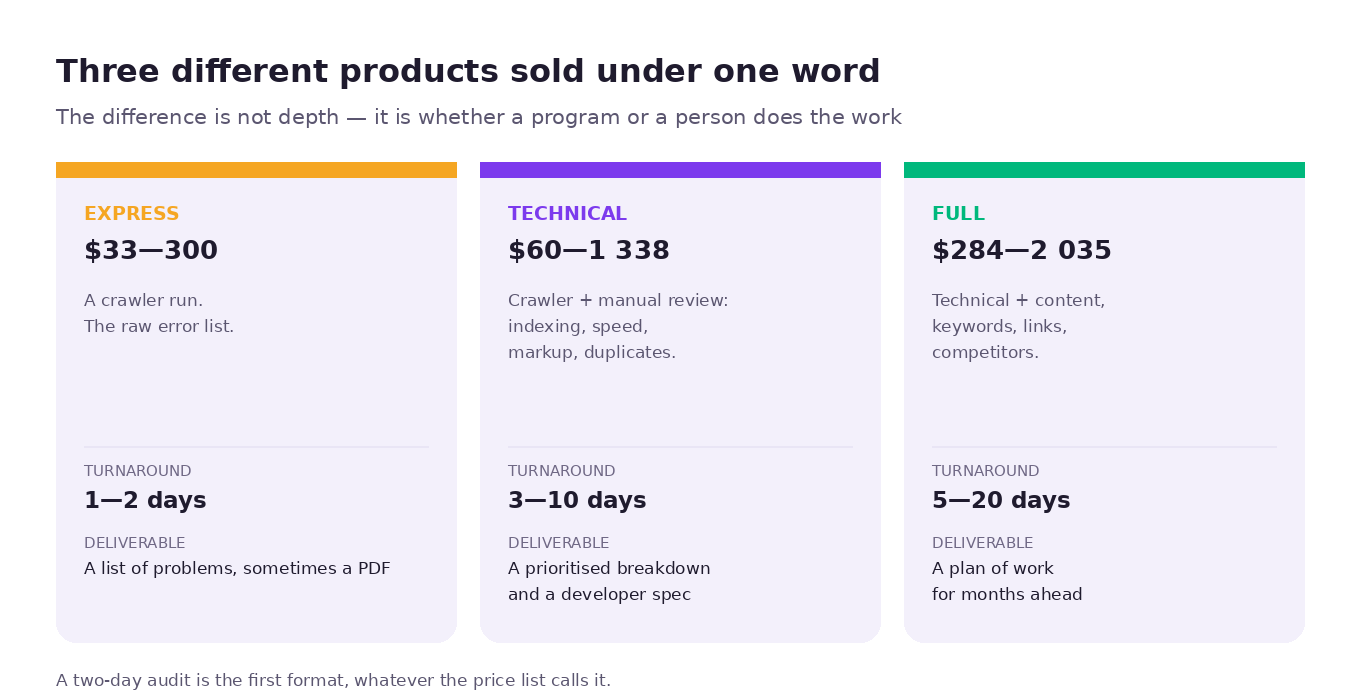
| Format | What is inside | Market turnaround | Deliverable |
|---|---|---|---|
| Express | A crawler run, the raw list of technical errors | 1–2 days | A list of problems, sometimes a PDF |
| Technical | Crawler plus manual review: indexing, speed, markup, duplicates, redirects | 3–10 days | A prioritised breakdown and a developer spec |
| Full | Technical plus content, keywords, links, competitors | 5–20 days | A plan of work for several months |
Look at the turnaround times competitors publish: from two days to twenty. A two-day audit is the first format, whatever the price list calls it.
How a report differs from an audit
A report is what a program outputs. You enter an address, a minute later you get a list: images without alt, short descriptions, slow loading. All of it is true, and all of it is useless on its own, because it says nothing about where to start or which of the findings is even worth touching.
An audit is what a human did with that list. They sorted the problems by what each one costs the business. They verified that each one exists. And they wrote down what has to be done, in wording a developer can take into work without a translator.
A colleague on this market described the bottom segment plainly, and I cannot put it better: the site is run through an automated service, the service generates a fifty-page PDF with charts, and the PDF is emailed to the client. It looks substantial. There is nothing in it to act on.
False positives are the longest part of the work
This is what you are actually paying for, and not one of the thirteen price lists mentions it.
Every crawler makes mistakes. It can misread a page, it can pull addresses that no longer exist out of the sitemap, it can flag a link as broken when the server simply answered slower than usual. Hand that list to a client as it is, and the developer spends a week fixing what is not broken while the real problem stays.
So in our audit the longest part is not the crawl, which takes minutes. The longest part is checking every finding to confirm it is real. That is where the timeline comes from: several days to a week depending on site size.
When you see "audit in two days" on a price list, it does not mean the provider is faster. It means the verification stage is not in their process.
What the price is built from
Three things, and none of them is "site complexity" in the abstract.
Size. A twenty-page site and a twenty-thousand-page store mean a different volume of manual review. Not crawling — review: on a store the errors are repetitive, but each one has to be confirmed on a sample from every template group.
Depth. The technical layer, content, links and competitors are four different jobs, and they are sold together only in the full format. In this sample most price lists call the first of the four "an audit".
The deliverable. A list of problems and a developer spec are different documents. The second costs more because it is written by someone who understands how to fix the thing, not only that it is broken.
Our prices, quoted first
I demand transparency from providers, so I show my own numbers first.
| Site type | Audit price | With an SEO engagement |
|---|---|---|
| Small site | from $250 | −75% |
| Corporate site | from $500 | −75% |
| Online store | from $700 | −75% |
The price depends on size — more pages means more manual verification. If you take SEO from us, the audit comes at a 75% discount, because in that case it is part of the work rather than a separate product: we are going to take your site apart before doing anything anyway.
Against the measurement, our numbers sit in the middle of the upper half. That follows: we do not sell the two-day format at all. Below a hundred dollars an audit is not done by hand — for that money it can only be generated.
What you can do yourself, for free
Before paying anyone, us included, crawl the site yourself. It is free and takes half an hour.
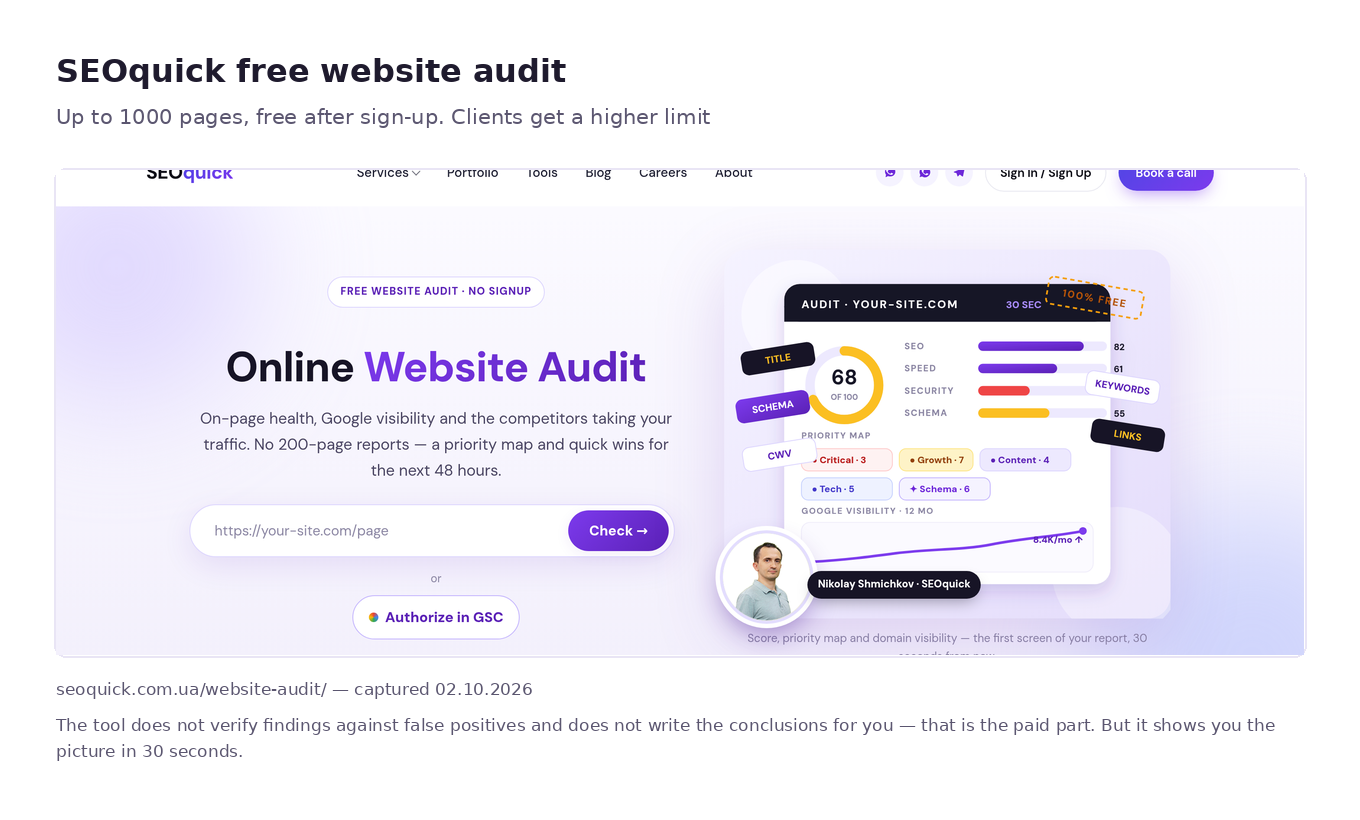
Our free website audit crawls up to a thousand pages, free, after sign-up. For most sites that is plenty: a thousand pages is already a mid-sized online store. Clients working with us get a higher limit, but the free tier is enough to see the picture.
Let me be equally honest about what the tool does not do. It will not read the conclusions for you: the priority map shows what is critical, but the decision about where to start in your business stays with a human. It does not replace a content and keyword review. And it does not verify findings against false positives — which is exactly the work we charge for in a paid audit.
One thing I am prouder of than the audit revenue. Former clients — people who no longer work with us — keep using this tool. I can see it in the crawls. They left, and the tool stayed in their working set, and that is a better review than anything on a testimonials page.
Why our audit looks at the site without JavaScript
This is the main technical decision in the tool, and it sometimes raises the question: "you are showing an error, but the site looks fine to me."
Correct. You are looking with your eyes, in a browser, with every script running. A search crawler, and a language model far more so, looks at the raw HTML. Our audit deliberately crawls the site without executing JavaScript — exactly the way the models see it.
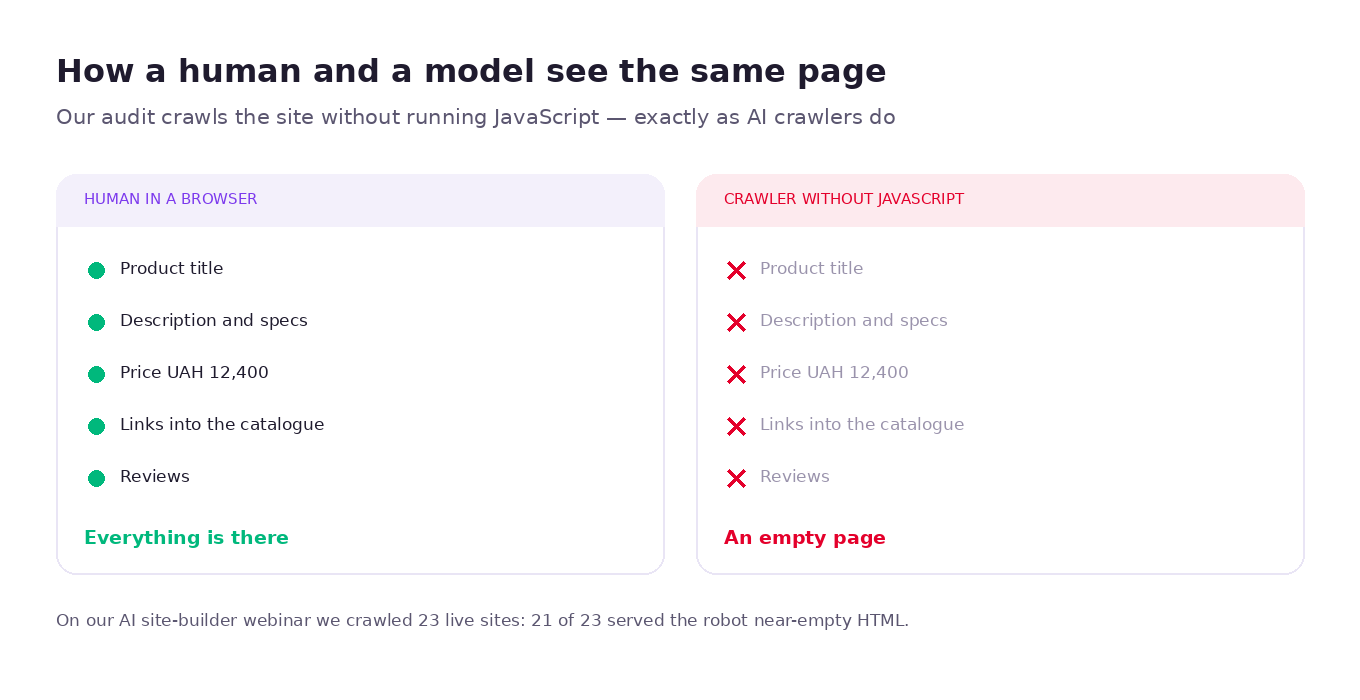
We checked separately how far this is from theory. Preparing a webinar about sites built on AI site builders, we crawled 23 live sites the way a crawler does: 21 out of 23 served the robot a practically empty page. Visually every one of them worked beautifully. And the large AI crawlers do not execute JavaScript at all.
So when our tool says a page has no heading or no text and you can see both, that is not a bug in the tool. It is a diagnosis. I covered how models read a site in more detail in the piece on optimising a site for GPT.
Free tools that still work in 2026
I checked everything listed here on 2 October 2026: opened each address and looked at what it serves today.
| Tool | What for | Terms |
|---|---|---|
| Google Search Console | Indexing, queries, errors — the only data that comes from Google itself | free |
| PageSpeed Insights and Lighthouse | Speed and Core Web Vitals, including field data from real users | free |
| Rich Results Test and validator.schema.org | Structured data | free |
| Screaming Frog SEO Spider | Full site crawl, exports in every direction | free up to 500 URLs |
| Netpeak Spider | Crawling with ready-made error reports, built in Ukraine | paid, trial available |
| Serpstat | Visibility, queries, competitors, its own audit module, built in Ukraine | paid |
| GTmetrix and WebPageTest | Deeper speed diagnostics | free with limits |
| Our audit | Crawl of up to 1000 pages without JavaScript: technical layer, speed, markup, priority map | free |
I run a full audit as a pair: our tool plus Screaming Frog. One shows the picture the way a model sees it, the other gives the complete per-page export. Then I merge them and write the breakdown point by point. Neither one on its own does everything I need, and in eight years I have not found a tool that does.
Dead addresses: where the tools Ukraine relied on lead today
This is the most useful part of the article, and it is in none of the "top audit services" lists. For a list like that, copying last year's version is enough; I opened every address by hand on 2 October 2026 and looked at what is there now.
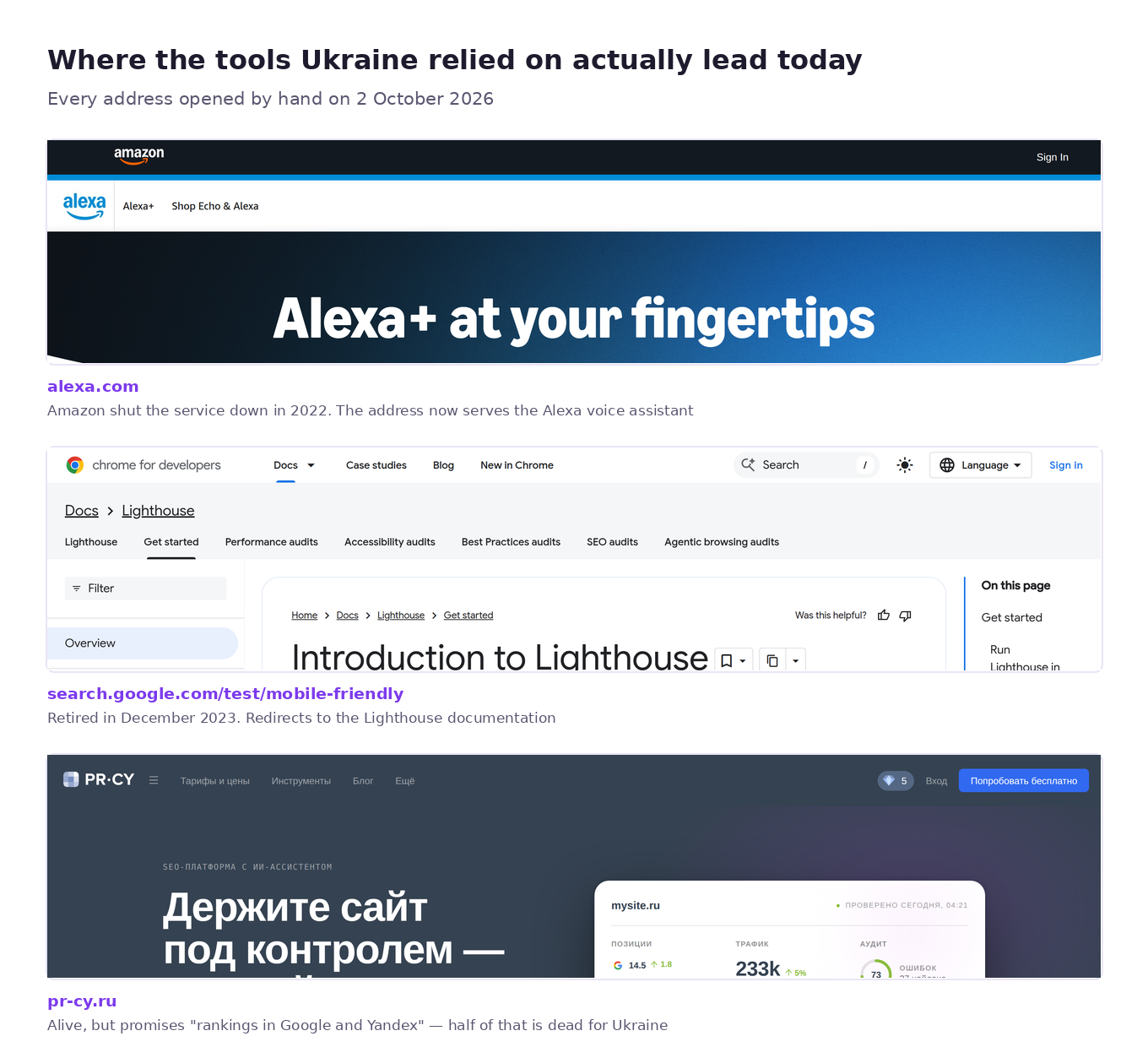
alexa.com — the service whose rank was used in Ukraine for ten years to measure "site authority". Amazon shut it down in May 2022. Today the address serves the Alexa voice assistant with an offer to try it on your devices. Not a word about websites.
Google's Mobile-Friendly Test — everyone from freelancers to agencies used it to check responsiveness. Google retired it in December 2023, and the address now redirects to the introductory Lighthouse article. Mobile has to be checked through PageSpeed Insights and the Search Console reports.
pr-cy.ru — it works, and that is the problem. The service is alive and has even been redesigned, but look at what it promises on the first screen: "rankings in Google and Yandex", and below that "ranking monitoring in Yandex and Google". Yandex left Ukraine in 2022 and is blocked. Half of what you pay for does not work for a Ukrainian site at all — along with IKS and the rest of the Yandex metrics.
Nibbler — redirects to silktide.com; the company pivoted to accessibility for people with disabilities. As an SEO tool it no longer exists.
Structured Data Testing Tool — the address that used to be in every checklist now leads to validator.schema.org. The tool did not die, but it moved and changed: to check Google rich results you need the Rich Results Test, while validator.schema.org checks the markup against the standard.
varvy.com — a special case, and I will not include a screenshot. The domain changed hands and now serves an Indonesian online casino. If you find varvy in someone's list of "useful SEO services" for 2026, that is a precise sign the list was copied rather than checked.
Summary: what died and what to use instead
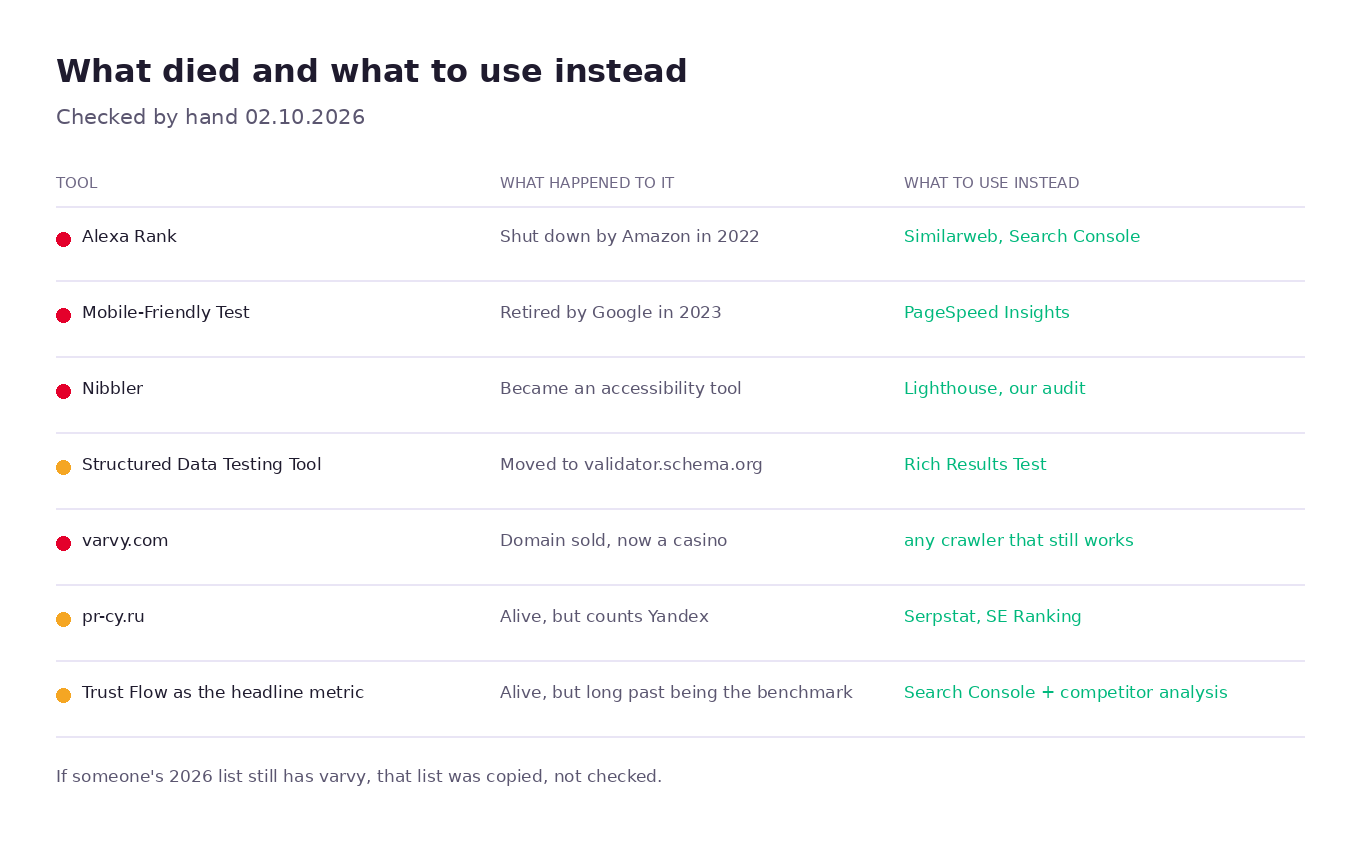
| Tool | What happened to it | What to use instead |
|---|---|---|
| Alexa Rank | Shut down by Amazon in 2022, address handed to the voice assistant | Similarweb, Search Console, Serpstat data |
| Google Mobile-Friendly Test | Retired in December 2023, redirects to the Lighthouse documentation | PageSpeed Insights, Search Console reports |
| Nibbler | Redirects to silktide.com, became an accessibility tool | Lighthouse, our audit |
| Structured Data Testing Tool | Moved to validator.schema.org | Rich Results Test for rich results, validator.schema.org for the standard |
| varvy.com | Domain sold, now serves a casino | any crawler that still works |
| pr-cy.ru | Works, but counts IKS and Yandex rankings | for Ukraine — Serpstat, SE Ranking, Search Console |
| Majestic Trust Flow as the headline metric | Alive, but long past being the main benchmark | Search Console plus competitor visibility analysis |
Metrics you should not be paying for any more
It is not only services that die — indicators do too. If an audit someone sent you leans on anything from this list as a serious argument, the report was built from a decade-old template.
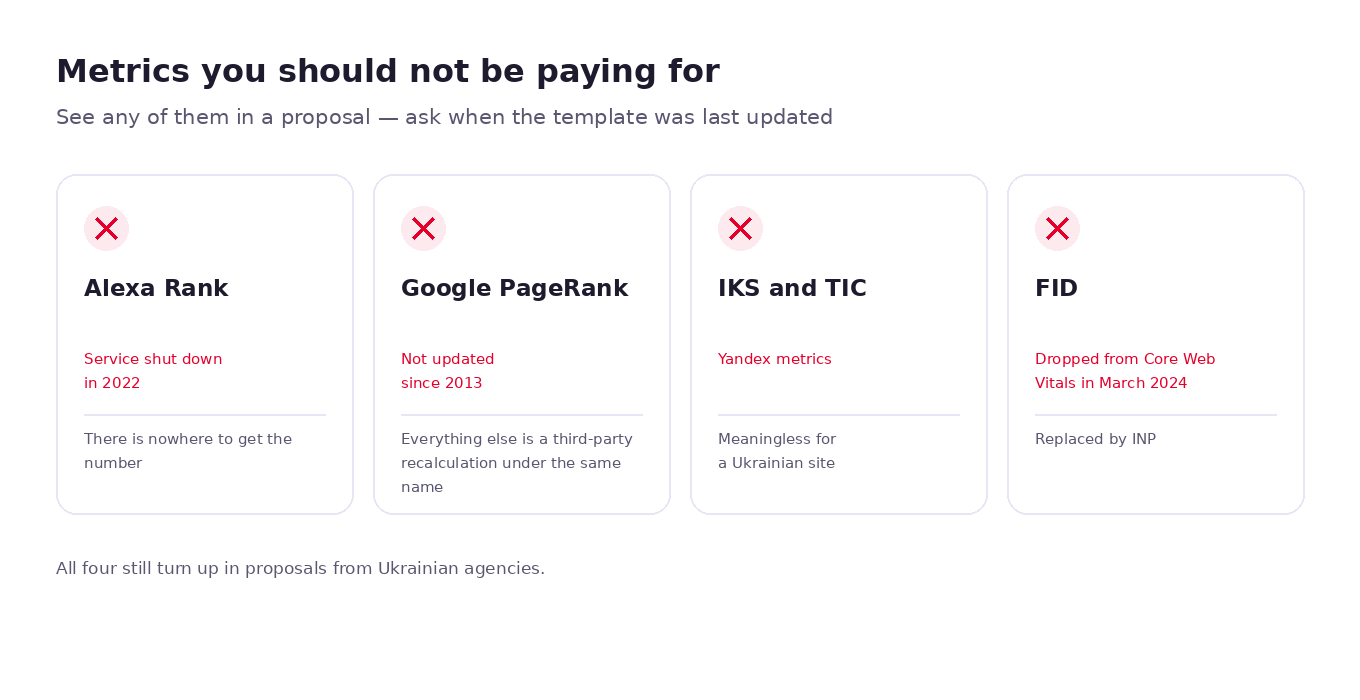
Alexa Rank — the service closed four years ago; there is physically nowhere to get the number.
Google PageRank — Google stopped updating the public value in 2013 and removed it from the toolbar in 2016. Everything called "PageRank" today is a third-party recalculation under the same name.
IKS and TIC — Yandex metrics. For a site serving a Ukrainian audience they are meaningless in principle.
FID — a real Google metric, but it was dropped from Core Web Vitals in March 2024 and replaced by INP. If a 2026 audit measures FID, the data is coming from an old template.
How to tell from a quote that the audit will be bad
Six signs I reject providers on when clients ask me to look at someone else's audit.
The price does not depend on site size. One figure for a landing page and for a twenty-thousand-page store means nobody is going to look at your pages.
Turnaround under three days. In two days a report can be generated, but the findings cannot be verified.
Volume is measured in report pages. "An 80-page audit" describes a PDF, not the work. A good breakdown is often shorter, because there is no padding in it.
No developer spec at the end. Ask directly: what will my developer receive? If the answer is "a list of errors", you are being sold the first format.
The sample report contains dead metrics. See the previous section.
They do not ask for access. A proper audit needs Search Console and preferably analytics. Without them the provider cannot see which pages are indexed or which queries you already appear for — they are working blind.
What the report must contain
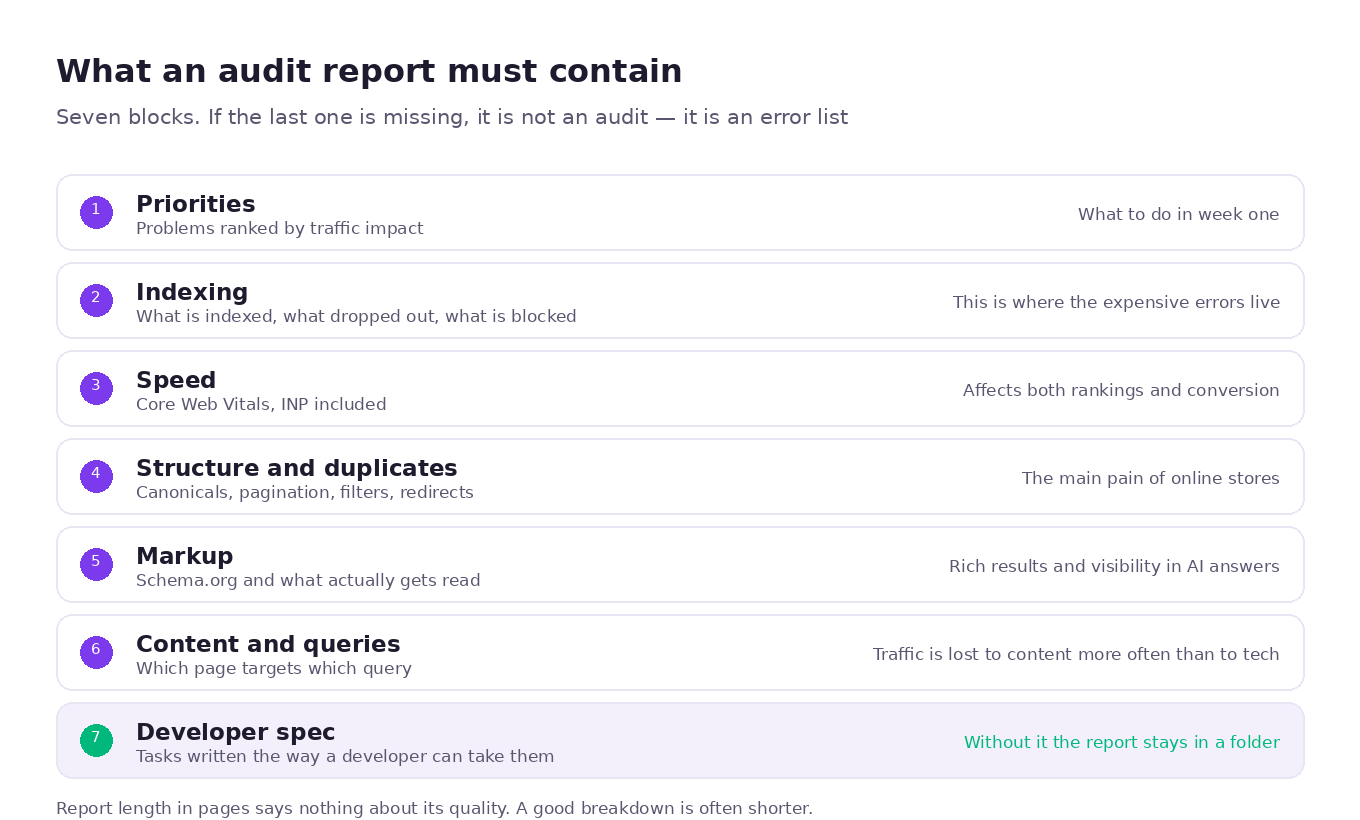
| Block | What is in it | Why you need it |
|---|---|---|
| Priorities | Problems sorted by impact on traffic | To know what to do in week one |
| Indexing | What is indexed, what dropped out, what is blocked by mistake | The most expensive errors live here |
| Speed | Core Web Vitals including INP, plus field data | Affects both rankings and conversion |
| Structure and duplicates | Canonicals, pagination, filters, redirects | On stores this is the main source of problems |
| Markup | Schema.org, correctness, what actually gets read | Rich results and visibility in AI answers |
| Content and queries | Which pages target which queries, where cannibalisation is | Traffic is lost to content more often than to tech |
| Developer spec | Tasks worded for a developer | Without this block the report stays in a folder |
How an audit actually brings in clients
Let me describe how it works for us, because the pattern is unusual.
Most sites came to us for an audit not through an enquiry form but through the tool itself. Someone crawled their site for free, saw the list of problems, and came back asking what to do about it. Then we did the full breakdown: our tool plus Screaming Frog, with the results merged by hand.
Several sites became long-term clients exactly this way. First a free crawl, then a paid audit, then an SEO engagement.
And there is one thing I am proud of separately. Even clients who left us and no longer work with us keep using our audit — I can see them crawling with it regularly. That is not a signature on a contract and not a testimonial; it is the choice of someone who owes us nothing.
I use my own audit as a genuine day-to-day working tool. It surfaces what neither Screaming Frog nor Netpeak Spider surfaces: how a model sees the page without JavaScript. That is what it was built for from the start.
How long it takes and what we need from you
Our audit runs from several days to a week depending on site size. Of that time the crawl takes minutes; the rest is manual work, and most of it goes on verifying false positives.
We need three things from you. Access to Google Search Console — without it the audit is blind. Access to analytics, if you have it. And a line to your developer: not for sign-offs, but so that I know what the site is built on, because the wording of the spec depends on it.
If there is no access, the audit can still be done, but part of the conclusions will be assumptions, and I will say so in the report.
When you do not need an audit
Three situations in which I talk people out of a paid audit myself.
The site is under two months old and has no traffic. There is nothing to analyse. Crawl it for free, fix the obvious, come back in a quarter.
You already know what to do and are not doing it. If the previous audit is sitting unimplemented, a second one will not help. The problem is not knowledge.
The site is on a website builder and you are not planning to move. Half of the findings cannot be fixed there technically. I went through this in detail in the piece on SEO for sites built on website builders: no audit cancels the platform's limits.
In all three cases a free crawl is enough. Paying makes sense when there is traffic you can lose or win back.
Frequently asked questions
How much does a website audit cost in Ukraine?
By my measurement of 2 October 2026, between $33 and $2,035, median $335. Our prices: from $250 for a small site, from $500 for a corporate one, from $700 for an online store, with a 75% discount when you order SEO.
Can an audit be done for free?
The technical part, yes. Our tool crawls up to 1000 pages free after sign-up. It will not verify findings against false positives and will not write the conclusions for you, but it will show you the picture.
How does a technical audit differ from a full one?
The technical one examines how the site is built: indexing, speed, markup, duplicates. The full one adds content, keywords, links and competitors. If you only need the technical layer, see our technical audit service.
How long does an audit take?
Ours takes several days to a week. The longest stage is not finding the errors but confirming that each one is real.
Why does your tool report an error where the site looks fine?
Because it looks at the page without executing JavaScript — the same way search crawlers and language models do. If the content only appears after the scripts run, for them it is not there.
Do I need an audit if an agency is already handling my SEO?
If the engagement has run for more than six months with no growth, yes — and preferably with an independent provider. An agency rarely finds the problems it created itself.
What do I do with the report afterwards?
Hand the spec block to your developer and work through it by priority. A report nobody opened is worth exactly zero, whatever you paid for it.
What to do with all this
The 62x spread exists not because someone is greedy. Three different products are sold under one word, and the only way not to overpay is to ask which one you are buying: an automated report, a human-verified breakdown, or a strategy.
Here is the order I would suggest. First crawl the site for free — half an hour and nothing spent. Look at what comes up. If there are few problems and they are clear, fix them yourself; you do not need an audit. If the list is long, it is unclear where to start, and the site has traffic you could lose, come to us. Our technical audit starts at $250, and with an SEO engagement it comes at a 75% discount.
And before paying anyone, open a sample of their report and search it for Alexa Rank. It is the fastest check on the market.
Website development cost in 2026 and what drives it
A landing page from $176 to $2,000, an online store from $335 to $6,700 — measured across 17 Ukrainian price lists. What website development cost is made of, why a “from” figure means nothing, what we charge and how long each type of site takes.
Read →
Website chatbots in 2026: what you are actually buying and how to vet the vendor
Three different products are sold under the word chatbot at roughly the same price. What separates a callback service from an AI widget from a system, a nine-point checklist with live demo tests, seven questions for the vendor, total cost of ownership and rollout times.
Read →
What ecommerce SEO costs in 2026 and what you pay for
Why the same question gets answered with $300 and $3,000, what actually drives the price, what agencies publish on their own sites, the five costs that are never in the quote, and how to work out whether it pays back on your catalogue.
Read →Want to apply this to your site?
We will review the current situation, find the first growth levers, and suggest a practical working format.