Website development: what it costs
We logged 71 prices from 17 Ukrainian pages where studios publish their own rates. For one and the same word, the asking price varies twentyfold. Below: why that is, what a quote is built from, and what we charge.


Short answer: in Ukraine, in autumn 2026, a landing page costs from $176 to $2,000, a business-card site from $230 to $3,000, a corporate site from $546 to $4,000, an online store from $335 to $6,700. That is not an “average market price” — it is the spread between the lower bounds Ukrainian studios publish on their own websites. We charge from $1,000 for a month of team time; we build a landing page in a month, an online store in six months and up. The one thing worth taking away from this article: the number on a price list means nothing until you know how many months of work it covers.
My name is Igor Sakun, I am a web developer at SEOquick — I build the sites our SEO department then promotes. That is a convenient vantage point for talking about price: I see both the development quote and the list of things we have to fix six months later, when someone starts promoting the site.
This is for someone who has already decided to commission a site and is choosing between two or three quotes. I will not be explaining what a landing page is or how it differs from a corporate site — you know that. The question is a different one: why do some people ask $546 for a “corporate site” and others $4,000, and which of them is lying.
Nobody is lying. That is the unpleasant part of the answer.
A word on the conflict of interest up front. We build websites ourselves, it is one of our services. So there will be no “top 10 studios in Ukraine” ranking here: we would pick the criteria so that we win, and you would feel it by the third paragraph. Instead of a ranking you get a survey of other people's price lists with a link behind every figure, our own prices stated first, and a checklist you can use to vet any contractor, us included.
Why there is no single answer to “how much does a website cost”
We took Google's results for the Ukrainian and Russian queries that mean “website creation price” and “website development price”, kept the pages that actually name numbers, and logged every price on them on 2 October 2026. That came to 71 price points across 17 pages. Hryvnia and euro figures were converted to dollars at the National Bank of Ukraine rate on the day of the survey: $1 = UAH 44.83, €1 = UAH 50.70. Links to every source are at the end of the article.
Below are only the prices a studio publishes as its own. No third-party market estimates and no promotional offers along the lines of “an AI landing page in 72 hours”.
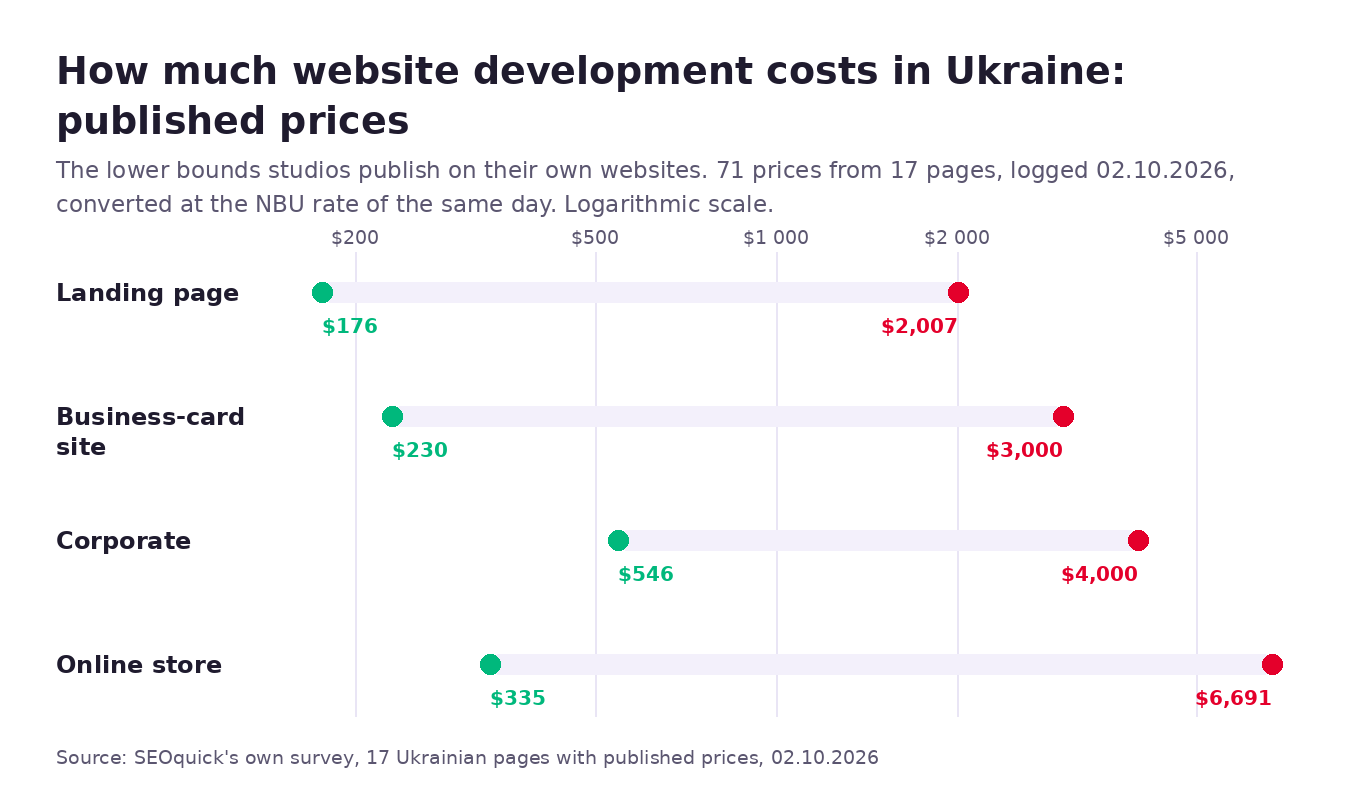
| Type of site | Prices in sample | Lowest | Highest | Spread |
|---|---|---|---|---|
| Landing page, single-page | 10 | $176 — UAH 7,900, Abordazh | $2,007 — UAH 90,000, MoveitOn | ×11 |
| Business-card site | 5 | $230 — UAH 10,300, Abordazh | $3,000, Seo-Design | ×13 |
| Corporate site | 9 | $546 — UAH 24,500, AyFish | $4,000, Seo-Design | ×7 |
| Online store | 10 | $335 — UAH 15,000, Abordazh | $6,691 — UAH 300,000, MoveitOn | ×20 |
Add in the market overviews on hosting and agency blogs and the picture stretches further still: HostiQ names “from $20,000” for a large store, Brainlab a bracket of $8,000–20,000, Seo-Design “from $20,000” for a marketplace. For stores the spread reaches sixtyfold.
Now the main point. The twentyfold difference exists not because of greed but because the same word covers different objects. Abordazh's “online store from UAH 15,000” is a catalogue on an off-the-shelf template with no integrations. SEOK's “online store, €5,200” is a cart, card payments, Nova Poshta, a customer account and a CRM connection, and they list all of it right there on the page. One word, two different products. Comparing those two figures makes about as much sense as comparing the price of a car with the price of a wheel.
Nikolay Shmichkov, head of SEOquick, puts the mechanics of price like this:
“A diamond's rarity was never a property of the stone. It was the cost of getting it plus the effort of keeping it rare. A developer's rate is not a property of the person either. It is the price of access to a scarce skill.”
It is the same with a website. You are not paying for an object, you are paying for the months of work of the people who assemble it. Which is why a conversation about price that does not start with a timeline is a conversation about nothing.
Pages about price with no price on them
While we were putting the survey together, we ran into something that explains why the answer is so hard to find on your own. We pulled Google's live results for the Ukrainian “website creation price” through SE Ranking on 1 October 2026 — Ukrainian region, Ukrainian language, no personalisation. The clean organic top: eight URLs.
| What kind of page | What figure is actually on it |
|---|---|
| Studio, service page | “from $1,500” — one figure for the entire page, with no site types |
| Classifieds board | Ads from private individuals, not a studio |
| Studio, article on turnkey pricing | A full breakdown: landing page from UAH 15,000, multi-page from UAH 35,000, corporate from UAH 70,000, store from UAH 80,000 |
| Hosting company's information section | Prices from 2023 |
| Studio, price list | A full price list from UAH 7,900, three tiers for each type |
| Agency, article titled “The cost of building an online store” | No development price. There is a price for plugins ($100–200) and hosting (from $50/mo) |
| Studio, pricing page | $800 for a “landing page on steroids” |
| Studio, article titled “How much does it cost to build an online store — turnkey price” | Not a single figure |
Two of the eight URLs are built for a price query and name no price whatsoever. One names the price of everything except development. One answers with figures three years out of date. Half of Google's first page for the question “how much does this cost” does not answer the question.
And a detail from the same survey: Google already shows an AI Overview on these results. The engine assembles the answer to “how much does a website cost” itself — out of pages, half of which contain no figures. The query itself has gone from 10 to 390 impressions a month in two months: people have started asking the machine instead of a contractor, en masse.
Six types of site and what is actually different about them
What follows is our own breakdown — by volume of work, not by the names of tiers. The timeline in the last column is ours, based on projects we have actually delivered.
| Type | What is actually inside | Our timeline |
|---|---|---|
| Landing page | One long page for one offer, a form, analytics, advertising pixels | 1 month |
| Simple services site | 5–10 pages, a structure built around search clusters, forms with spam protection, an admin panel for text edits | 2 months |
| Heavy-duty site | Several lines of business with different logic, a blog, language versions, integrations with external services | 3 months |
| Corporate portal | Sections for different audiences, staff profiles, documents, a careers section, complex navigation | 4 months |
| Catalogue without a cart | Thousands of items, filters by attribute, a feed from the accounting system, search | 3–4 months |
| Online store | Everything in the catalogue plus cart, payment, delivery, customer account, CRM and stock integration | 6 months and up |
The difference appears not in the number of pages but in the number of distinct logics you have to design, draw, build and test. Seven pages of the same kind are one job. Seven pages where one is for B2B, the second for a private customer and the third for the defence sector are three scenarios, three sets of arguments and three forms. One of our projects in personnel security looked like “38 pages” and was in substance traffic routing across three audiences with a separate path for each.
What a quote is made of
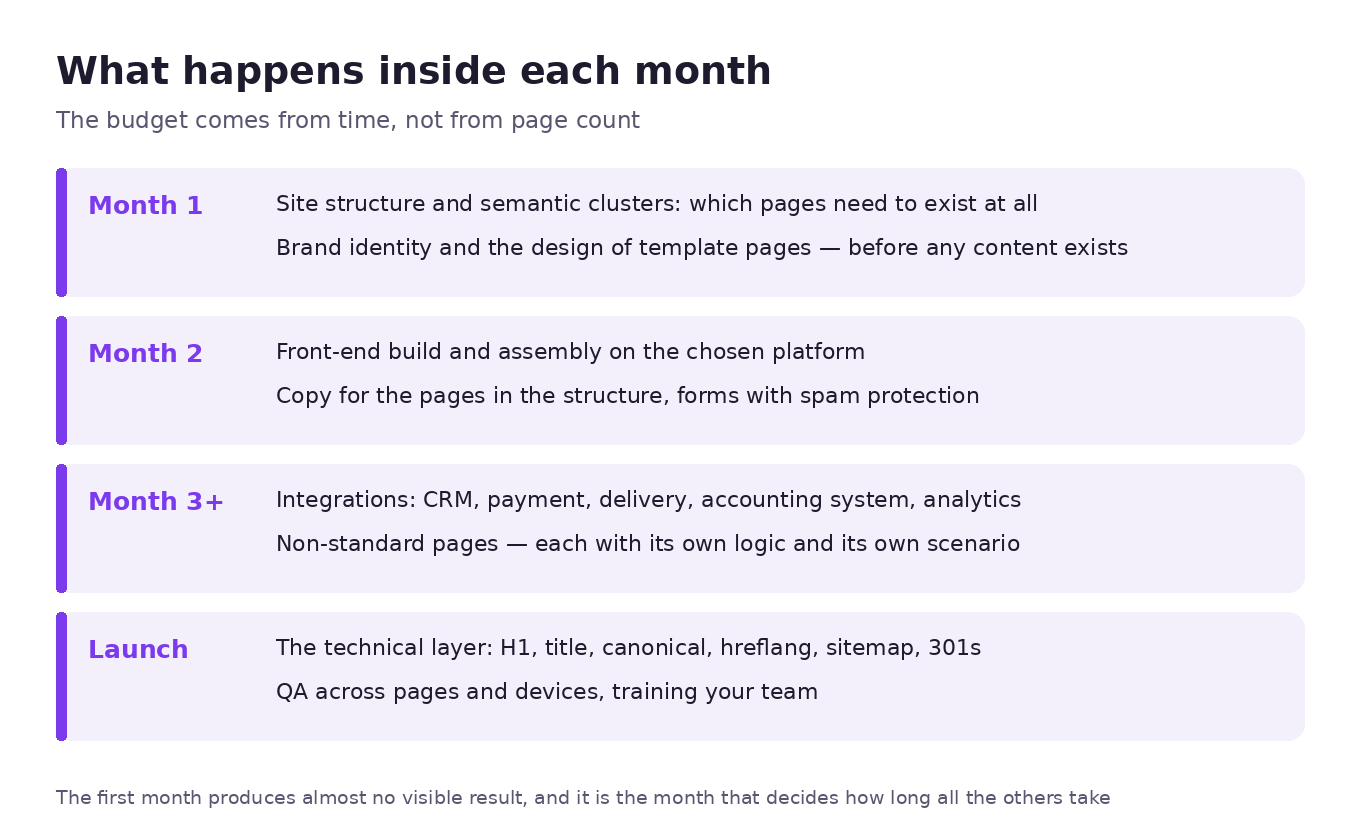
A development quote is the cost of the team's time multiplied by the number of months. A developer, a designer and a copywriter work on the project at the same time; the monthly budget is what they cost together. Everything else follows from that, including the things clients find surprising.
The first month produces almost no visible result. It goes on the brand identity and the design of the template pages — before any content exists. From the outside it looks as though nothing is happening, when in fact that month decides how long all the others will take.
Drawing really has got cheaper over the past two years. Nikolay on the designer's role today:
“Today you need a designer at the revision and sign-off stage, and for building the concept, not for the whole journey.”
What got cheaper is the drawing, not the design thinking. Deciding which pages need to exist at all and how a person moves through them is still done by a human, and that is the most expensive part of the first month. Clients usually expect the opposite: that with AI, development has all but stopped costing money. It has got considerably cheaper — but it is still the time of an IT specialist, a designer and a copywriter, and that time is not free with any toolset.
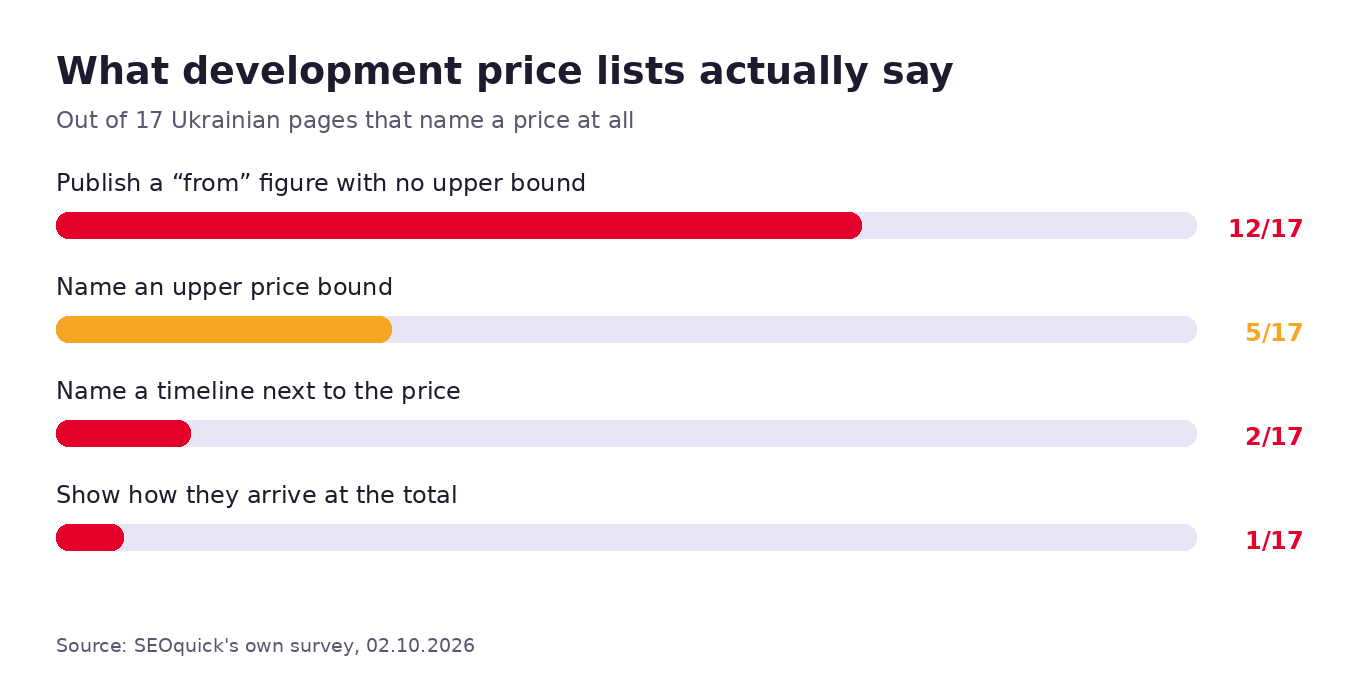
Across the sample of seventeen pages, exactly one source shows the arithmetic instead of a final figure. The AyFish web studio breaks it down like this: the home page is UAH 7,500 of design, each inner page UAH 2,000, a specialist hour UAH 500, then multiply by actual time. Five inner pages give UAH 10,000, plus the home page, plus the hours, for a total of UAH 32,500. You can argue with the rates, but it is the only price list in the survey that can be checked on a calculator. The other sixteen give you a number and invite you to believe it.
Platform: why WordPress costs more up front
Here is something you do not usually hear from a developer. WordPress is more expensive at the development stage — in our experience it adds around 30% to the hours. Not because the system is bad, but because it comes with a theme, a set of plugins, their compatibility, security and speed, and all of that has to be put in order by hand. A static site requires no such entourage.
The difference between platforms is visible right there in other people's price lists. One studio in our survey publishes “CMS with a ready-made design from $598” and, next to it, “CMS with a unique design from $4,798”. Same platform. The eightfold difference is the price of drawing and design work, nothing else.
How we decide what is worth paying extra for.
An off-the-shelf CMS with a custom theme — when the client needs to edit content themselves every week. We assemble pages from the editor's native blocks, and after handover you do not need a developer to change a line of text. That is how the site for a suspended-ceiling manufacturer was built: seventeen new and rewritten pages, all editable by the owner without us. The extra 30% of hours is justified here — it is spent on the client's convenience for years to come.
Static — when speed and resilience are the main requirements and the content changes rarely. A company in personnel security was sitting on WordPress 5.4.19: useful content, painful updates, no speed to speak of. We moved it to a static generator — 38 pages, two language versions, two months of work, a lab audit after launch instead of a permanent fight with plugins.
A bespoke solution — when the business has operational logic that off-the-shelf CMSs do not have. For an accounting services site we wrote our own admin panel for pricing tiers and testimonials: five manageable price sections, moderation of reviews before publication, sessions with CSRF protection and lockout after five failed logins, automatic page backups on every save. A full CMS was not what that project needed — it needed an editor for two specific entities, and that came out cheaper than wrestling someone else's system into shape.
The criterion sounds dull but it works: you choose the platform for how you will live with the site after launch, not for how convenient the site is for the contractor to build.
Our prices, stated first
We demand transparency from contractors, so we show our own numbers first. Otherwise everything above is worthless.
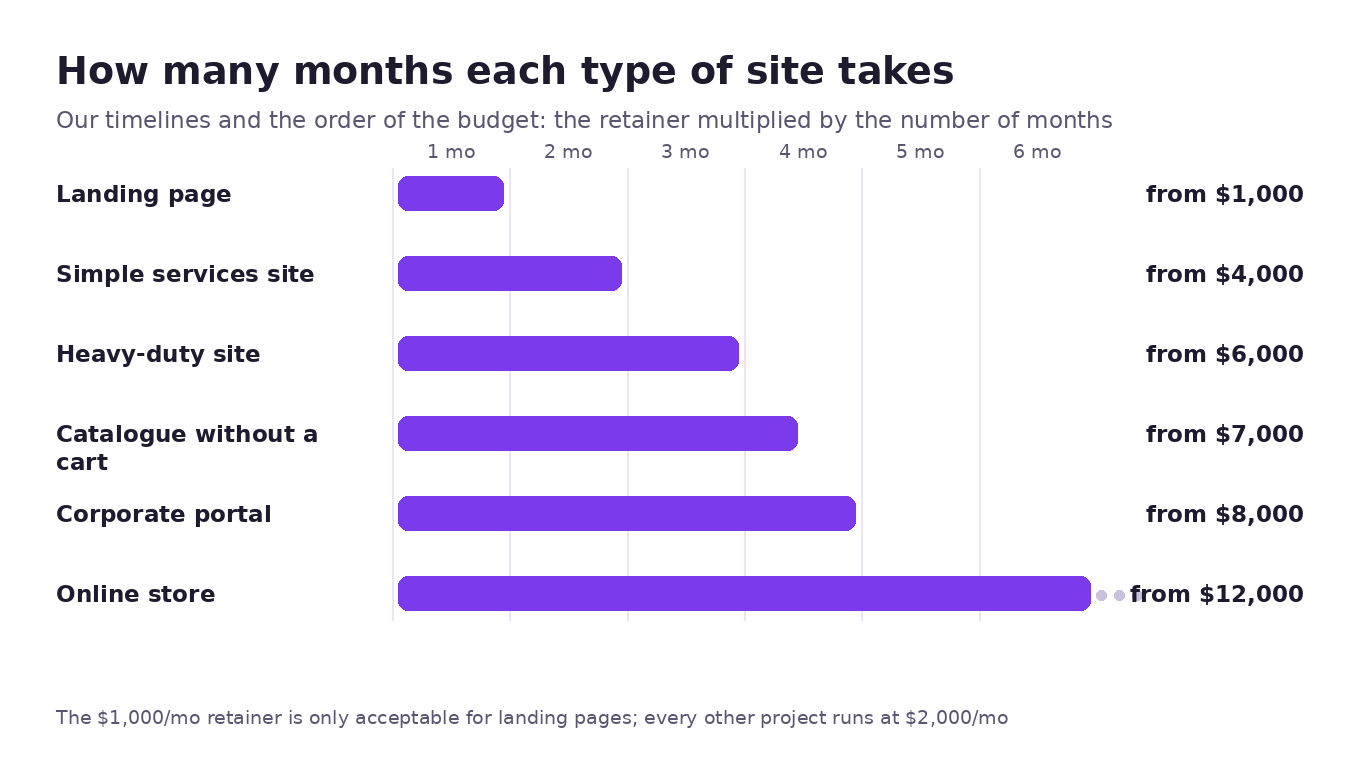
We do not sell a website, we sell months of team work. The minimum retainer is $1,000 a month, and it is only acceptable for landing pages. The optimal one, which every other project runs on, is $2,000 a month. For each month the volume of hours and the quote for that volume are agreed separately. The number of months is the complexity of the project.
| Type of site | Retainer | Timeline | Order of budget |
|---|---|---|---|
| Landing page | $1,000/mo | 1 month | from $1,000 |
| Simple services site | $2,000/mo | 2 months | from $4,000 |
| Heavy-duty site | $2,000/mo | 3 months | from $6,000 |
| Corporate portal | $2,000/mo | 4 months | from $8,000 |
| Online store | $2,000/mo | 6 months and up | from $12,000 |
An additional language version is $400 on top. We do not take development work below these prices, and that is not posturing: for less money you cannot put a designer, a developer and a copywriter on a project at the same time, and one at a time they assemble the same site three times slower.
Two ends of our own range, so the figures are not abstract. The simplest project was the accounting services site, around $600: six pages, that custom pricing admin panel, and it really was very simple, we did it more as a bonus. The redesign for the suspended-ceiling manufacturer was around $3,000 for seventeen pages, native blocks, structured data, forms that copy each enquiry into the CRM, and clearing up after a hack. Almost everything else sits between those two ends.
What the budget always includes: structure design, design, front-end build, copy, the SEO foundation, analytics and training your team to work with the admin panel.
What is billed separately: the domain, hosting, licences and your analytics accounts. There is one reason — you have to be the owner of all of it. A domain registered to the studio is the cheapest way to lose your site when you fall out with your contractor. Copywriting is partly counted inside the project, for exactly the pages in the structure; anything beyond the project scope goes on a separate line under additional costs.
After launch the site moves onto support, and the same floor applies there: a retainer for our programmers costs the same for every client. It covers content uploads, audits, fixes and adding new information. Bugs are fixed free — the things we got wrong. Everything else is work, and work costs money; the difference is that clients on an SEO retainer get a large pool of edits inside it, whereas the same edits bought as one-off programmer time usually come with a noticeable invoice.
Timelines: where the time goes
Of the seventeen sources in the survey, one publishes a timeline next to the price. SEOK gives tiers and weeks together: a landing page at €1,200 / €1,980 / €3,000 over 2–3 weeks, a corporate site at €3,500 / €5,500 / €9,000 over 5–6 weeks, an online store at €5,200 / €7,800 / €10,500 over 6–7 weeks. One more source, MoveitOn, publishes timelines from two weeks to two months at prices from UAH 90,000. The other fifteen name no timeline at all.
Which is strange, because the timeline is precisely what you are paying for. And because the timeline is where the difference between $176 and $2,000 for a landing page hides: nobody can work for a month on the first figure, which means the work will take three days and be done on a ready-made template.
Our timelines are hard commitments in the contract. The only thing that genuinely stretches them is slow sign-off on the client's side: until the revisions to the first screen are approved, month two does not start.
What makes a quote change mid-project
Short answer: only the volume of work and the functionality, and both are agreed before the month begins. We have never had a “it turns out we need extra” surcharge — precisely because we sell a month of work, not an abstract “turnkey site”. If a new type of page appears in month three, it either takes up hours from that month or adds another one. That is visible in the quote before the work starts.
Hence a practical tip for reading someone else's quote: look not for the final total but for the description of what happens when the scope changes. If there is no such description, the surcharge will appear — the only question is when.
What it costs to leave a website builder
First, honestly, about what builders can do. Modern platforms cover basic technical SEO out of the box — meta tags, sitemap, robots.txt, canonical — and we have taken sites like that to the top ourselves: we have a separate breakdown of promoting a site built on a website builder, where all of this is laid out platform by platform.
My position as a developer is harsher than that. In competitive commercial results builders are a rarity, and the reason is not Google's bias: you control neither speed nor markup nor URL structure, which means you hit the ceiling exactly when you start to grow. If you are on Tilda or Wix now and plan to develop, it is better to leave today, while the site is small and the move is cheaper.
And about those top rankings, plainly: it was hard then and it is harder now. The real cost of a builder sits in manual labour, not in the subscription. On your own platform a developer writes the template once, and from then on a change propagates across the whole site in a single pass — with AI that is faster than it has ever been. On a builder the same work is repeated by hand, page after page, by a content manager. Those hours are not in the builder's price list, but they leave your budget every month.
The problem with a builder is not that it is bad but that it is a boundary. While its capabilities are enough, everything is fine. On the day they are not, you pay for development a second time — full price, with no discount for the fact that the site “already exists”.
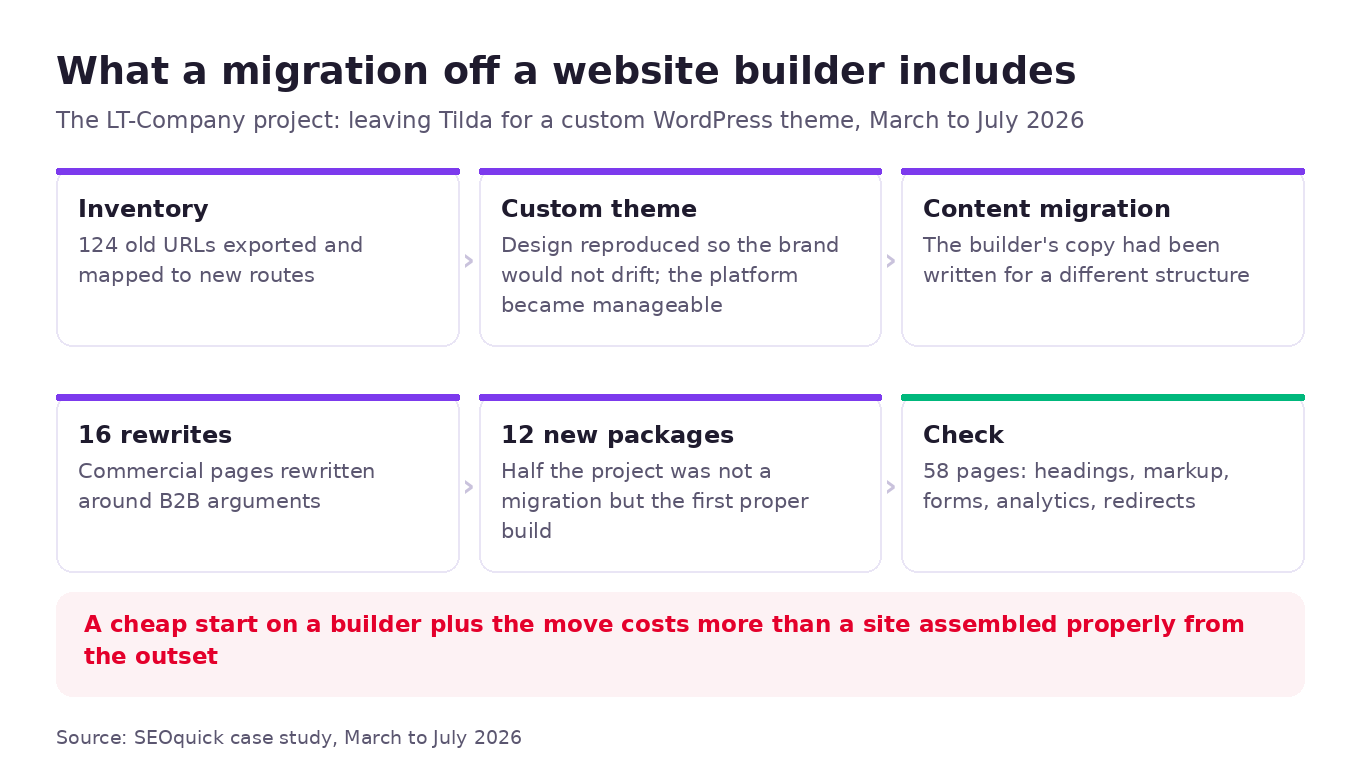
Here is how it looked for LT-Company, a facade contractor. We pulled 124 old URLs out of the builder and mapped each one to a new route — work that is invisible in a quote, but without which the search history resets to zero. We reproduced the design so the brand would not drift. Sixteen pages were rewritten from scratch: the builder's copy had been written for a different structure. Twelve new page packages were built for actual search demand — in other words, half the project was not a migration but the first proper build. March to July 2026, full budget.
The arithmetic is simple: a cheap start on a builder plus a later migration costs more than a site assembled from the outset on a platform you can develop. There is one exception — if the hypothesis does not pan out and there is nothing to migrate. Then the builder turns out to be the cheapest way to find that out, and that is a fair argument in its favour.
Content is a separate cost line, and it is always forgotten
Content is the most underestimated line in a development quote. The client usually reckons they already have the text. Then it turns out what they have is a company description from 2019, a price list in Excel and photos taken on a phone.
The market benchmark from our survey: populating a site is quoted from UAH 350 an hour. That is populating — moving finished text into the admin panel and formatting it, not writing it. Copywriting with proofreading costs separate money, and in most price lists it simply is not there: it hides inside the word “from”.
Data, as opposed to text, is a story of its own. For a diagnostic centre we consolidated the official CT and MRI price lists into a single structure: 117 rows, around thirty items missing, and the contrast-enhanced values needing manual reconciliation against documents. That is not copywriting and it is not design. It is painstaking work in which an error in one figure has a real cost for both the patient and the clinic. In a quote, things like this have to be a separate line with a clear scope, otherwise they get done in the last week at a run.
SEO inside development: either at the start, or you pay twice
With us, SEO comes at the start, in the core of the project. Not “we will bring in an optimiser after launch”, but at the stage where the structure is being drawn: which pages exist, for which query clusters, how they link to each other, what their URLs are.
What has to be done before launch, or it costs more to redo: one H1 per page and a coherent hierarchy of subheadings; unique titles and descriptions on every page, not a template with substitution; canonical; language signals, if there is more than one version; 301 redirects from all old URLs, if this is not the first site; a sitemap in which every URL returns a 200; a dedicated 404 page and utility pages closed off from indexing.
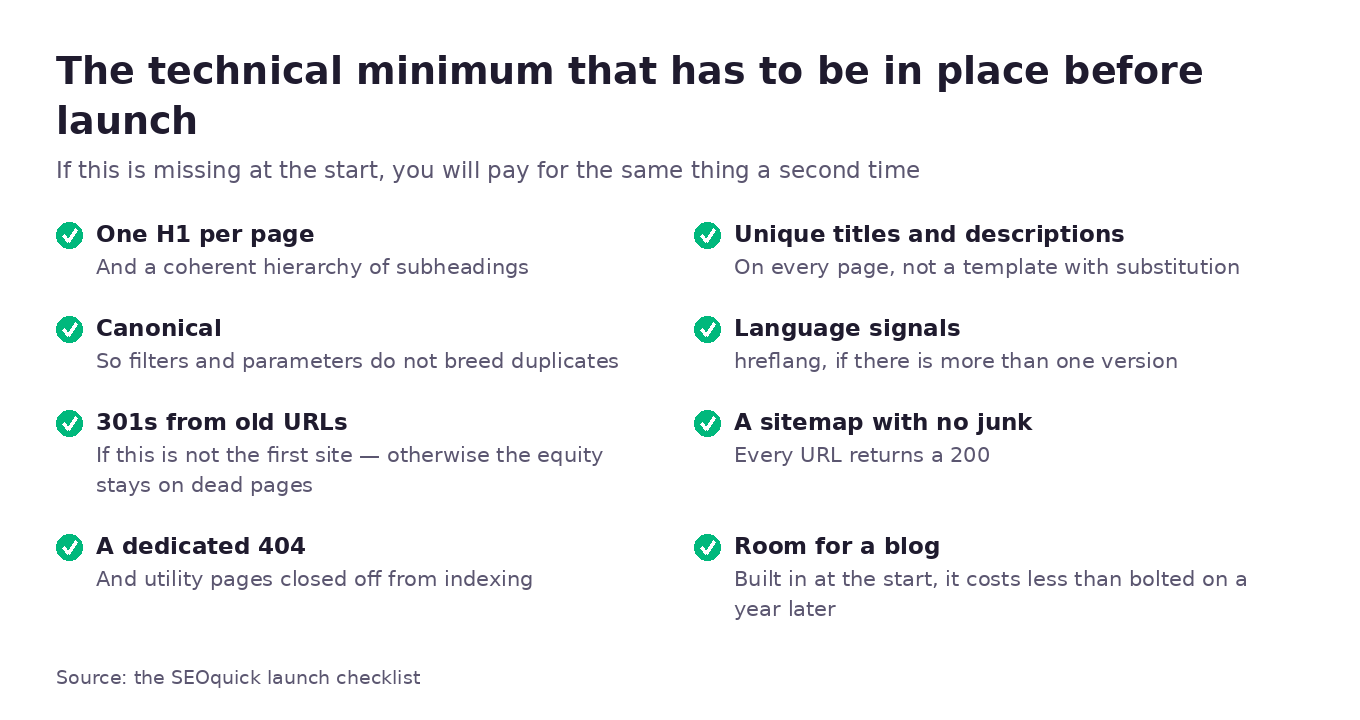
There is a simple thing behind that technical list. For a company in personnel security we built a new site to replace a WordPress version with accumulated search equity. Had the 301 redirects not been part of the project, that equity would have stayed on dead pages. So unique titles and descriptions were written for all 38 URLs in the sitemap, hreflang was reconciled for the Ukrainian and Russian versions, and redirects were set up both from the sensible old URLs and from the legacy junk WordPress had generated over the years. The whole project took two months.
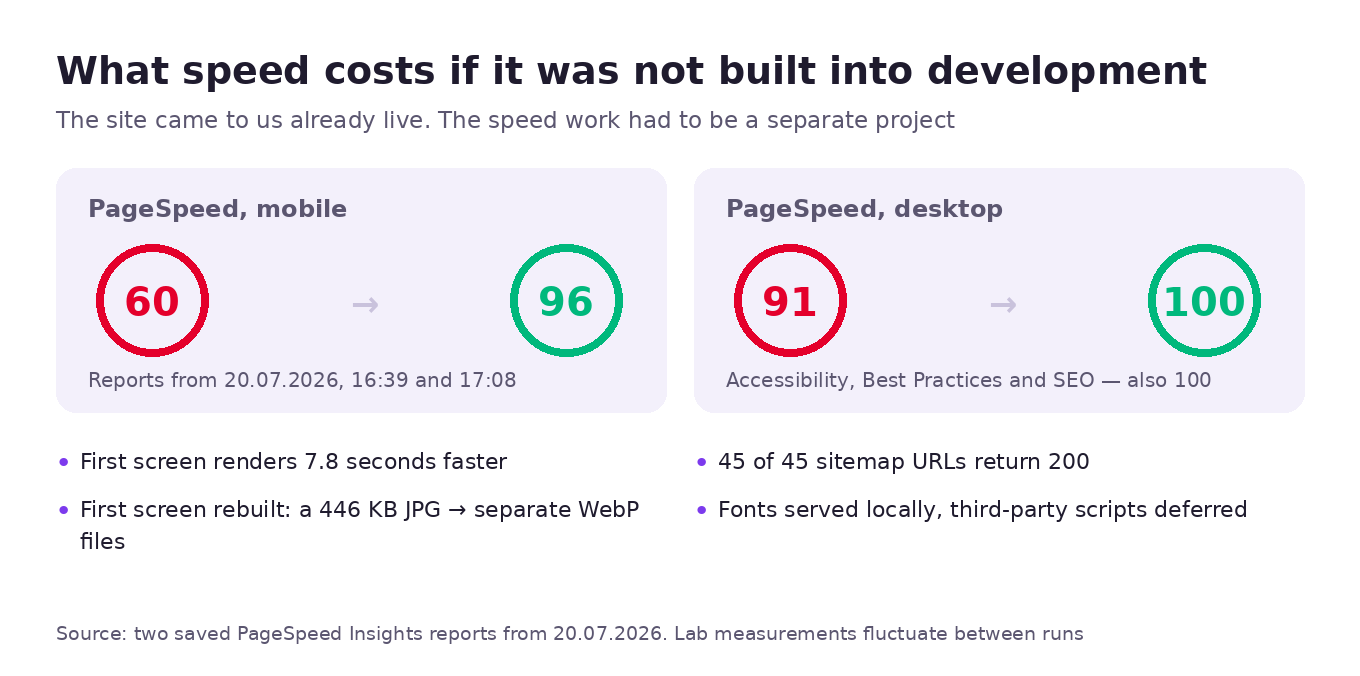
We have had the reverse situation too, and it costs more. A medical site arrived already live, with a mobile speed score of 60 and the first screen rendering in almost ten seconds. Getting the mobile score to 96 meant rebuilding the media, localising the fonts, deferring third-party integrations and closing off the technical layer. A separate project, a separate budget. All of it gets done at the development stage for a fraction of that money.
And before launch it is worth deciding whether the site will have a blog. Nikolay explains it like this:
“My site barely showed up in AI answers at all. Size matters: traffic from the neural engines turned out to depend on the number of pages. Even if you have a small site with 3–4 services, run a blog. The whole bottom of the funnel (BOFU) can be covered today, and you can get traffic from it.”
A blog built into the architecture at the start costs less than a blog bolted on a year later: there is no need to redo templates, internal links and the sitemap.
And straight on to the next cost line, so it does not come as a surprise: development ends at launch, and promotion is a separate monthly budget. We went through the order of those sums and what they are made of in our piece on how much online store promotion costs.
Redesign or start over: which is cheaper
A redesign is cheaper, and the reason is not the volume of code. In a redesign the content has to be polished; building from scratch, it has to be invented. Structure, site plan, brand identity, the copy for every page — an enormous layer of work that in a redesign simply does not exist.
The same logic is visible in other people's figures: SEOK charges €2,500 / €4,000 / €7,000 for a redesign, and €5,200 / €7,800 / €10,500 for an online store from scratch. At comparable tiers the difference is roughly twofold.
Tearing down and rebuilding is justified in two cases: when the platform leaves no room to grow — a builder, a bespoke solution with no documentation, a CMS with no support — and when the site's structure does not match what people are searching for. The second is more common and recognised less often: from the outside the site looks fine, and the pages for half the demand simply are not on it.
Two stories: when rewriting from scratch is cheaper
The most common type of order we get is not “a site from scratch for a new business” but a five-year-old site that has stopped coping. Two projects that arrived in roughly the same condition.
SteliPro — a suspended-ceiling manufacturer. Inconsistent titles, H1s and descriptions, semantics half covered, outdated content, WordPress technical debt and the aftermath of a hack that had left the hosting with no resources for updates. We rewrote ten key pages and rebuilt the Armstrong page separately, created seven new ones for installation, pricing and informational queries, moved everything onto the editor's native blocks, removed the malicious files and freed up around 49 thousand inodes stuck in an old staging copy. We split the enquiry form across three channels so it would not depend on a single mail server.
LT-Company — a facade contractor on Tilda. The home page had no proper H1, descriptions repeated, and there was nowhere left to develop the site. We moved it onto our own WordPress theme, keeping the design and the old URLs, checked 124 routes, rewrote 16 pages, added 12 new page packages built for demand, and ran 58 pages through a check on heading structure and markup.
Both sites ended up with a clean technical foundation — the kind you do not have to redo for promotion later. That is our answer to the question “why are you more expensive than a freelancer”: we are SEO specialists first, and we assemble a site so that it will not need rewriting. A site assembled by an inexperienced freelancer with no SEO really will be cheaper — right up to the moment someone starts promoting it.
The third story is shorter and shows what everything above is for. We launched Dobroyou.bg on the Bulgarian market, and it took the top spots for commercial queries with no backlinks whatsoever — on structure and technical cleanliness alone. We do not have a public case study on it yet, but the story is telling: where competitors are buying links, sometimes a site assembled right from day one is enough.
What was done for that money
I am giving the project totals in months of work — that is more honest than dollars, because the budget is months multiplied by the retainer.
| Project | Scope of work | Time |
|---|---|---|
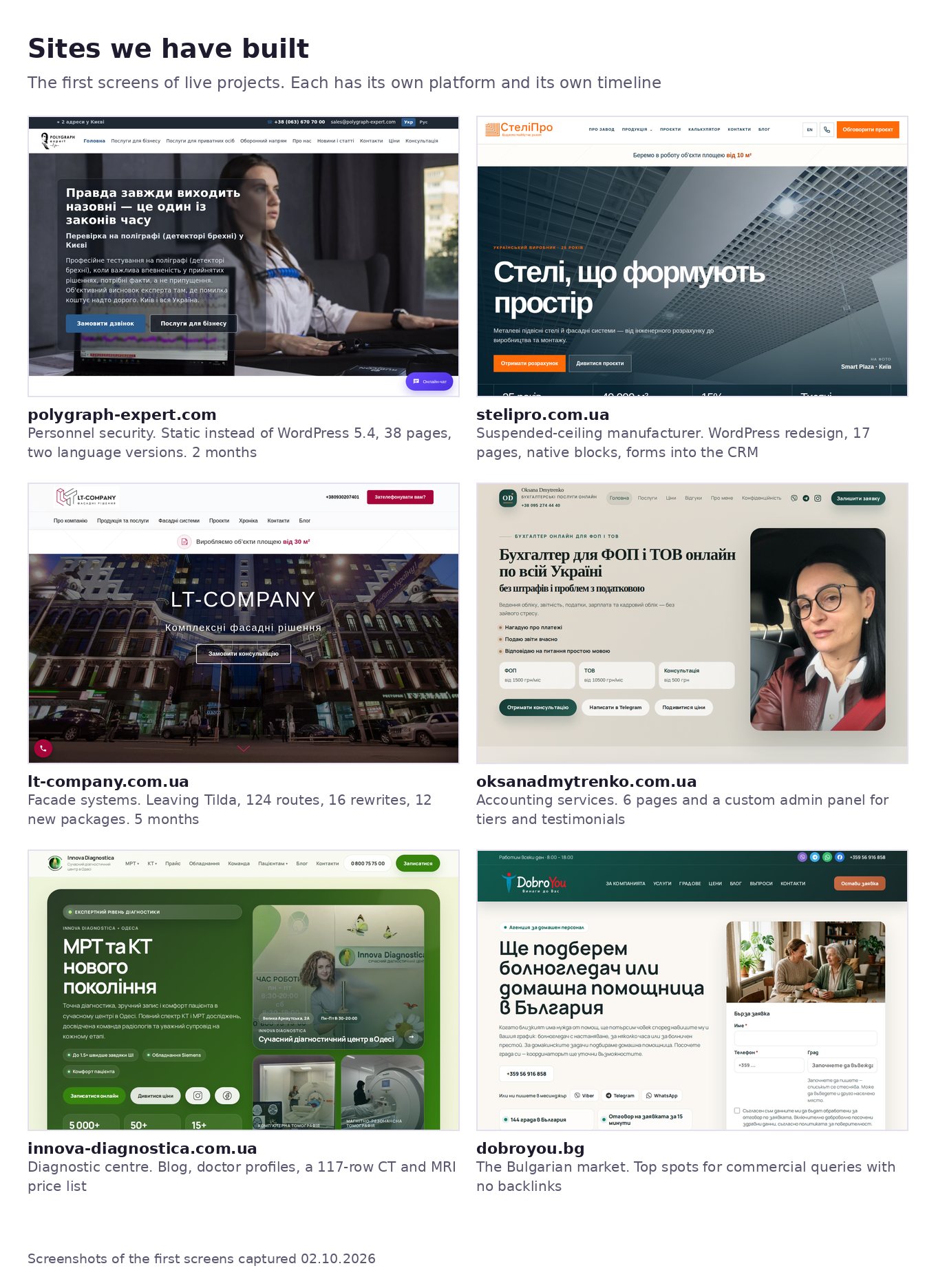
| Personnel security site | Migration from WordPress 5.4.19 to static, 8 stages, 38 pages, two language versions, unique titles and descriptions on every URL, 301s from old and legacy URLs, hreflang, post-launch audit | 2 months |
| Facade contractor | Leaving Tilda for our own WordPress theme, 124 routes reconciled, 16 pages rewritten, 12 new page packages, forms with protection and analytics, 58 pages checked for headings and markup | 5 months |
| Suspended-ceiling manufacturer | Redesign: 10 rewritten pages plus Armstrong, 7 new ones, native Gutenberg blocks, structured data, forms copied into the CRM, clean-up after a hack | around $3,000 |
| Accounting services | 6 pages, a custom admin panel for pricing tiers and testimonials, anti-spam form, responsive down to 390 px, backups on save | around $600, a very simple project |
| Diagnostic centre | Medical blog, doctor profiles, a 117-row CT and MRI price list in two synchronised versions, structured data, mobile navigation | developed in several stages |
| Medical site | Speed work: mobile 60 → 96, desktop up to 100, media rebuilt, local fonts, deferred integrations, 45/45 URLs returning 200 | a separate project after launch |
Checklist: what to ask a contractor before signing
These questions work against us exactly as they work against any other contractor. If our answer does not satisfy you, that is useful information.
- How many months of work are built into the figure, and how many people are on the project each month?
- Which of these is included in the number: structure design, design, front-end build, copy, SEO foundation, analytics, training?
- How much does one additional non-standard page cost, and one additional language version?
- In whose name are the domain, the hosting and the analytics accounts registered?
- What happens to the price and the timeline if it turns out in month three that another type of page is needed?
- Which SEO work is included in development: H1, titles and descriptions, canonical, hreflang, sitemap, 301s from old URLs?
- If this is not the first site — how is the search history carried over, and who checks the redirects?
- Which platform, and why that one? What will I not be able to do myself after handover?
- Who writes the copy, and how many pages of text are in the budget?
- What does post-launch support include, and what does it cost per month?
- What gets fixed free under warranty, and what counts as new work?
- Show me two sites of your own build that are more than a year old, and the URL of each.
If you are choosing not only a developer but a promotion contractor as well, the vetting procedure there is similar — we described it in our article on how to choose an SEO agency.
The last item is the most awkward and the most useful. A site that is a year old shows you not beauty but survivability: whether the rankings held, whether the layout fell apart, whether the content gets updated without a developer.
Red flags you can see right in the price list
This is not speculation — we found every one of these in those same seventeen sources of the survey.
“From” with no ceiling and no description of scope. Five sources out of seventeen name an upper bound; the other twelve publish “from” with no ceiling. The wording itself is fine; what is bad is when there is not a single parameter next to it that the price depends on. In a price list like that, the figure is not a price but an invitation to talk.
A price with no timeline. Fifteen out of seventeen. If a contractor will not name a timeline, they either have not costed the project or do not intend to hold to a schedule.
Internal contradictions in the price list. On one and the same page, one studio lists “online store from $2,000” and “business-card site from $3,000” — the store is cheaper than the business card. That is not an error in our survey, that is what the page says. Most likely their store runs on an off-the-shelf solution and the business-card site comes with a custom design, but not a word about that. Which means there is no described scope of work behind the tier names, and later there will be nothing to argue from.
A page about price with no price. Two URLs out of eight in the live top. That tells you nothing about price and everything about approach: the page was made for a search query, not for the person who arrived on it.
Three-year-old prices with no date. One source. A price list with no date of record is not a price list.
The sixth thing is not visible in a price list but surfaces in the contract: in whose name the domain is registered. Check that before signing, not after.
Where we are in this picture
There is no ranking here in which we come first, and there will not be. In its place, an outside assessment by someone else's methodology. In the 2026 ranking of Ukrainian SEO agencies by Ukrainian Business Award, with Serpstat and Clarity Project as analytics partners, SEOquick sits 11th of 20 with an overall score of 4.63. We got the maximum, 10 out of 10, for the technical condition of our own website, 9 out of 10 for service quality, and we lost points on team size and project volume.
Eleventh place, said out loud, proves more than first place in a ranking you compiled yourself. If you are choosing a development contractor, that is exactly what to demand: an external assessment, not a self-assessment.
Frequently asked questions
Can a site be built for UAH 10,000?
It can — in our survey the lower bound for landing pages starts at UAH 7,900. You will get a single-page site on a ready-made template, put together in a few days. For testing a hypothesis that is enough. For the site to bring in enquiries from search, it is not: that money physically does not cover either structure design or copy written for demand.
Why can't an exact price be named straight away?
Because the price is the number of months of team work, and the months depend on the number of distinct logics on the site, not on the number of pages. Until it is known how many page types, language versions and external integrations you have, an exact figure does not exist. A bracket does, though: the retainer multiplied by the timeline from the table above, and the error rarely exceeds one month.
Who owns the site after development?
You do — along with the domain, the hosting and the analytics accounts. We deliberately bill those separately in your name. A domain registered to the contractor turns any disagreement with them into the loss of the site, and that is not a theoretical risk.
What to do next
If you are comparing quotes, go through the checklist above with every contractor and compare the answers, not the totals. A contractor who answers with figures has costed the project. A contractor who answers “it depends on the task” has costed nothing.
If you want to understand the order of the budget for your own task, we have two pages: website development — what exactly the work includes and which projects we have delivered, and the commercial proposal calculator, which costs a quote by volume of work rather than by type of site. The second option is faster: it will show you a bracket before you talk to us.
Survey sources
All prices were taken from live pages on 2 October 2026, converted at the NBU rate of the same day ($1 = UAH 44.83, €1 = UAH 50.70). Studio price lists: Abordazh, Friendly, SEOK, Seo-Design, Space Site, Limenet, Webnauts, AyFish, Impulse Design, Vaybo, Zina Design, MoveitOn. Market overviews on blogs: HostiQ, Brainlab, Wezom, MarkWeb, AG Marketing. Results for the Ukrainian query “website creation price” were pulled through SE Ranking on 1 October 2026, Ukrainian region, no personalisation. Query volumes — SE Ranking, Ukraine database, October 2026.

Website chatbots in 2026: what you are actually buying and how to vet the vendor
Three different products are sold under the word chatbot at roughly the same price. What separates a callback service from an AI widget from a system, a nine-point checklist with live demo tests, seven questions for the vendor, total cost of ownership and rollout times.
Read →
What ecommerce SEO costs in 2026 and what you pay for
Why the same question gets answered with $300 and $3,000, what actually drives the price, what agencies publish on their own sites, the five costs that are never in the quote, and how to work out whether it pays back on your catalogue.
Read →
How to choose an SEO agency in 2026: a verification procedure
Not another ranking. Ten criteria with a specific check for each, how to tell a number you can trust from one you can't, what the market actually charges with links to the agencies' own price pages, what belongs in the contract, and when you don't need an agency at all.
Read →Want to apply this to your site?
We will review the current situation, find the first growth levers, and suggest a practical working format.