A strong product on a raw SEO foundation
In 2022 the Sunshouse.com.ua store came to SEOquick. It isn't a reseller — it's a factory that has sewn men's jackets, coats and parkas for years and sells them under its own brand via the site and marketplaces.
The goal was clear: bring the site to steady organic sales — above all on competitive queries in the 'men's jackets' and 'men's coats' clusters. Strong product, long history — but in search almost none of that was working.
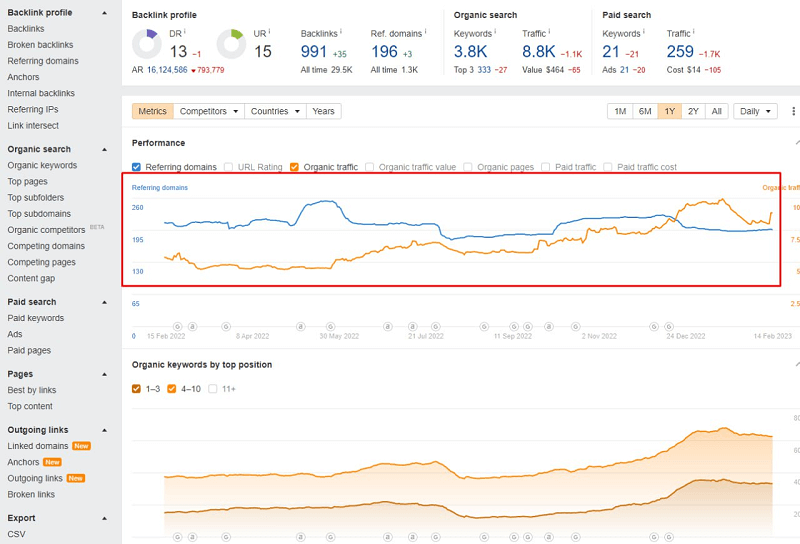
The starting picture was typical for a manufacturer brand: the catalogue grew fast, but category pages lived 'their own life' — thin texts, no real coverage of the range or buyer value.
Strong offline brand
Factory, experience, a wide range — none of it 'packaged' into SEO signals.
Thin categories
Short texts, no coverage of styles, materials or seasonality.
Weak internal linking
Users drowned in filters and product cards instead of moving between seasons and styles.
Minimal link profile
Almost no external mentions — against marketplaces with thousands of referring domains.
A manufacturer losing to marketplaces in search
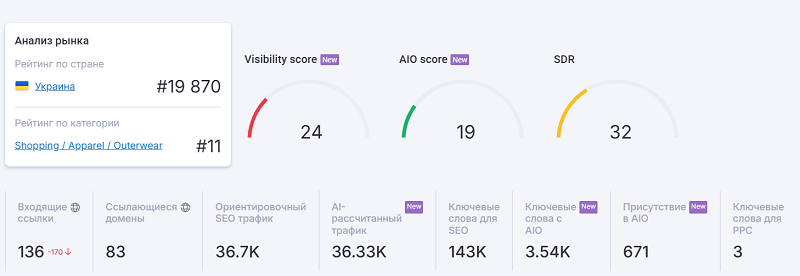
The main competitor wasn't another manufacturer — it was marketplaces and big stores, stronger on semantics, structure and content. The project's value was to out-rank them on commercial queries with the factory's own pages, carrying expertise the aggregators don't have.
Semantics and content audit around 'men's jackets'
The first month focused on on-page optimisation. We started with a content audit and built the semantic core across key directions: the general 'men's jackets' cluster; seasonality (winter, autumn, demi-season, summer); types and styles (classic, elongated, short, hooded, fur-trimmed); and two language branches — RU and UA.
In the brief for the 'Men's jackets' cluster we gathered dozens of high- and mid-volume queries and, in the same file, defined the structure of the future texts: range, materials, styles, price tiers, product picks and a micro-FAQ. The semantics weren't a separate keyword list — they were woven straight into the future content.
In parallel we audited existing texts: which categories were underwritten, where copy was 'watery', where SEO descriptions were missing, and which pages cannibalised each other on similar queries.
Category re-packaging: one page = one micro-cluster
Next came re-packaging the category pages. For the copywriter we prepared a large document with sheets per page type: 'Men's jackets', 'Winter', 'Demi-season', 'Autumn-Winter', 'Classic', 'Hooded', 'Fur-trimmed'.
One category — one intent
'Winter men's jackets' answers questions about warmth, fillers, water protection and temperature range — not 'one more text about jackets'.
Structure for keywords
Which models are in stock, which materials (fabric, insulation, lining), which styles for which occasions, how the brand differs (lifespan, warranty, patterns).
Commercial intent
No abstract SEO walls of text: 'in our range you'll find…', 'pick a model for your height and body type' — the copy sells, not just holds keywords.
Storefront integration
Part of the content worked as a mini storefront: tables of models and prices right inside the SEO text.
Internal linking and schema: connecting season, style and length
We prepared a dedicated linking brief: from the general 'men's jackets' categories — links into seasonal and style sub-categories; cross-links between close sections ('winter' ↔ 'winter elongated' ↔ 'fur-trimmed'); accent links from texts to specific product picks.
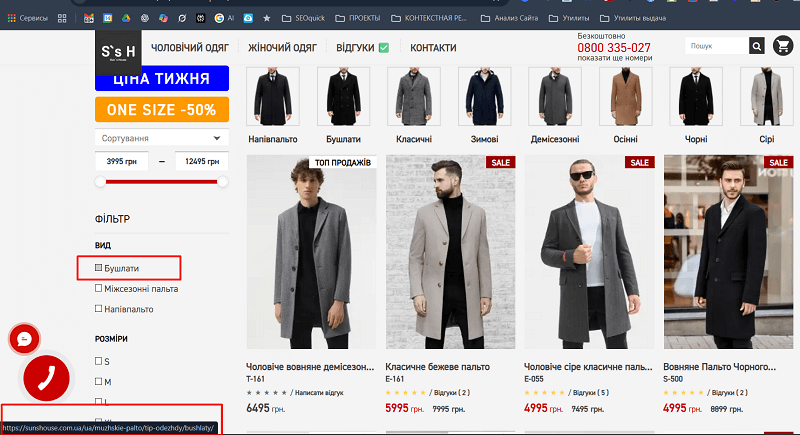
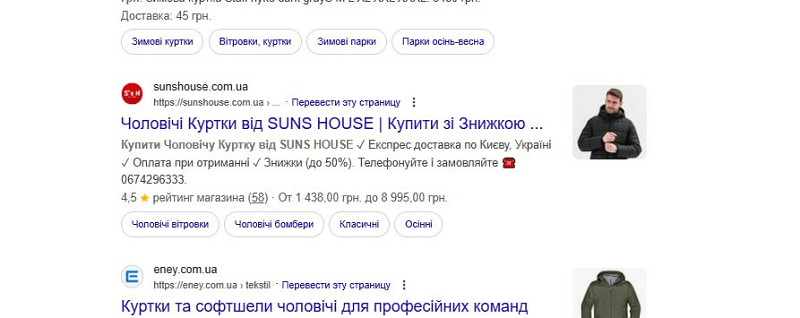
The linking was built once and for good — through optimised filter pages. It solved two tasks at once. Search: it's easier for the crawler to understand the catalogue's logical structure. Behaviour: the user doesn't hit a dead end but moves to a narrower or adjacent segment.
In parallel we briefed the developer on schema: product markup, breadcrumbs, richer snippets. For an apparel store this is critical — correct snippets with price, availability and rating help stand out against aggregators.
Directories, reviews and brand mentions
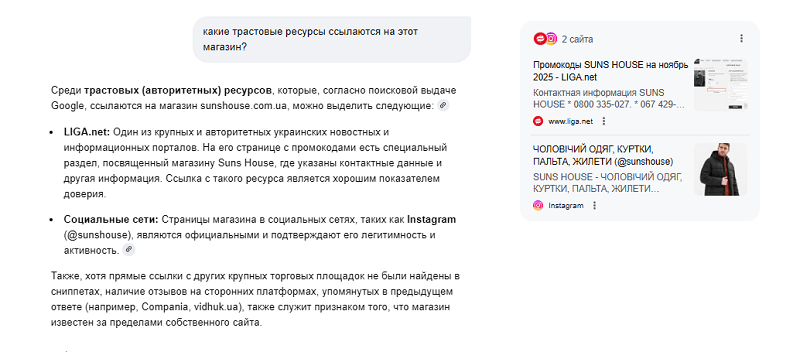
The task wasn't to 'pile up links' but to embed the store into an ecosystem. We registered the brand in key Ukrainian directories where users actually look for clothing stores; expanded presence on review platforms; and built a mix of branded and near-branded mentions — 'Sunshouse jackets reviews', 'Sunshouse coat', 'Sun's House clothing'.
That shaped a natural profile of links and mentions — exactly what fits a manufacturer with history and a broad range.
What Serpstat shows today
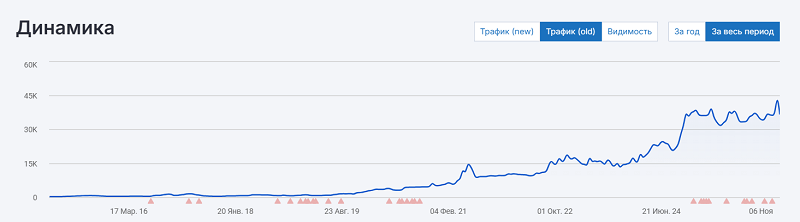
The project has long outgrown its starting point. Per Serpstat the domain is visible across a broad commercial core in men's outerwear — and holds the TOP on key styles and seasons.
| Query | Position | Volume |
|---|---|---|
| men's winter jacket (UA) | 5 | 9 900 /mo |
| men's jackets (UA) | 10 | 6 600 /mo |
| men's biker jacket (UA) | 3 | 5 400 /mo |
| men's parka (UA) | 4 | 3 600 /mo |
| men's coat (UA) | 6 | 2 900 /mo |
| men's demi-season jacket (UA) | 4 | 1 600 /mo |
| men's wool coat (UA) | 2 | 720 /mo |
| men's jacket size chart (UA) | 1 | 320 /mo |
Source: Serpstat, Google Ukraine database. Representative commercial queries shown; full core — 105,089 phrases, est. traffic ≈ 38,480 visits/mo.
Commercial queries — in Google Ukraine's TOP
TOP-1–2
'men's wool coat', 'men's jacket size chart', 'men's jacket sizes' — on the first positions in Google Ukraine.
TOP-3–10
A notable share of the 'men's jackets / coats' cluster settled in the first ten.
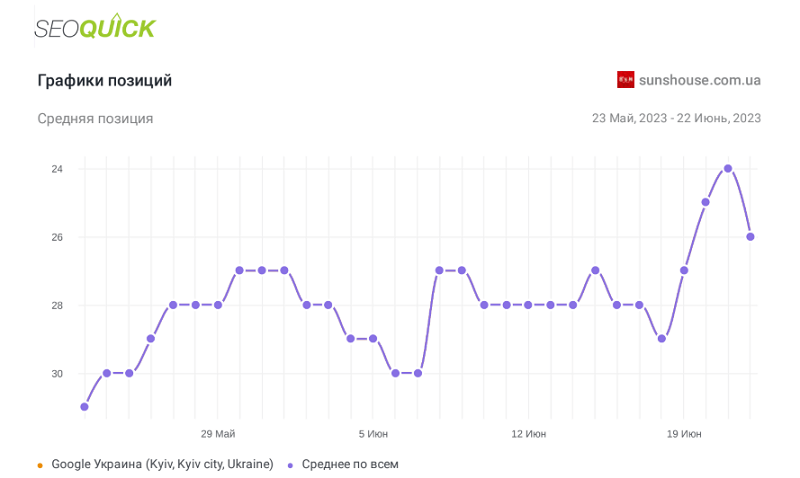
Avg position ↓
The average-position chart in monitoring trends steadily down — i.e. toward improvement.
Not just brand
Monitoring captured commercial queries in direct competition with marketplaces.
Source: Sunshouse.com.ua rankings report, 23.05–22.06.2023; Serpstat data as of the current date.
Project team
The project was led by Nikolay Shmychkov — SEO strategy (deputy director, SEOquick). Full team and roles on the 'About' page.
What's next
A similar e-commerce case: SEO for the Belsta online store. Run an online store or a factory? The concrete next step is a semantics and structure audit.