Initial problems
Lumident is a large metropolitan dental clinic in Kyiv. In SEO terms it's a typical commercial medical YMYL project: a wide service structure, a large volume of informational material, separate landings for treatment, prosthetics and implantation types, and a massive 'legacy' link profile.
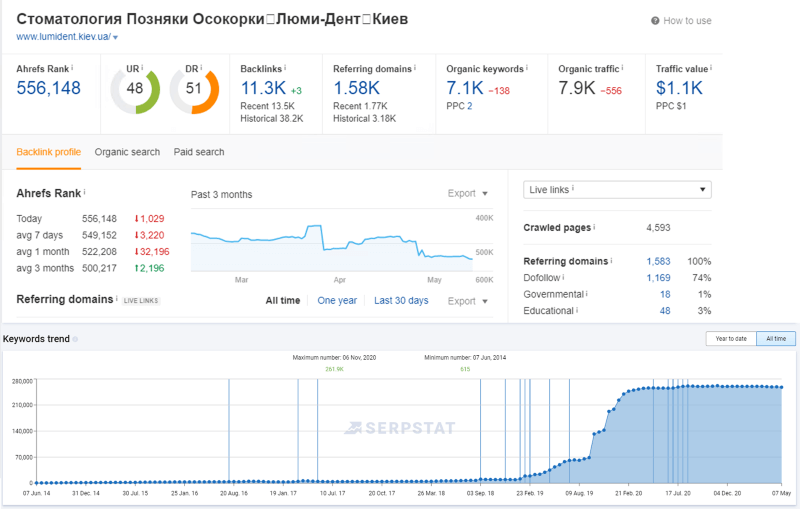
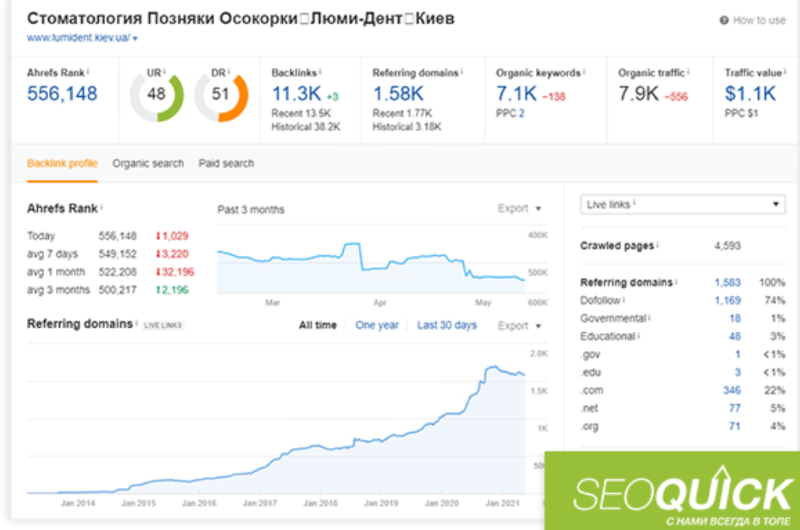
When Lumident came to SEOquick, it was already an established clinic with a strong brand, at the peak of recognition and traffic. The paradox: that very peak and years of work with various contractors had created fundamental problems — technical 'debt', unmanaged content, traces of aggressive link building.
Our task wasn't to 'pull the site up from zero' but to rehabilitate a large medical project that's formally already in the TOP yet increasingly suffers from algorithm updates.
The project's main challenge
Problems stacked in layers: strict YMYL requirements, years of technical debt (indexing, AMP, INP), an uneven link profile and traces of past contractors' aggressive link building. On top of that, the site stayed full-cycle with another agency while we were engaged for SEO consulting.
Strategy: stabilise → strengthen
Technical rehab
Full audit, a developer brief, a separate AMP and Core Web Vitals block: remove everything hurting indexing and harming INP, speed and UX.
Content re-assessment
For medicine it's not enough to 'write text': a page must be structured, answer the patient's questions, look expert. We checked drops, rewrote meta, briefed rework with editor proofing.
YMYL & trust
An audit of how doctors, the clinic, legal information and contact/trust blocks are presented — for Google this is part of medical ranking logic.
Scholarship × 3
Three Scholarship campaigns for natural .edu/.gov links that strengthen E-A-T and don't conflict with the medical niche's requirements.
Work done
At the start we ran the full classic set of audits. The technical one described where the site loses speed, which AMP pages error out, what blocks indexing — as concrete developer tasks prioritised for Core Web Vitals. In parallel — a YMYL audit (doctors, clinic, legal info, transparency) and a usability audit (how a patient finds a service, how menus and filters work).
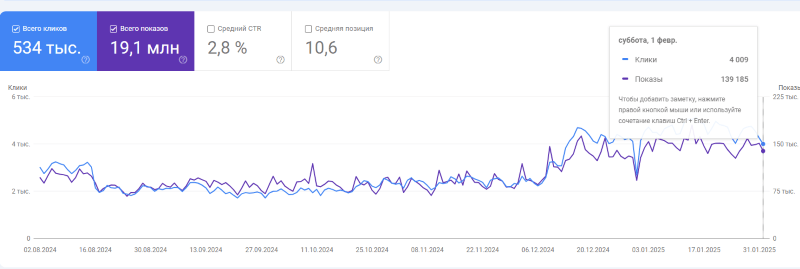
Rehabilitation after a wave of updates
| Stage | Organic traffic/mo |
|---|---|
| End of 2020 | ~40,784 |
| Low (June 2021, after updates) | ~10,456 |
| Peak (September 2023) | 168,549 |
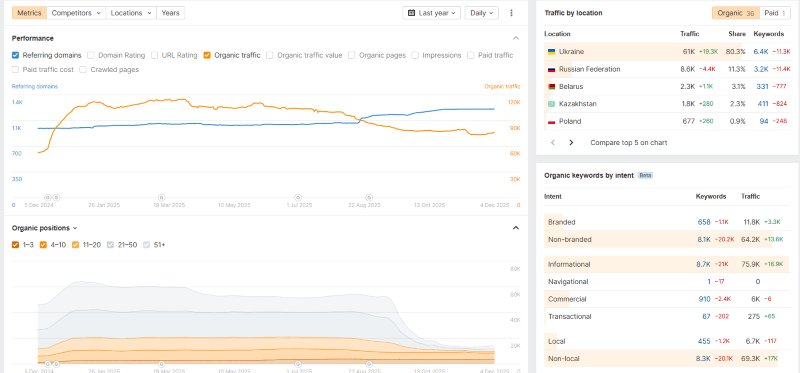
| After adaptation (December 2025) | 75,966 (≈×7 vs the low), of which ~64,000 — non-brand |
Source: Ahrefs data for the Lumident domain. Referring domains — 1,200+.
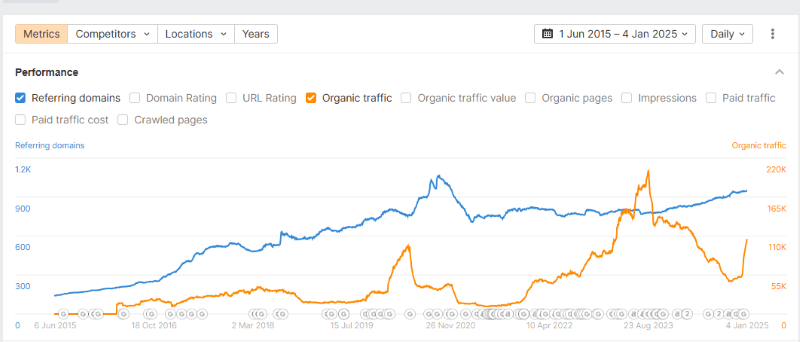
The dynamics show clearly in Ahrefs: at the end of 2020 organic held around 40,784 visits/mo. Then an algorithm reshuffle caused a drop — to 10,456 in June 2021, after which recovery began: ~35,000 by end of 2021, 81,000+ by end of 2022. By autumn 2023 the project reached a peak of 168,549 visits/mo.
But that's exactly when the medical topic met another wave of updates. Our 'rehab' strategy let us hold and adapt the project: by December 2025 traffic stabilised at 75,966 visits/mo — about seven times the low, with roughly 64,000 of it non-brand traffic.
Project team
The project was led by Nikolay Shmychkov — SEO strategy (deputy director, SEOquick). Full team and roles on the 'About' page.
What's next
A similar medical case: SEO for a clinic website in Kyiv (FamilyHealth) — over 17× organic growth. Have a large medical site under update pressure? The concrete next step is a YMYL audit and a rehab plan.